 Guide On Map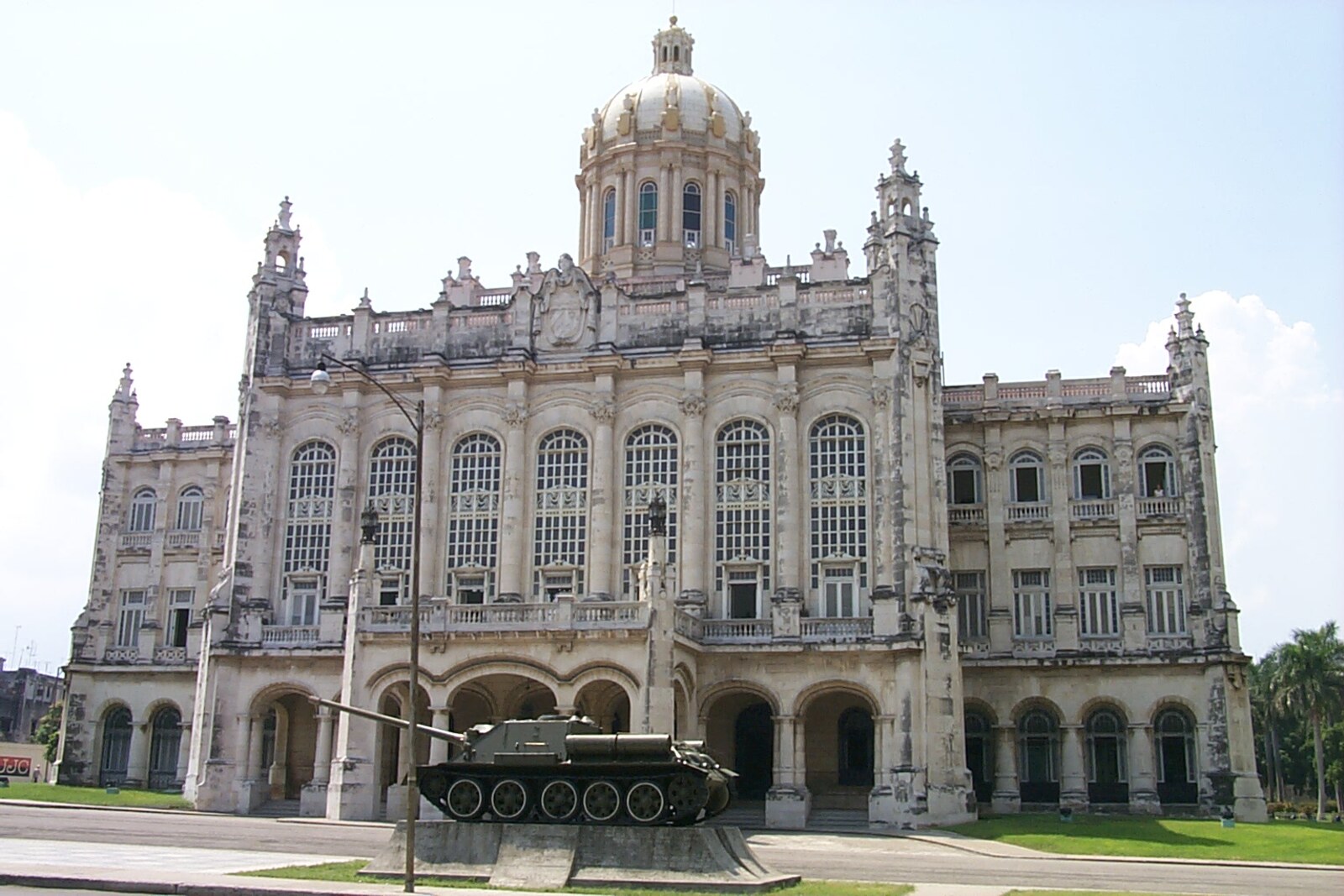
Look around first
What to notice
- Ceremonial entrance
- Large marble staircase
- Bullet chips
- Presidential office
The story of the place
Behind the ceremonial facade of this former Presidential Palace, the floors were divided almost like separate worlds. Service rooms operated below, above them came offices and halls for official receptions, and higher up began the living quarters and the barracks of the palace guard. Since nineteen seventy-four, the permanent exhibition of the Museum of the Revolution has been here, but the layout was not altered: the palace's working and residential parts have survived. Bullet marks are visible on the wide marble staircase.
On March thirteenth, nineteen fifty-seven, a small convoy pulled up to the ceremonial entrance of the Presidential Palace: a passenger car, a red delivery-service van, and another car. About forty armed men rode in the van. The unit's military commander was Carlos Gutiérrez Menoyo, a Spanish émigré who had fought against Nazi troops in the French army. The organizers chose him specifically for his combat experience: Menoyo was to lead the attackers through the guards to the office of President Fulgencio Batista and kill him.
Five years earlier, Batista had seized the presidency in a coup and cancelled the elections. The underground Revolutionary Directorate, which had grown out of the university movement, hoped to decapitate the regime with a single blow, arm its supporters, and restore constitutional order. Menelao Mora, a lawyer, former deputy, and opponent of Batista, prepared the political side of the operation. As he left home, he gave his son his wristwatch: if he did not return, the watch would remain with his son.
For such a plan, everything had to be over in a few minutes. Service rooms lay below; above them were the presidential office, the Hall of Mirrors, and the Council of Ministers hall; higher up lived Batista's family, and the palace garrison occupied the top floor. Menoyo neutralized the post at the entrance and led part of the unit upstairs. The attackers broke into the Hall of Mirrors and reached the office, but the president was no longer there.
According to Batista's later account, a few minutes before the shooting, he crossed the corridor, opened a door beside his office, and went up the internal staircase to the living quarters: his young son had caught a cold, and the father went to check on the child. This ordinary movement between the office and the apartment proved enough. While the attackers searched for Batista on the ceremonial floor, the guards gathered upstairs and began forcing them back.
The support unit that was supposed to block the approaches to the palace never appeared. The assault group's ammunition was running out. Carlos Gutiérrez Menoyo received a mortal wound, Menelao Mora also died inside the palace, and the survivors withdrew. Batista survived the assassination attempt and remained president until January first, nineteen fifty-nine, when he left Cuba.
The permanent exhibition of the Museum of the Revolution was placed here in nineteen seventy-four. The former palace has preserved the office the unit fought its way toward and the residential floor above it, where Batista went. Bullet chips from March thirteenth were left on the large marble staircase.
Useful on site
Daily 10:00–17:00
Checked: June 19, 2026. Check the official source before visiting.The traces of the assault inside are accessible only when visiting the museum; check the entrance and open halls separately. If the building is closed, view it from outside and try to see the Granma Pavilion from an authorized public area.