 Guide On Map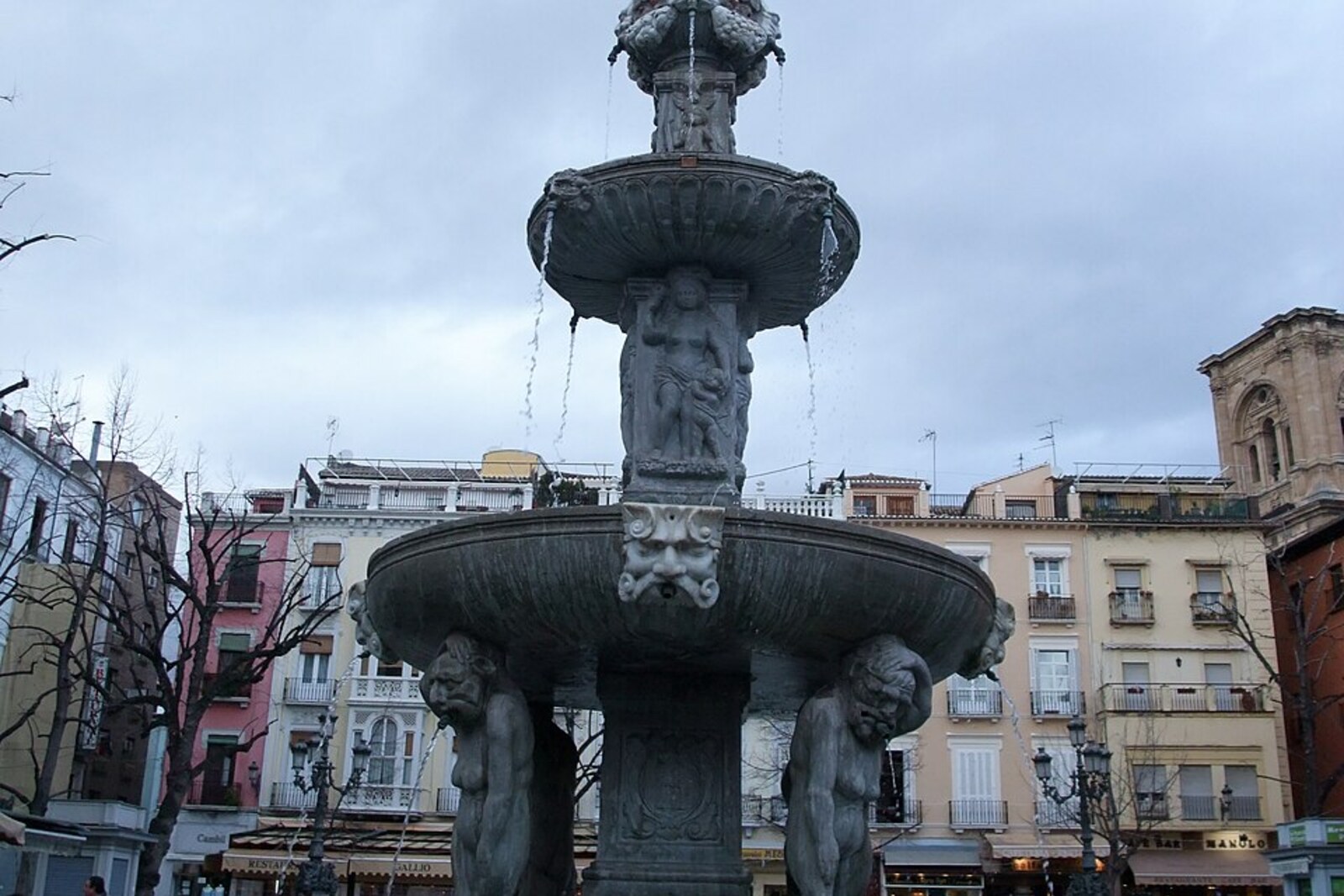
Look around first
What to notice
- Fuente de los Gigantones
- Market kiosks
- Terraces
- Where market streets lead into the square
The story of the place
Today, Plaza Bib-Rambla is occupied by terraces, market kiosks, and the Fuente de los Gigantones. Market streets still lead here: grain that, at the previous stop, spent the night in the locked courtyard of the alhóndiga was then distributed through the markets of this district. The same openness was once needed for a very different commodity—books that had to be destroyed before everyone's eyes.
After Granada surrendered in fourteen ninety-two, its Muslim inhabitants were promised the right to keep their faith, mosques, property, and their own judges. Seven years later, Francisco Jiménez de Cisneros, Archbishop of Toledo and Queen Isabella's confessor, arrived in the city. He sought rapid mass baptisms and, thanks to his closeness to the queen, could push aside supporters of gradual conversion through preaching.
Between fourteen ninety-nine and fifteen hundred—the exact day is reported differently by the sources—Cisneros ordered the alfaquis, Muslim experts in faith and law, to hand over Qurans and other religious books. His devoted biographer counted four or five thousand large and small volumes. They were piled up here, on Plaza Bib-Rambla.
The advisers suggested at least making use of the valuable parchment, paper, and bindings. Cisneros refused: he wanted to deprive the Islamic community of the very texts from which people taught, judged, and prayed. He made an exception for thirty or forty manuscripts on medicine. They were sent to the library of the college he had founded in Alcalá de Henares. The division was exact: books that sustained the former faith were burned; knowledge useful to the city's new masters was taken away.
The bonfire was part of a campaign that included pressure, imprisonment, and mass baptisms. It provoked an uprising in the Albaicín. For three days, the rebels kept Cisneros's house under siege, so the danger to the queen's confessor became very physical. After negotiations, the siege was lifted. Cisneros secured the declaration that the residents of the district were guilty of rebellion and required to be baptized. Resistance spread to the Alpujarras, and the former guarantees of freedom of faith soon lost their force.
Plaza Bib-Rambla was chosen for such a bonfire because here the decision became a public spectacle. The square lay immediately behind one of the city's main gates, at the entrance to the commercial center with the Zacatín, the Alcaicería, the Great Mosque of Granada, and the Madrasa of Granada. People and goods came through the gate from the direction of the Vega of Granada; a crowd could be gathered in the open space.
The present name comes from this gate. Bab al-Ramla means “the gate of the sandbank”: nearby, the Darro River left deposits of sand. In eighteen eighty-four, the city council ordered the gate demolished for the redevelopment of the center. The surviving stone parts were later reassembled in the woods of the Alhambra. On the square itself, there is neither a gate nor a trace of that bonfire. The Fuente de los Gigantones was installed only in nineteen forty-two. What remains here is the name of the vanished entrance—Plaza Bib-Rambla.
Useful on site
Open around the clock, free admission.
Checked: June 17, 2026. Check the official source before visiting.Listen from the edge of the square, without stopping in the main flow of people. The gate itself is not here: the story is connected with its former location and the surviving name.