 Guide On Map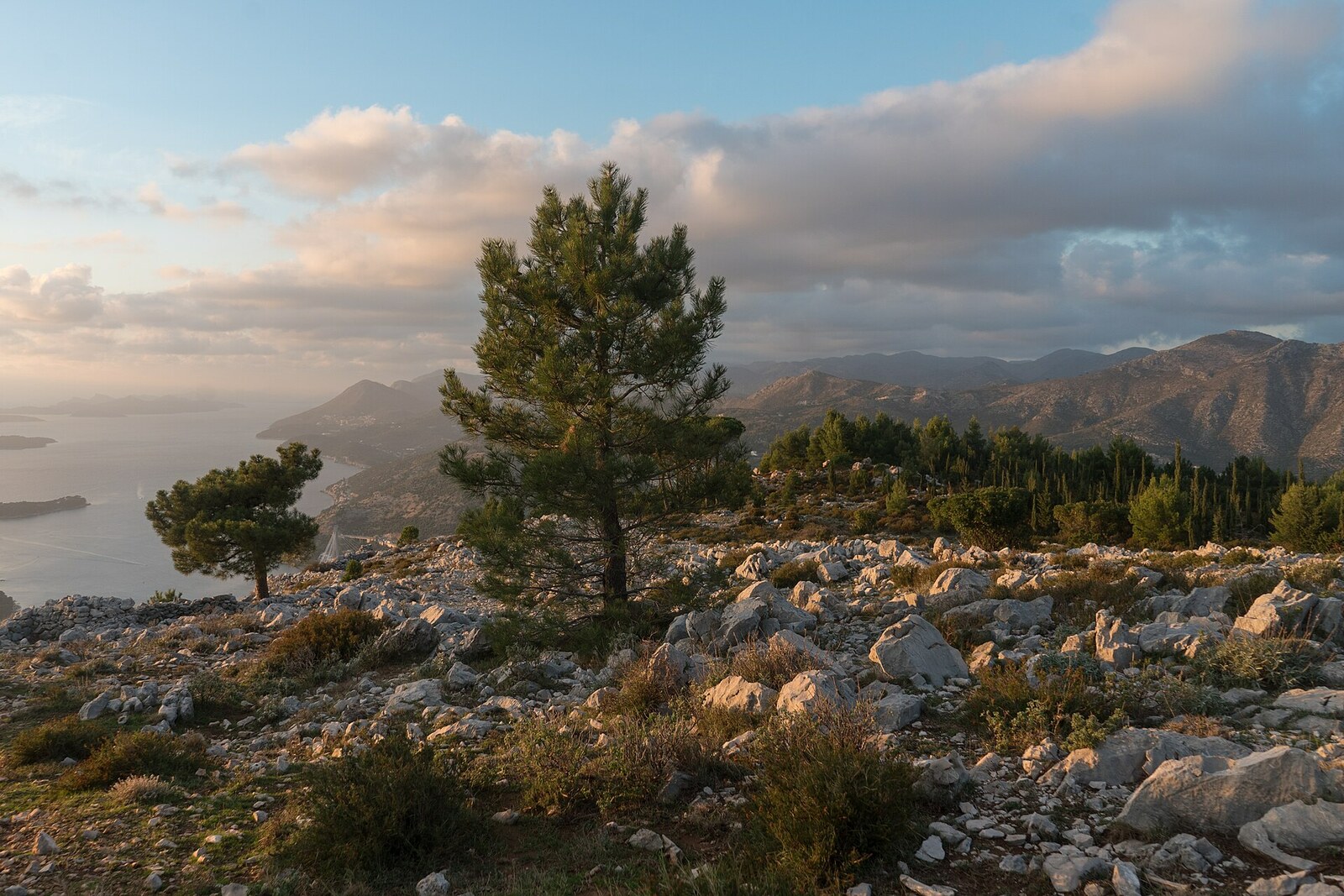
Look around first
What to notice
- Koločep Island
- Lopud Island
- Šipan Island
The story of the place
West of Dubrovnik, the islands line up one behind another: Koločep lies nearest, Lopud beyond it, and farther on is the largest, Šipan. These are the three main inhabited islands of the Elaphiti Islands. In the Middle Ages, their clearly distinguishable line, visible from here, served as a communication route.
A little east of the present fort, near the summit of Mount Srđ, stood the Church of Saints Sergius and Bacchus—early Christian martyrs once venerated as Dubrovnik's patrons. The Croatian form of the name Sergius is Srđ; the mountain received its present name from this church.
A small tower-like house adjoined the church. Two or three guards lived in it permanently. Their duty was to watch for approaching vessels and not miss signals from Mount Hum on Šipan. During the day, the island watchmen raised smoke; at night, they lit a fire. From Šipan, messages were relayed farther between Dubrovnik, Ston, Mljet, and Lastovo.
Ston was a remote fortified possession of the Republic of Ragusa—a city-state centered in present-day Dubrovnik. If it needed help, waiting for a boat carrying a messenger was dangerous. In thirteen seventy-one, Dubrovnik's rulers established which signals Ston was to give and after which sign, received through Šipan, reinforcements were to be sent from the city. For the guards on Mount Srđ, smoke above a distant island meant a specific assignment on which people several stages away depended.
The watch did not operate only temporarily. In fourteen seventy-six, the Minor Council of the Republic of Ragusa allocated ten perpera for repairs to the watch house. This means that almost a century after the known order, several people still lived beside the church and watched the western horizon.
The church stood until the French occupation. When Fort Imperial began to be built on the summit, it was dismantled; the adjoining guardhouse disappeared as well. Archaeologists place their site below the fort's eastern corner. Almost nothing remains on the surface, but both parts of the old signal line have survived: the mountain still bears Sergius's name, and Šipan still lies on the western horizon, from where the guards here awaited smoke or fire.
Useful on site
The open viewing point is accessible when the area around the fort is freely accessible; restrictions are possible in bad weather and during work on the fort.
Checked: June 30, 2026. Check the official source before visiting.In haze, the islands may blend into the horizon, so do not expect to make out every detail. Stay on stable ground away from the exposed edge.