 Guide On Map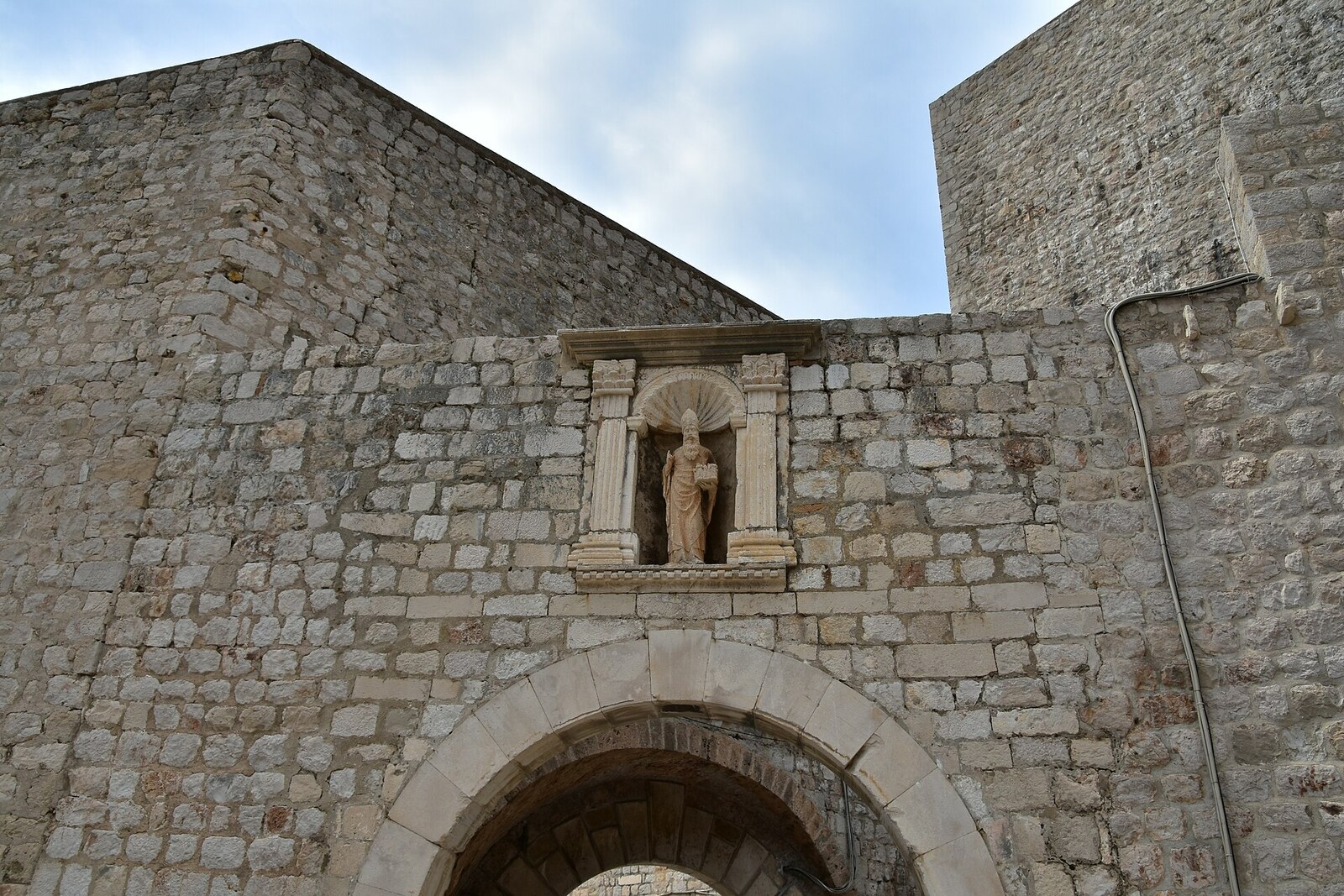
Look around first
What to notice
- Inner and outer arches
- Stone bridges
- Wooden drawbridge section
The story of the place
From the suburb of Ploče, the way into the Old Town passes through two stone arches and bridges, connected by a wooden drawbridge span. At night, this span was raised, so the road from the suburb ended at the outer line of fortifications. Now both arches are open, and the crossing once again connects Ploče with the Old Town.
On January twenty-seventh, eighteen fourteen, Dživo Natali stopped before this gate—a Dubrovnik nobleman, merchant, and colonel of the rebels, who was working to restore the Republic of Ragusa. French troops had occupied the city for nearly eight years, and the republic itself had been abolished as early as eighteen oh eight.
A noble title did not guarantee Natali a comfortable life. A later denunciation drawn up by his opponent says that his small country holdings were not enough to support him, and that he earned a living through trade under the French. By launching the uprising, Natali risked his property, income, and life.
That January day, he saw the old flag of the republic above the city. The residents inside the walls disarmed the French sentries and disabled the cannons. Natali brought about a thousand armed men from Župa and Brgat—settlements on this side of Dubrovnik—to the eastern entrance.
Ploče Gate is named for the suburb of Ploče, which it opens onto. The inner and outer arches, stone bridges, and a wooden drawbridge section formed a successive corridor. The wooden span was raised at night. It now remained to decide whom to let through during the day.
The city leader Sabo Giorgi and his assistant Bozdari refused to open the gate to Natali. Rebel detachments were already looting houses in the suburbs, and the leaders feared that new pogroms would begin inside the walls. They also feared a clash with the approaching Austrian units. Natali warned them: if his men remained outside, the Austrians would occupy the city first. The gate was locked anyway.
Austrian General Todor Milutinović commanded the allied units besieging the French garrison. He promised the Dubrovnik nobility that two hundred rebels would enter the city with weapons and their own flag. At the same time, the general announced that he had received orders to occupy Dubrovnik in the name of the Austrian emperor.
While Natali waited before Ploče Gate, the French agreed with Milutinović on a surrender. In a surviving account by a participant in the uprising, an English officer with several soldiers approached this gate under the guise of a negotiator. He forced Natali's men to retreat, went inside, posted his own guard, and closed the gate leaves again.
The French garrison left Dubrovnik. Austrian and English soldiers entered through the opposite Pile Gate, while the Dubrovnik rebels were not let in. The city guard was disarmed, and the republican flag was soon taken down. Part of the enraged detachment attacked Natali; other rebels fought off the attackers and saved their commander's life.
The following year, Natali went to Constantinople to seek diplomatic support for restoring the republic. He returned empty-handed and never led another uprising. Dubrovnik was annexed to the Habsburg Monarchy.
Today both arches are open, and the bridge once again leads from the suburb of Ploče into the Old Town. Natali achieved the departure of the French garrison, but he himself never entered through this eastern passage.
Useful on site
Access is open around the clock; the bridges over the moat are freely passable.
Checked: June 17, 2026. Check the official source before visiting.Take in the passage step by step, and do not linger in the middle of the flow. The main details are visible from outside; no separate visit is required.