 Guide On Map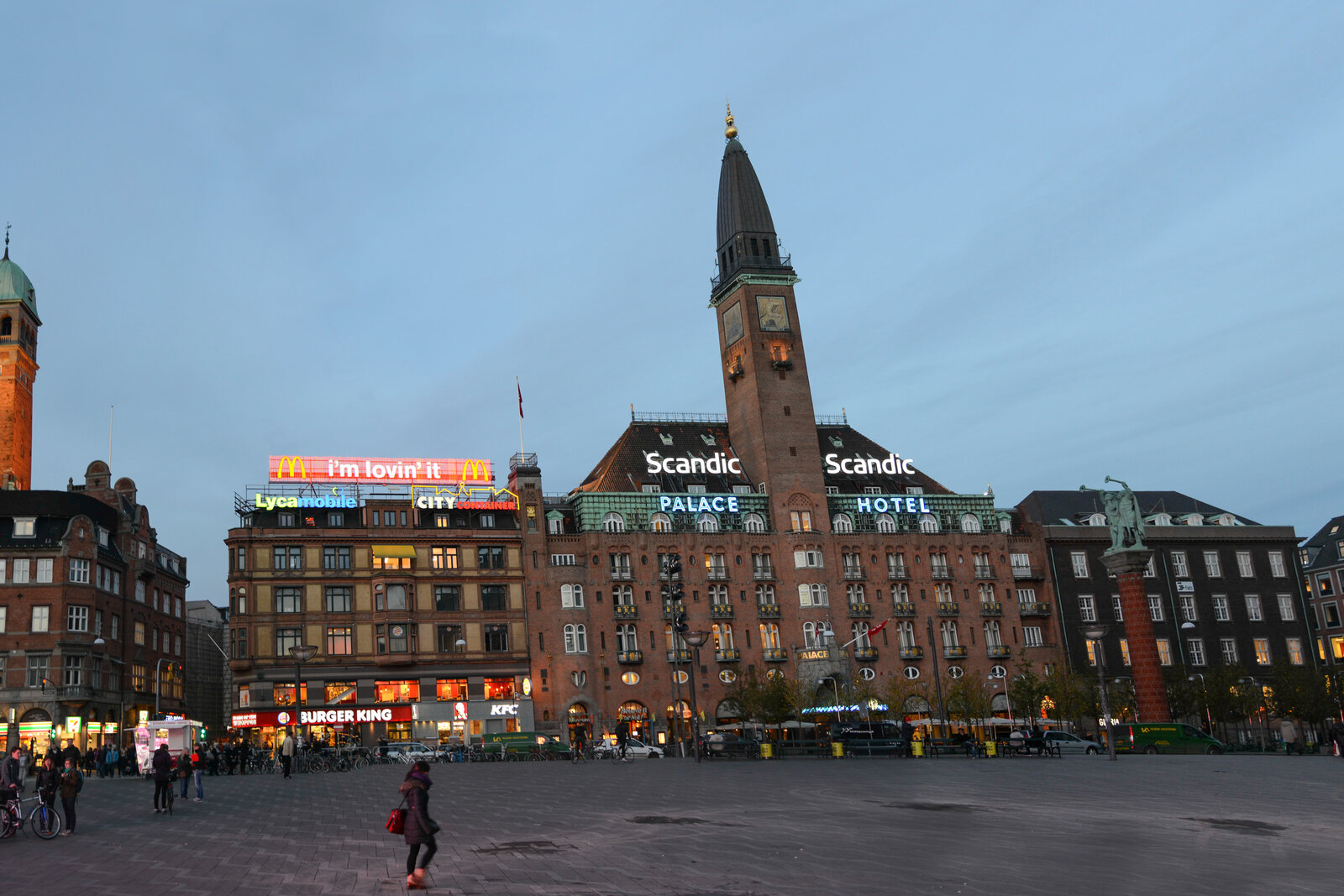
Look around first
What to notice
- The brick façade of City Hall
- The City Hall clock
- The gray Dagmarhus building
The story of the place
City Hall Square has two notable edges: the brick wall of City Hall with its clock, and the gray Dagmarhus opposite. During the war, earthen ramparts rose in the middle of the square, surrounding air-raid shelters in case of an air raid. The rooms of Dagmarhus housed the German administration and secret police. The ramparts were removed long ago, and films are now shown in the building where those institutions were based.
Copenhagen’s city administration still works in the brick City Hall, while citywide celebrations, concerts, and ceremonial gatherings are held in front of its façade. The square received its present name in eighteen ninety-three, when the new City Hall was being built here to a design by Martin Nyrop. Before that, it was the Hay Market, and earlier still the western gate, rampart, and moat ran along its edge. After the fortifications were demolished, an open space capable of holding a large crowd appeared in front of the former entrance to the old city.
On April ninth, nineteen forty-five, five years of the German occupation of Denmark had elapsed. The Danish resistance movement called on residents to stop for two minutes at noon in memory of the dead. For an office worker, shop assistant, or tram driver, taking part meant interrupting work in full view of patrols. After the arrest of Danish police officers, the streets were controlled by the HIPO Corps—Danish collaborators whom the occupiers recruited into an auxiliary police force to fight the resistance.
People gathered here, beneath the City Hall clock. At the other end of the square stood Dagmarhus, a gray building occupied by the German administration and secret police. When the clock struck twelve, the crowd fell still, with their backs turned toward Dagmarhus.
The two minutes had not yet passed when HIPO personnel began driving around the square and firing automatic weapons. People rushed toward the earthen embankments around air-raid shelters built in the middle of the square in case of an air raid. Within a few minutes, the shooters achieved their immediate aim: the silence was broken, and the square was emptied.
Less than a month later, German troops in Denmark capitulated. The HIPO Corps ceased to exist; after liberation, many of its members received long prison sentences. Residents again filled City Hall Square, this time to celebrate the end of the occupation.
The wartime shelters and embankments were later removed. The City Hall clock remains above the square, and Dagmarhus still stands on its former corner: a cinema now operates in the building that people turned away from then.
Useful on site
The square remains a busy transport hub, so it is easier to listen away from the main flows of people. The World Clock is inside City Hall and requires separate access.