 Guide On Map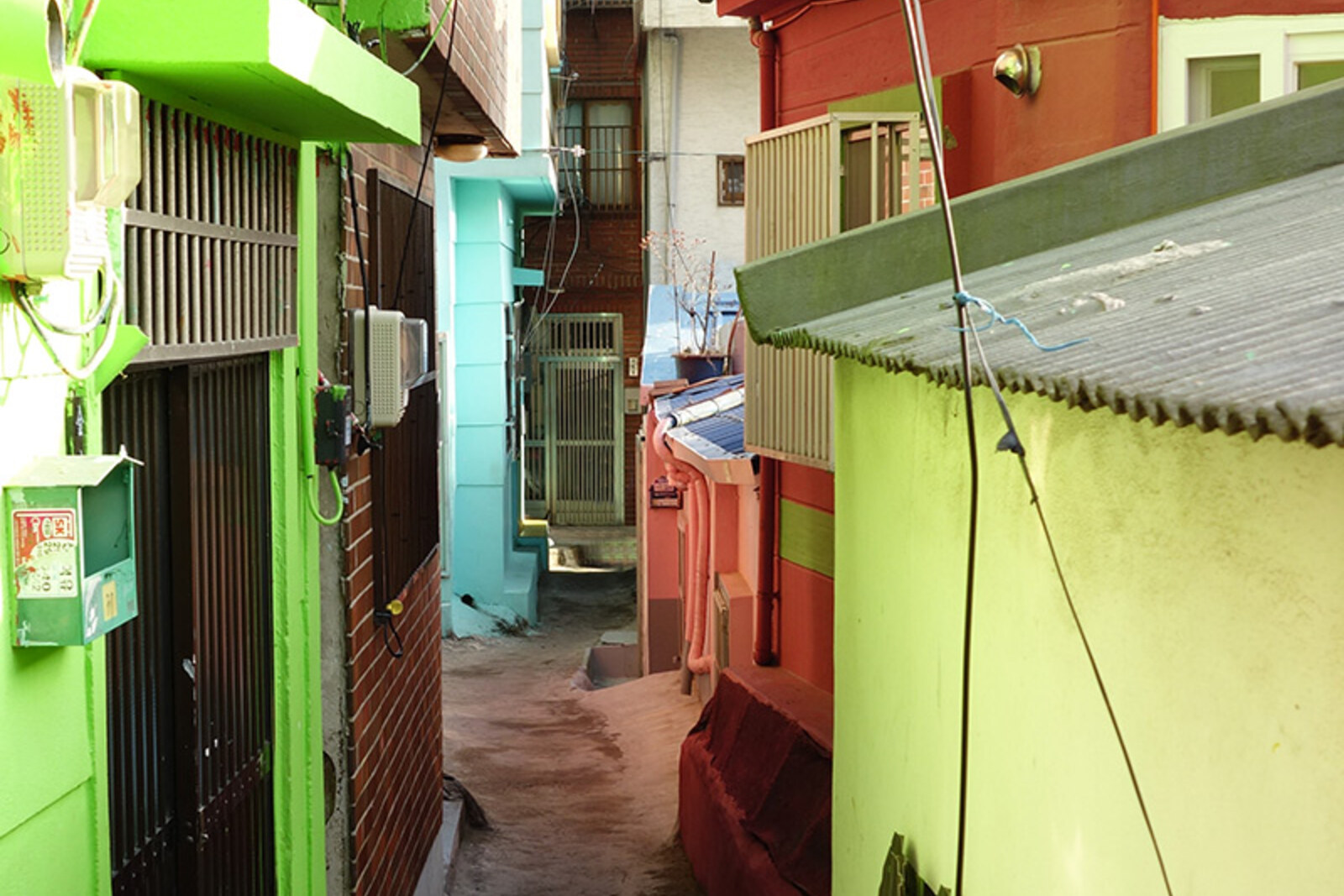
Look around first
What to notice
- The “Gamnae-ro” sign
- Rows of low houses
- Horizontal lanes
- Stairways between the rows
The story of the place
Cafés, workshops, and souvenir shops line upper Gamnae-ro. Below, residential lanes begin: they run along the slope, connect by stairways, and lead to house doors. This division appeared long before tourists arrived.
In nineteen fifty-five, Jo Cheol-je, the leader of the Korean religious movement Taegeukdo, was looking for a place for a new spiritual center and a communal settlement for his followers. Their plank dwellings in Bosu-dong had been slated for demolition as part of the city’s redevelopment. Jo chose state-owned land between Mount Cheonmasan and the summit of Oknyeobong. In the community’s beliefs, the valley enclosed by slopes was considered a favorable refuge hidden by the sky; for the resettlers, something else was decisive: hundreds of families could be housed close together here.
Jo divided the slope into nine sections. Each was assigned to Taegeukdo followers from a particular part of the country, while a temple complex was planned in the middle. Then the whole community began the resettlement. Some leveled the building sites, others dismantled the old shacks in Bosu-dong, and still others built houses here from planks and earth. Most men made their living through day labor or small trade. While they were building the settlement, there were no daily earnings. The Taegeukdo chronicle says that downpours and storms repeatedly destroyed unfinished walls. The resettlement committee opened its own grain shop and supplied families with food at wholesale prices. By the end of the first autumn, about eight hundred households had settled here.
The community’s leaders established two building rules. Every lane had to connect with all the others, and a new house could not be built in a way that blocked the view from a dwelling higher up the slope. That is why the houses were built low and arranged in terraces. Horizontal passages linked neighbors in the same row, and stairways linked the rows to one another. Later, residents paved the roads themselves and put the wells in order.
Over time, the wide upper street took in shops and visitors, while most of the narrow passages below retained their residential function. From here, you can see the consequences of those two building rules: roofs descend in rows, and lanes without dead ends continue between them.
The street’s name is linked to a play on words that the Taegeukdo chronicle attributes to Jo Cheol-je. He associated the local name “Gamnae” with the ending of the Korean saying “gojin gamnae”: “after bitterness comes sweetness.” The present-day sign retains the word “Gamnae-ro”; the plank houses from the first resettlement have disappeared, but the street grid built by their owners has remained below the street.
Useful on site
The street is in an open village; tourist services list the village as freely accessible, but shops and workshops keep their own schedules. Checked 2026-07-01.
Checked: July 1, 2026. Check the official source before visiting.Observe from the public street, and do not try passageways at random if they look like private entrances. In tight places, give way.