 Guide On Map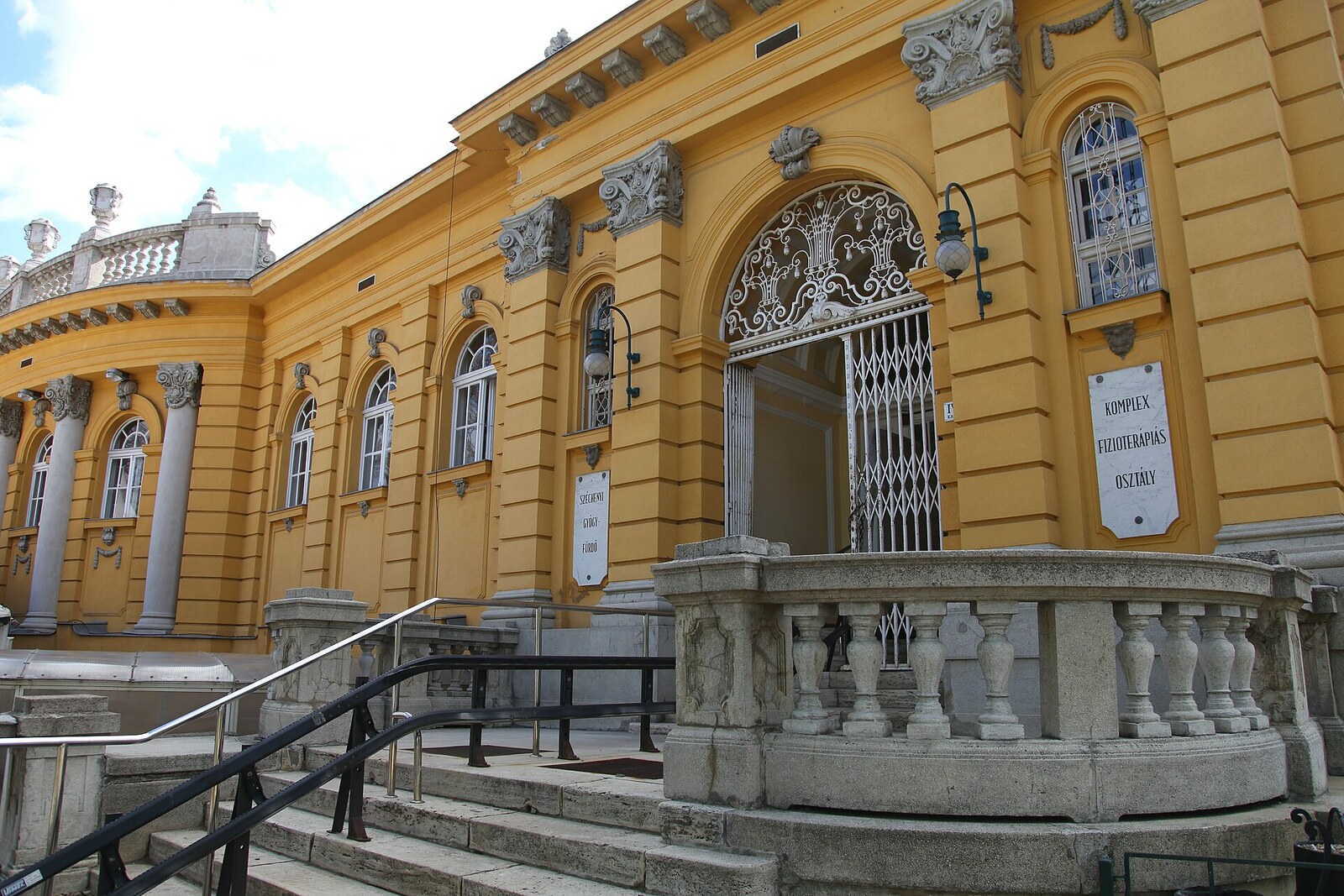
Look around first
What to notice
- The main building of the baths
- Outdoor pools
- Entrance from Károly Kós Alley
- Bust of Vilmos Zsigmondy
The story of the place
Beneath the main building and outdoor pools operates a major municipal therapeutic bath that grew out of a small bath on an island in the middle of the park lake. Water from two deep sources flows into the pools and treatment departments; the hotter one sustains the complex's present-day life. Count István Széchenyi's name was given to the bath only after it opened: Hungary's reformer had nothing to do with this water. That is why a bust of the person without whom there would be neither pools nor this building stands by the entrance from Károly Kós Alley.
In November eighteen sixty-eight, mining engineer Vilmos Zsigmondy began drilling a well where Heroes' Square now stands. He expected to extract hot water on the flat Pest side. The city council wanted to use it to replenish the lake in City Park, water the park, and supply the baths.
Zsigmondy planned to finish the work in a year or two. Instead, the well collapsed, part of the drive wheel broke, and lightning struck the drilling tower. The drill had to be lowered much deeper than the calculated depth. The money allocated by the city ran out, and many already doubted that water would appear at all.
Zsigmondy worked as a private engineer and earned his living by drilling wells. He continued drilling at his own expense. On January twenty-first, eighteen seventy-eight, after ten years of work, water at a temperature of nearly seventy-four degrees rose from a depth of about nine hundred seventy meters. The well produced more than a million liters a day.
At first, residents came here to drink the mineral water. In eighteen eighty-one, it was diverted to the small Artesian Bath on an island in the middle of the park lake. There were baths and shared pools there; the facility quickly stopped being able to accommodate everyone who wanted to come. Zsigmondy died in eighteen eighty-eight. He saw the first bath, but not the present building.
The city council opened the large complex in nineteen thirteen. At that time, the former working name, “Artesian Bath,” was replaced with the name of Count István Széchenyi—a statesman and reformer who worked to modernize Hungary. Széchenyi had nothing to do with the search for water: his name was given to an already completed public institution.
After the baths were expanded, even more water was needed. Geologist Ferenc Pávai-Vajna directed new drilling and in nineteen thirty-eight obtained a second source: deeper than one thousand two hundred fifty meters, with water at a temperature of about seventy-seven degrees. It supplies the present thermal pools and treatment departments, while people swim and take hot baths in the outdoor pools.
The first drilling tower disappeared, as did the small bath on the island. The site of Zsigmondy's well remains by Heroes' Square, near the figure of the chieftain Árpád. A bust of the engineer stands in front of the entrance from Károly Kós Alley: the building bears Széchenyi's name, while opposite it stands the person who paid to continue the drilling with his own money.
Useful on site
The exterior is accessible in the park; the baths are usually open Mon–Thu 07:00–20:00, Fri 07:00–22:00, Sat–Sun 08:00–20:00, with the ticket office open until one hour before closing.
Checked: June 28, 2026. Check the official source before visiting.Only the architecture is accessible from outside; swimming requires separate admission, suitable belongings, and a check of the visiting rules in advance.