 Guide On Map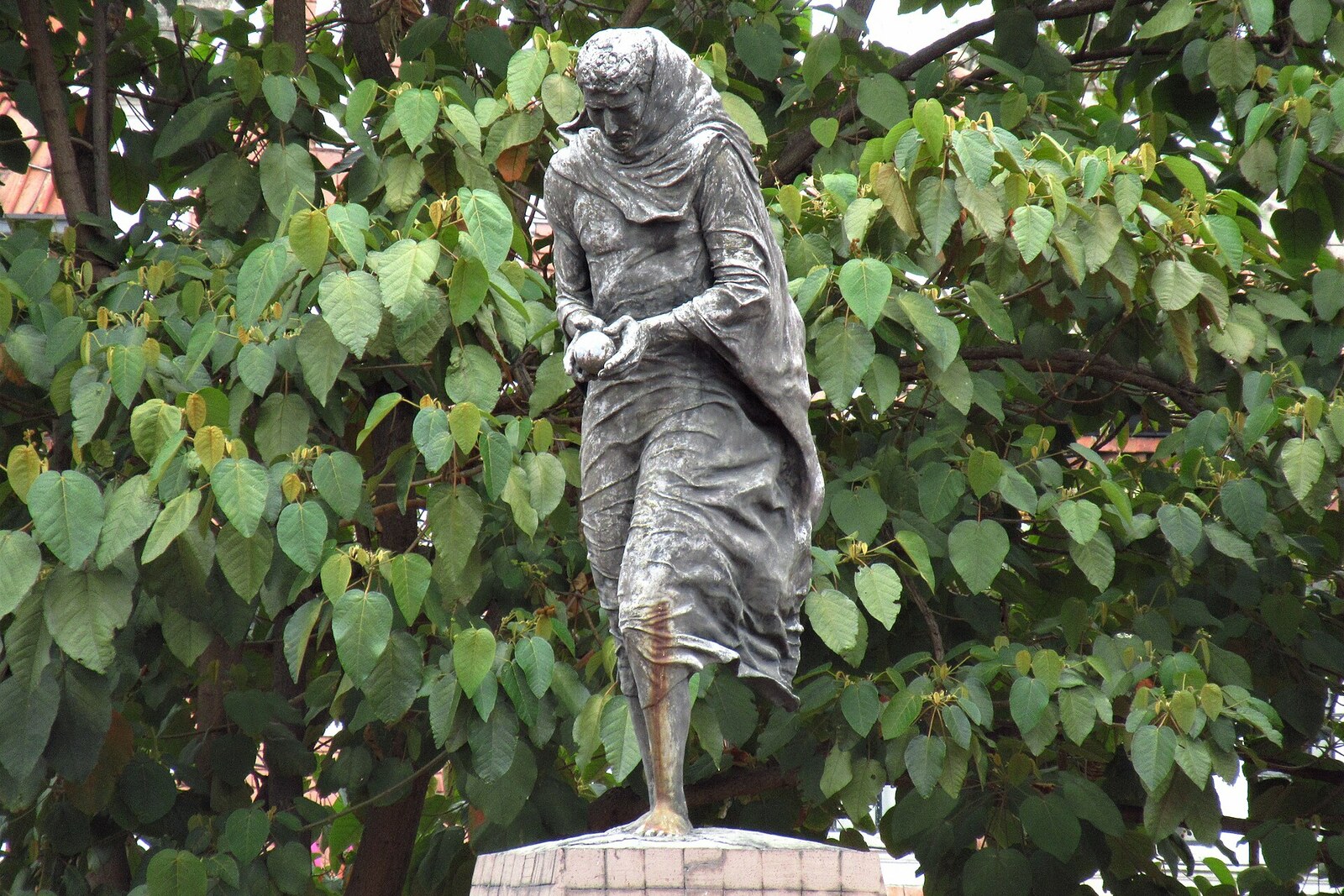
Look around first
What to notice
- Bronze figure
- Armillary sphere
- Two plaques on the pedestal
- Separate platform for the monument
The story of the place
In the Quinta Camacho neighborhood, a small park is arranged around a separate platform with a bronze figure. It holds an armillary sphere: intersecting rings represent celestial circles and turn the monument into a conversation about the structure of the world. A path curves around this platform, and two plaques have survived on the base, linking the park to a Renaissance philosopher and his Bogotá story.
Eighteen-year-old Miguel Urrutia More was commissioned to cast his first monument for this park in a public space. At the time, the Bogotá administration and the Bogotá Institute of Culture were restoring public sites in Quinta Camacho. The international cultural organization New Acropolis joined the project: for the thirty-third anniversary of its educational work, it decided to commemorate Giordano Bruno. The sculptor completed the bronze figure in nineteen eighty-nine. It was unveiled on July twenty-ninth, nineteen ninety, and the name on its pedestal was applied to the entire park.
The site took its present form later. In two thousand three, a path was laid around it and a separate platform was created for the monument. This gave the small park between Ninth and Tenth Carreras a person, a name, and a center.
The bronze figure holds an armillary sphere—a model of the sky made of rings that represent celestial circles. It did not belong to the real Bruno. Urrutia placed it in the philosopher's hands to show the idea for which the commissioners had chosen him.
Filippo Bruno was a Dominican monk; he took the name Giordano in the monastery. He sought the opportunity to teach philosophy without subordinating its conclusions to church doctrine. He had no estate of his own: Bruno lived by giving lessons, taught Latin and astronomy, edited texts at a printing shop, and looked for a university chair. Copernicus's teaching became his starting point. Bruno went further and described an infinite universe with countless solar systems.
After returning to Venice, he was hired by the patrician Giovanni Mocenigo, who wished to master the art of memory developed by Bruno. Having heard his teacher's religious and philosophical views, Mocenigo informed the Inquisition against him. In fifteen ninety-two, Bruno was arrested and then transferred to Rome. The trial lasted nearly eight years.
From the inscription on the pedestal, one might conclude that Bruno died for a single astronomical theory. Court documents point to a broader conflict: the accusers examined his ideas about God, Christ, the soul, the eternity of the world, and the structure of the universe. The exact list of the eight propositions he was required to renounce has been lost.
At first, Bruno answered with reservations and defended his formulations in writing. At the end of fifteen ninety-nine, he told the judges that he had nothing to recant. The Roman Inquisition declared him an obstinate heretic, banned his books, and handed the condemned man over to city officials for execution. On February seventeenth, sixteen hundred, Bruno was burned in Rome's Campo de' Fiori.
Two original plaques have survived on the Bogotá pedestal. One calls Bruno a philosopher, humanist, and martyr of the Renaissance. The other records the local history: July nineteen ninety, the city administration, the organization New Acropolis, and the name of the young sculptor Miguel Urrutia.
Useful on site
Open city monument; visit in daylight or along the neighborhood's illuminated streets.
Checked: June 28, 2026. Check the official source before visiting.The monument stands in an open square and is viewed from outside. Do not climb onto the pedestal, and be mindful of everyday traffic around it.