 Guide On Map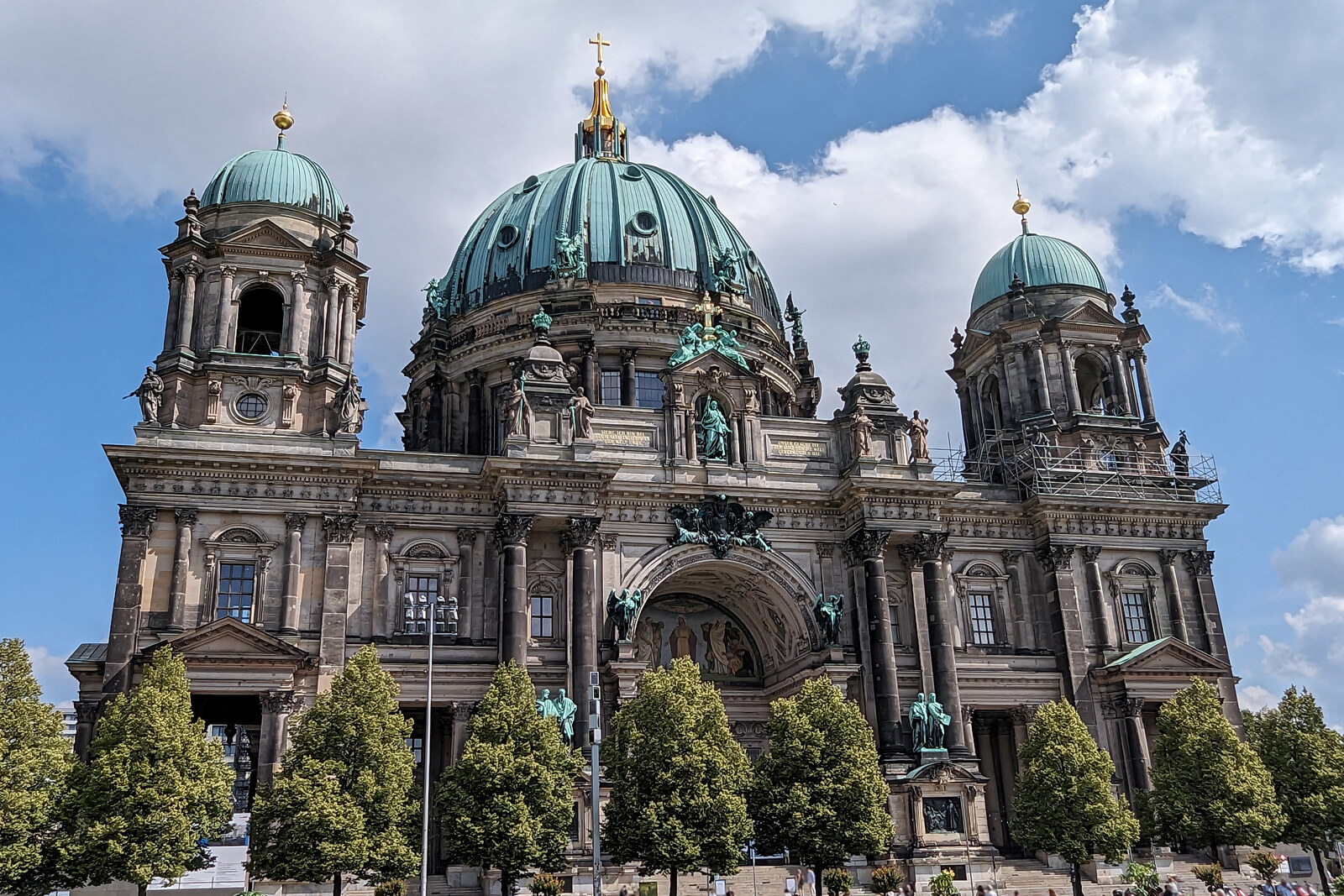
Look around first
What to notice
- The large dome
- The entrance on the Lustgarten side
- The domed hall
The story of the place
The word “cathedral” is only conditional for this church: it has never had an episcopal see. The German name “Dom” came from a medieval collegiate church whose own council of clergy made decisions. The large dome, the entrance on the Lustgarten side, and the spacious hall appeared under Wilhelm II, who commissioned the new church for the court and for ceremonial state services. After the war, the domed hall had to be restored; an active parish now holds services here again.
On September twenty-third, nineteen thirty-four, Ludwig Müller entered this cathedral to solemnly assume the office of Reich Bishop—the single head of the German Protestant churches. Müller was a former military chaplain and Hitler's appointee. He sought to bring the independent regional churches under a single leadership and to unite Christian teaching with the National Socialists' racial doctrine.
Church leaders initially rejected his candidacy and elected another bishop. Hitler then demanded new elections. With the regime's open support, the German Christians won a majority—a movement of pastors and parishioners that brought National Socialist principles into the church. They elected Müller Reich Bishop.
For his inauguration, Müller chose Berlin Cathedral. The church was the principal ceremonial church of German Protestantism: services of national importance were held here. Yet there had never been an episcopal see in the cathedral. The German name “Dom” remained from a medieval collegiate church with a special council of clergy. The present building was erected under Emperor Wilhelm II as a court church and representative center, which was why Müller needed this very dome, this entrance on the Lustgarten side, and this enormous hall.
The rite was unusual. No other bishop consecrated Müller: he himself pronounced a solemn oath and assumed leadership of the church. Inside stood delegations of the German Christians, party storm troopers, and SS men; during the service, those present raised their arms in the Nazi salute. For the people gathered in Lustgarten, the ceremony was broadcast through loudspeakers.
Yet the solemnity did not make Müller the recognized head of the Protestants. On that same day, the Bavarian bishop Hans Meiser, who defended the independence of his church, and hundreds of pastors spoke against him from their pulpits. Müller responded by attempting to remove Meiser and the Württemberg bishop Theophil Wurm. Both were placed under house arrest. Clergymen risked their positions and freedom, parishioners gathered outside the bishops' homes, and the protests spread.
A few weeks later, Müller had to retreat: Meiser and Wurm returned to their duties. The Confessing Church, assembled in Berlin's Dahlem district, declared the leadership of the Reich Bishop illegitimate and created its own church council. In the summer of nineteen thirty-five, the regime transferred church affairs to a new ministry, effectively depriving Müller of influence. He still tried to regain his former position, but received no support and took his own life soon after the end of the war.
The domed hall where he took the oath was severely damaged during the war and later restored. It is now once again the Preaching Church of an active parish. Berlin Cathedral still serves for major churchwide services, but an episcopal see has never appeared here, and the office that Müller solemnly assumed beneath this dome disappeared together with the Reich Church.
Useful on site
Usual visiting hours: Mon–Fri 09:00–18:00, Sat 09:00–17:00, Sun 12:00–17:00; until 19:00 in summer, last entry 60 minutes before closing; services and events take priority.
Checked: June 28, 2026. Check the official source before visiting.An exterior visit is enough for the main story. Treat the interior, the crypt, and a possible climb to the top as a separate visit, and check access in advance, especially if a service or event is taking place in the cathedral.