 Guide On Map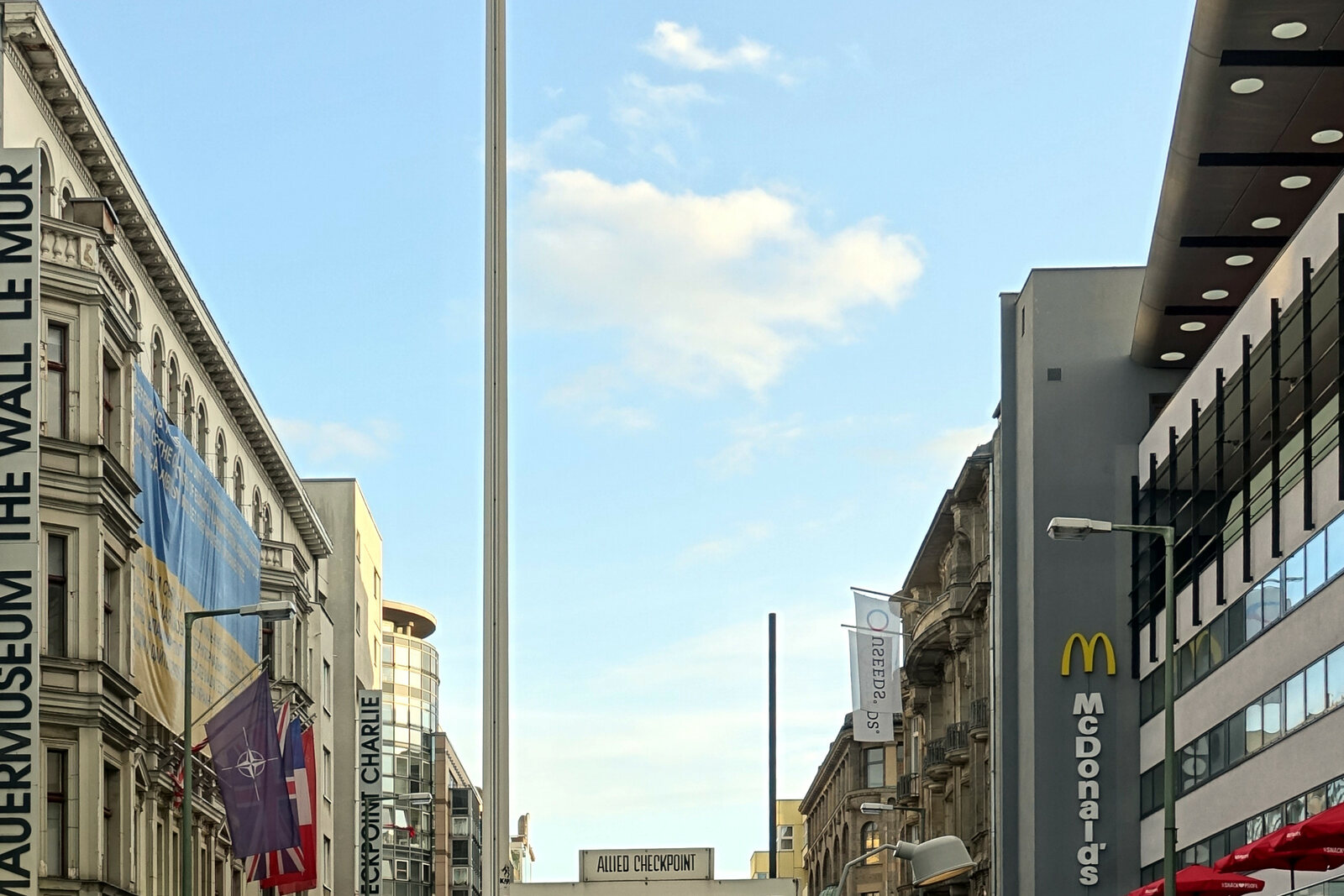
Look around first
What to notice
- White guard booth
- Friedrichstraße
- Site of the former border line
The story of the place
The white guard booth stands in the middle of Friedrichstraße, where people once crossed the line that cut through Berlin. After the wall was built, diplomats, military personnel of the Allied Powers, and foreigners were allowed through this crossing, while Berliners had other routes. The name Charlie came from the American naming system: checkpoints followed the letters of the international alphabet, and this one received the third. The Americans later took the original booth to the Allied Museum, leaving a replica on the street and the exact point of the former border.
On October twenty-second, nineteen sixty-one, Allan Lightner Jr. drove with his wife to the site of today’s white guard booth at Checkpoint Charlie, on their way to a performance in East Berlin. The car bore license plates of the American occupation forces. Until then, that had been enough to get through, but border guards of the German Democratic Republic demanded that Lightner show identification.
Lightner was deputy head of the American mission, a career diplomat. His job was to represent the United States throughout Berlin, which after the war had been divided among four powers. Americans recognized only Soviet military personnel as having the right to check their diplomats. Showing documents to an East German officer would have meant tacitly accepting that the former Allied rights no longer applied.
Lightner refused and asked for a Soviet officer to be called. That request was denied. The American command then brought a tank with infantry up to the crossing, while eight military police officers with loaded rifles surrounded the car and escorted it across the border. Lightner did enter East Berlin after all. The couple’s trip to the performance had turned into an armed test of who controlled the crossing.
This checkpoint existed precisely for such trips. After the Berlin Wall was built, this crossing was retained for diplomats, military personnel of the Allied Powers, and foreigners. Ordinary Berliners were allowed through elsewhere. Americans named their checkpoints after letters of the international radiotelephony alphabet: Alpha, Bravo, Charlie. This was the third one, hence the name that is now understood as a proper name.
After Lightner’s passage, Walter Ulbricht, leader of the German Democratic Republic, ordered documents to be demanded from Allied personnel in civilian clothes. Lucius Clay, the representative of the president of the United States in Berlin and a former military governor, decided to make the border guards back down. For several days, he sent cars with American license plates here. If they were stopped, an armed escort crossed the line, with tanks ready for combat standing behind it. Clay was seeking free passage, but every new test raised the price of the next refusal.
On October twenty-seventh, after another such passage, ten Soviet tanks moved forward from the eastern side. American tanks were already standing opposite them. About one hundred meters of Friedrichstraße lay between the leading vehicles. The ammunition was live. Now the first shot could have drawn two countries with nuclear weapons into a clash, although it had all begun with the question of who was allowed to open a diplomatic passport.
The confrontation lasted sixteen hours. John F. Kennedy, president of the United States, secretly proposed that Nikita Khrushchev, the Soviet leader, withdraw the tanks first and promised a reciprocal withdrawal of the American tanks. On the morning of October twenty-eighth, the Soviet vehicles began backing away. About an hour later, Clay withdrew the American tanks and most of the infantry. There was no shooting. The American command ended the armed checks at the crossing and temporarily asked its military personnel and officials not to travel to East Berlin.
On June twenty-second, nineteen ninety, the Americans closed the checkpoint and removed the last guard booth that had served here; it is now in the Allied Museum. The white booth in the middle of Friedrichstraße was installed in two thousand as a replica. There are no tanks, border installations, or genuine post here. What remain on the former line are the booth’s exact location and the operational name of the third American checkpoint: Charlie.
Useful on site
The outdoor point on Friedrichstraße is accessible as urban space; the museums and viewing platforms around it have separate tickets and schedules.
Checked: June 28, 2026. Check the official source before visiting.It is cramped and commercially noisy by the booth, so listen a little to the side. Do not mistake today’s street scene for the full scale of the former border system.