 Guide On Map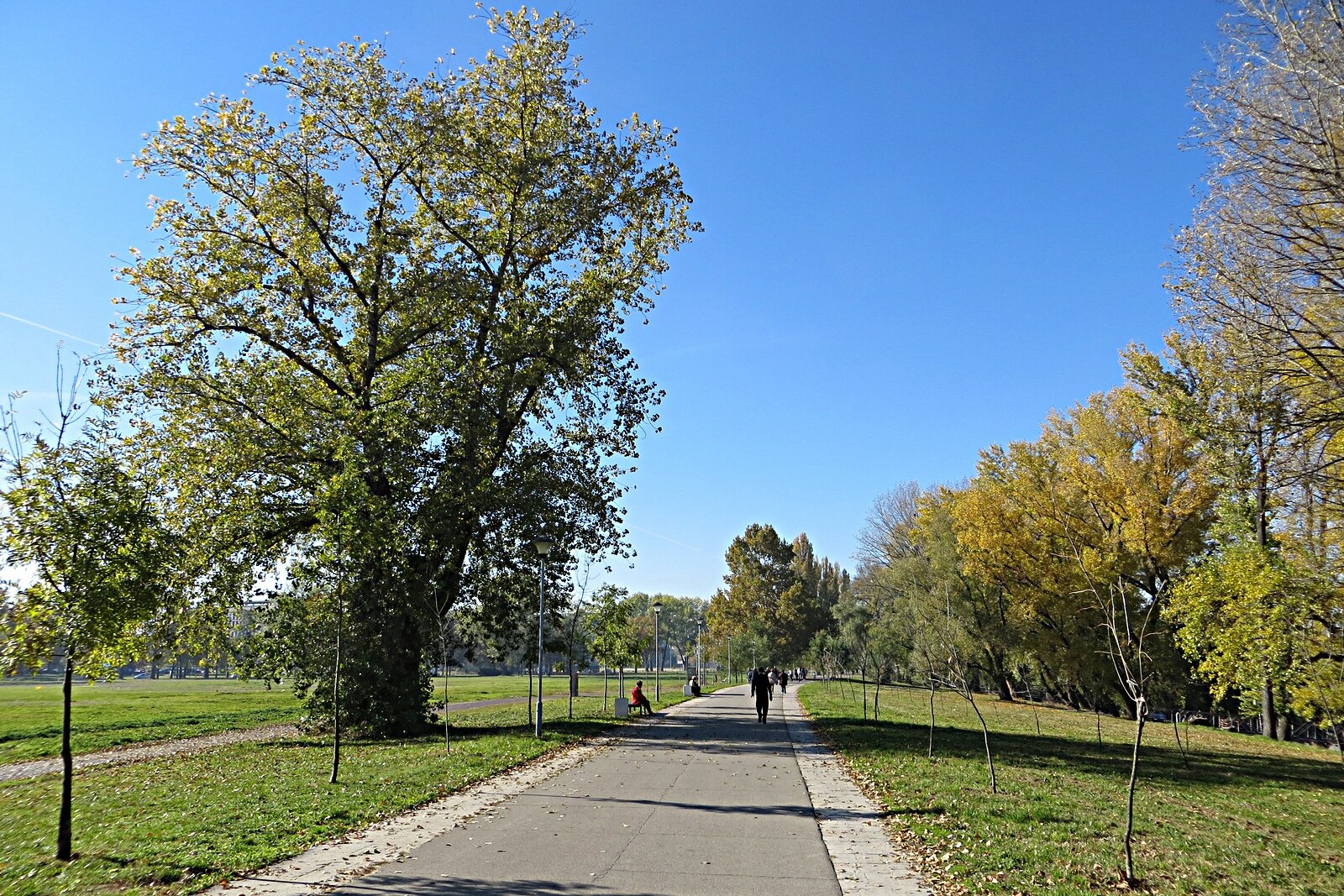
Look around first
What to notice
- Peace Avenue
- Rows of plane trees
- Stone plaques with names
- Pyramidal oak
The story of the place
On the open site by the confluence of the Sava and the Danube, a park grows with a shared diplomatic avenue. Plane trees stand in even rows eight meters apart, and stone plaques lie at their roots with a name, country, planting date, and tree species. When nearly undeveloped land still stretched beyond the federal government building, enough room was left here for new plantings without separate national corners. Later, this layout became a city custom for visiting leaders of different countries.
On August twenty-ninth, nineteen sixty-one, three days remained before the opening of a major international conference. Voja Leković, chairman of the Serbian youth greening movement, proposed preserving its memory in trees. The city councils for culture and urban planning supported the project. Already on August thirty-first, Leković planted a pyramidal oak here—the first tree of the future Park of Friendship.
The site was chosen beside the present-day Palace of Serbia, then the building of the Federal Executive Council, the federal government of Yugoslavia. Beyond it lay land near the confluence of the Sava and the Danube that was still almost undeveloped. It could hold as many trees as the foreign delegations Belgrade would receive.
Representatives of twenty-five states came to the conference, unwilling to subordinate their foreign policy either to Washington or to Moscow. Many of these countries had recently freed themselves from colonial rule. For Yugoslavia's president, Josip Broz Tito, an independent course was also a matter of security: after the break with Stalin, his country left the Soviet bloc, lost its former economic ties, and for several years awaited a possible attack.
The organizers prepared a special note and a planting layout for the heads of delegations. Each was invited to plant a plane tree with their own hands. The trees were of the same species and stood at equal intervals of eight meters. Beside each sapling, a plaque was placed with the person's name, the name of their country, the year of planting, and the name of the plant.
On September third, the first plane trees were planted by Saudi Foreign Minister Ibrahim Suwayel and Tunisian President Habib Bourguiba. Then Jawaharlal Nehru, prime minister of India, recently freed from British rule, Egyptian President Gamal Abdel Nasser, and other conference participants took up shovels. In all, twenty-six plane trees appeared in the original Peace Avenue. On September seventh, Tito planted his own tree; this day is considered the park's official birth date.
The participants left, and planting became a diplomatic custom in Belgrade. Later, heads of state from both opposing camps, monarchs and presidents, left trees here: Richard Nixon, Leonid Brezhnev, Elizabeth II, Indira Gandhi, Fidel Castro, and Mikhail Gorbachev. The trees were not divided into national sections—new trees were added to the shared park.
During the reconstruction of nineteen nineteen, workers raised and cleaned one hundred ninety-one stone markers of “peace trees,” and planted new saplings in place of lost trunks. That is why the present-day tree beside a plaque is not always the very one once held by the person named on it. The plaque marks that person's place in the old planting layout—where friendship between countries was recorded by name at the roots.
Useful on site
Open public area; access may change during events at Ušće.
Checked: June 29, 2026. Check the official source before visiting.The park can be explored freely, but individual memorial trees are not always easy to identify without plaques; do not step right onto the lawn for a photograph.