 Guide On Map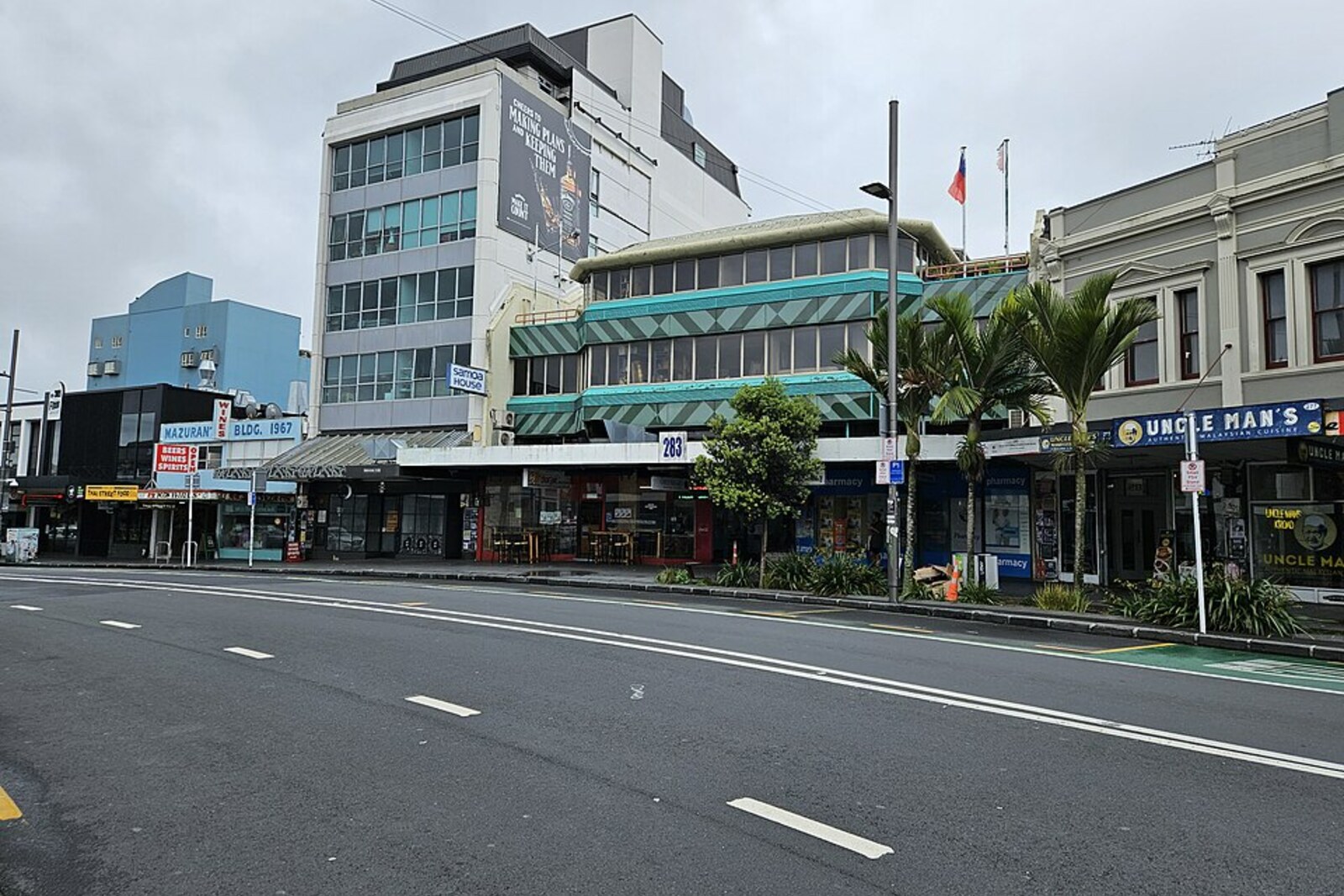
Look around first
What to notice
- The name “Samoa House” on the facade
- The urban street-front block
- The oval wooden hall
- The high, curved roof
The story of the place
The site between Karangahape Road and Beresford Street was too narrow for a large freestanding building, so a three-story block with offices and rental spaces was built along the street. Space was left at the back for the shared hall; it cannot be seen from the sidewalk, although people gathered there for classes, family celebrations, concerts, and exhibitions. When the consulate operated in this house, people also came here for passports, doctors and dentists, the café, and the shops. The passport windows have now moved away, and the second floor is occupied by an independent art library assembled from donated books.
Behind an ordinary facade on Karangahape Road is an oval wooden hall with a high, curved roof. The Samoan word “maota” is an honorific name for a chief’s house. Here, that lofty title was given to an entire country: “Samoa House” means “House of Samoa.”
Auckland’s Samoans had been talking about such a house since nineteen fifty-four. Sixteen years later, Manitete Fonoti, chair of the Samoan Progressive Movement, proposed a way to pay for it: one dollar a month from each of New Zealand’s twenty thousand Samoans—men, women, and children—for ten months. A family of five was expected to pay five dollars each month: the levy was calculated by people, not by the number of those earning an income.
Fonoti sought an urban center where Samoans could come with legal questions, learn the language, look for work, and discuss personal difficulties with trained advisers from their own community. Yet he himself did not hold a matai title—the head of an extended Samoan family. Some community elders did not recognize the right of a person without such a title to speak on behalf of all the country’s Samoans. The project passed to a new organization, the Chiefs, Orators and People of Samoa Organisation. Fonoti and his supporters refused to submit to its leaders and withdrew from the undertaking.
Other community groups continued the collection. The construction money was ultimately raised by a special fund made up mainly of local people of Pacific heritage. Architect Ivan Mercep traveled to the Samoan village of Poutasi to study the layout of a fale—a traditional open meeting house. In Auckland, he was given a narrow site between Karangahape Road and Beresford Street. The fale was therefore joined to a three-story urban block: offices and rental spaces faced the street, while the shared oval hall was placed behind them.
On December fifteenth, nineteen seventy-eight, the first Samoan-style fale outside Samoa opened here. The building housed a consulate where passports were processed, while medical services, a dental clinic, a café, and shops operated nearby. Classes, family celebrations, fundraisers, concerts, and exhibitions were held in the shared hall. In this way, the center fulfilled the program for which Fonoti had begun his collection, although he no longer ran the project.
The consulate moved to Māngere in two thousand sixteen. An independent art library now operates on the second floor, with a donation-built collection of about seven thousand books. Behind the street-front block, the oval wooden hall still stands—the part of Samoa House that the community raised with one dollar from each person.
Useful on site
Samoa House Library Tue–Fri 11:00–17:00; Samoa House and church spaces may be closed for private events.
Opening hours by day
This is a living community house with studios, classes, and an independent library, not an exhibition with free permanent entry. Check the specific program separately and respect meetings taking place inside.