 Guide On Map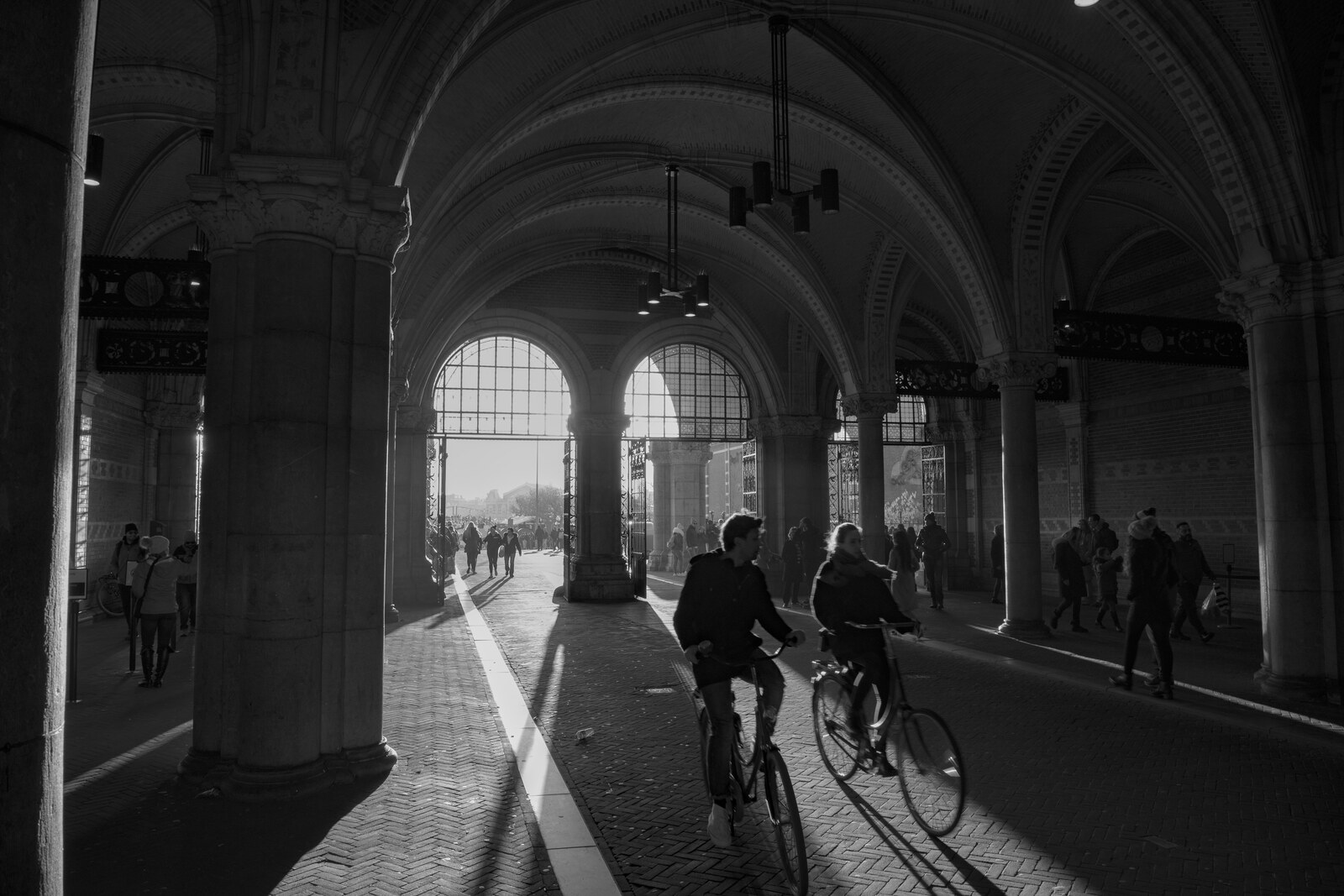
Look around first
What to notice
- Arched passage
- Side entrances
- Hatch above the passage
- Bicycle path
The story of the place
The city would not allow the road from old Amsterdam to the southern development to be blocked when the Rijksmuseum was planned here. The museum building was placed above the familiar route: the arch runs through the entire building, with entrances on either side. Exhibition galleries lie above the bicycle path, and an elongated hatch is visible in the ceiling. Pedestrians and bicycles move along the bottom of the building all day.
Museumstraat runs beneath the Rijksmuseum arch—a city street open to pedestrians and cyclists. The entrances to the national museum are set into the side walls, while the Gallery of Honour and the Night Watch Gallery lie above the passage.
This arrangement came from the calculations of city engineer Jan Kalff. In eighteen seventy-four, he placed the future museum directly above the planned street: the city would then have more adjoining land left to sell. Amsterdam required that the road from the old center to the southern districts under construction be preserved, and architect Pierre Cuypers turned it into an arched passage through the building.
This street beneath the museum galleries proved useful in a danger for which Cuypers had not intended it. In nineteen thirty-four, a long hatch was cut into the floor of the Night Watch Gallery. Through it, large paintings could be lowered directly into the passage, bypassing the stairs. Three years later, staff rehearsed an evacuation: they removed Rembrandt’s enormous canvas from its frame and held it with ropes.
The museum’s director general, Frederik Schmidt Degener, spent fifteen years rearranging the displays and striving to have the paintings hang in a carefully considered order. On August twenty-fifth, nineteen thirty-nine, when the Netherlands began preparing its army for a possible war, he had to dismantle his own work. The museum closed, and staff began removing about thirty thousand objects.
The Night Watch was lowered through the hatch into the arch and sent to Radboud Castle in Medemblik. After the German invasion, Schmidt Degener personally took the painting farther on, to a protective storage facility. The canvas would not fit through the bunker opening. Outside, it was removed from its frame and rolled, with the painted surface facing outward, onto a cylinder padded with soft fabric. Several more moves followed; in nineteen forty-two, the rolled painting was sheltered in a tunnel beneath Mount Saint Peter near Maastricht, at a depth of thirty-five meters.
Schmidt Degener died in nineteen forty-one and did not see his display return. The Night Watch came through the war undamaged and returned to its place in the museum in the summer of nineteen forty-five.
The hatch above the passage was preserved. In March nineteen thirteen, The Night Watch was raised through it after the Rijksmuseum’s long reconstruction. Now cyclists cross the arch beneath the very opening through which museum staff once lowered its principal painting onto the city street.
Useful on site
Public passage for pedestrians and cyclists; the museum is open daily 09:00-17:00, and a timed ticket is required.
Checked: June 28, 2026. Check the official source before visiting.Listen at the edge of the pedestrian zone, without stepping onto the bicycle path. You can pass through the building without a museum ticket, but admission to the displays is arranged separately.