 Guide On Map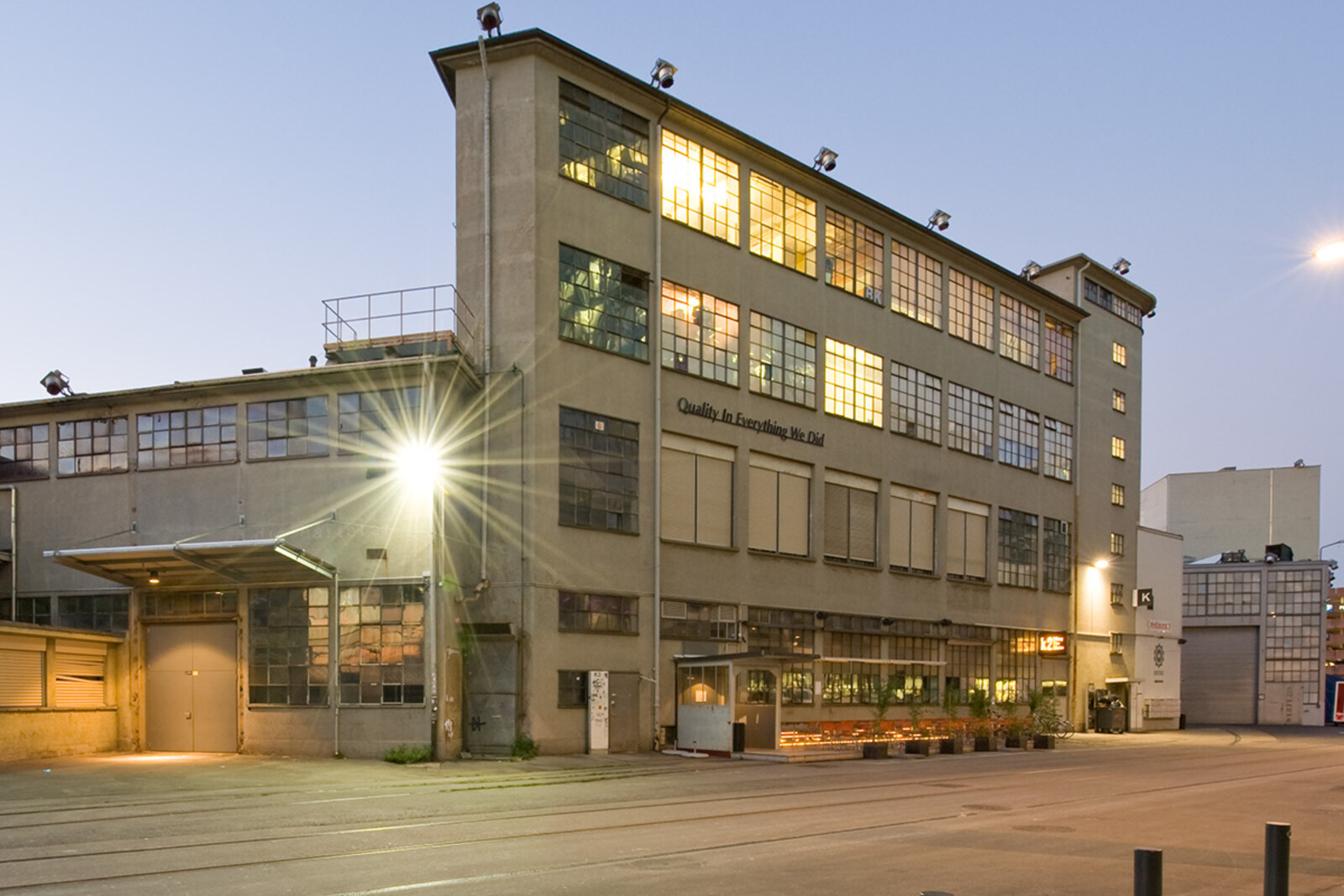
Look around first
What to notice
- Hardening shop
- Assembly hall
- Large factory bays
- Zahnradstrasse street sign
The story of the place
On a street named after the cogwheel, part of the later complex of an engineering factory has survived. Parts were strengthened in the heat-treatment workshop, machines were assembled in the neighboring hall, and finished products were sent to customers through the workshops and dispatch department. The spacious bays, designed for equipment, accommodated a stage, an auditorium, and temporary sets after production left. The factory buildings now host performances, concerts, exhibitions, and club nights.
Max Maag's path to this site began with a flawed gear. In nineteen oh eight, the young designer made a mistake while milling the first gear on a new machine. The shifted tooth profile suggested to him a way to make the teeth stronger and achieve a high gear ratio with less distance between the shafts. Maag calculated his own gear-meshing system, but the calculations still had to be turned into machines and mass-produced parts.
By then, he had dropped out of Zurich Polytechnic, become a mechanic's apprentice, and opened a small engineering office. He had no factory of his own: the machines he developed were made by other companies. The engineer needed a workshop, money, and the opportunity to be personally responsible for the precision of every gear.
These were provided by the businessman Jakob Muggli, who decided to invest in Maag's invention. In April nineteen thirteen, Muggli arranged a workshop and office for the designer on Hardstrasse, in the vacant buildings of the Safir car factory. It was here that Maag began producing hardened and ground gears and the machines to make them. His name came to designate both the meshing method and the factory's products. Patents were filed in fourteen countries, and foreign machinery manufacturers bought licenses.
Rapid growth required money that the inventor still did not have. In nineteen seventeen, with the participation of Swiss Bank Corporation, the factory was turned into a joint-stock company. Maag retained a share and management, but after the First World War orders declined, and the company stayed afloat thanks to bank loans. In nineteen twenty, Georg Fischer was appointed commercial director, and he was to save the company; Maag was left influence mainly over technical matters.
He continued inventing grinding machines, gear pumps, and measuring instruments. But when the crisis intensified and license buyers began cancelling orders for machine tools, his freedom to invent already depended on the people paying the debts. In nineteen twenty-six, Maag left the company that bore his surname. Fischer and Albert Brupbacher received a majority of the shares and continued production; soon the firm opened operations in Italy and France. Maag himself took up new measuring instruments and organs, and later founded another company, Mikromaag.
The first buildings he moved into have not survived. Before us are later sections of the expanded factory: the workshops and dispatch building, the hardening shop, and the adjoining assembly hall. After industrial production left at the end of the nineteen nineties, they were occupied by organizers of exhibitions, performances, concerts, and club nights. The large factory bays could hold a stage, an auditorium, and temporary structures; since nineteen oh two, the independent Maag venue has operated here.
On Zahnradstrasse—Cogwheel Street—the hardening shop, the assembly hall, and the engineer's surname remain. Maag himself was removed from his factory almost a century ago; the name survived both his departure and the disappearance of the machines.
Useful on site
Access to the halls depends on the Maag program; exterior viewing and the passageways around them vary with events/work.
Checked: June 26, 2026. Check the official source before visiting.View the complex from publicly accessible passageways: some buildings are used for work and events and are not intended for unrestricted viewing.