 Guide On Map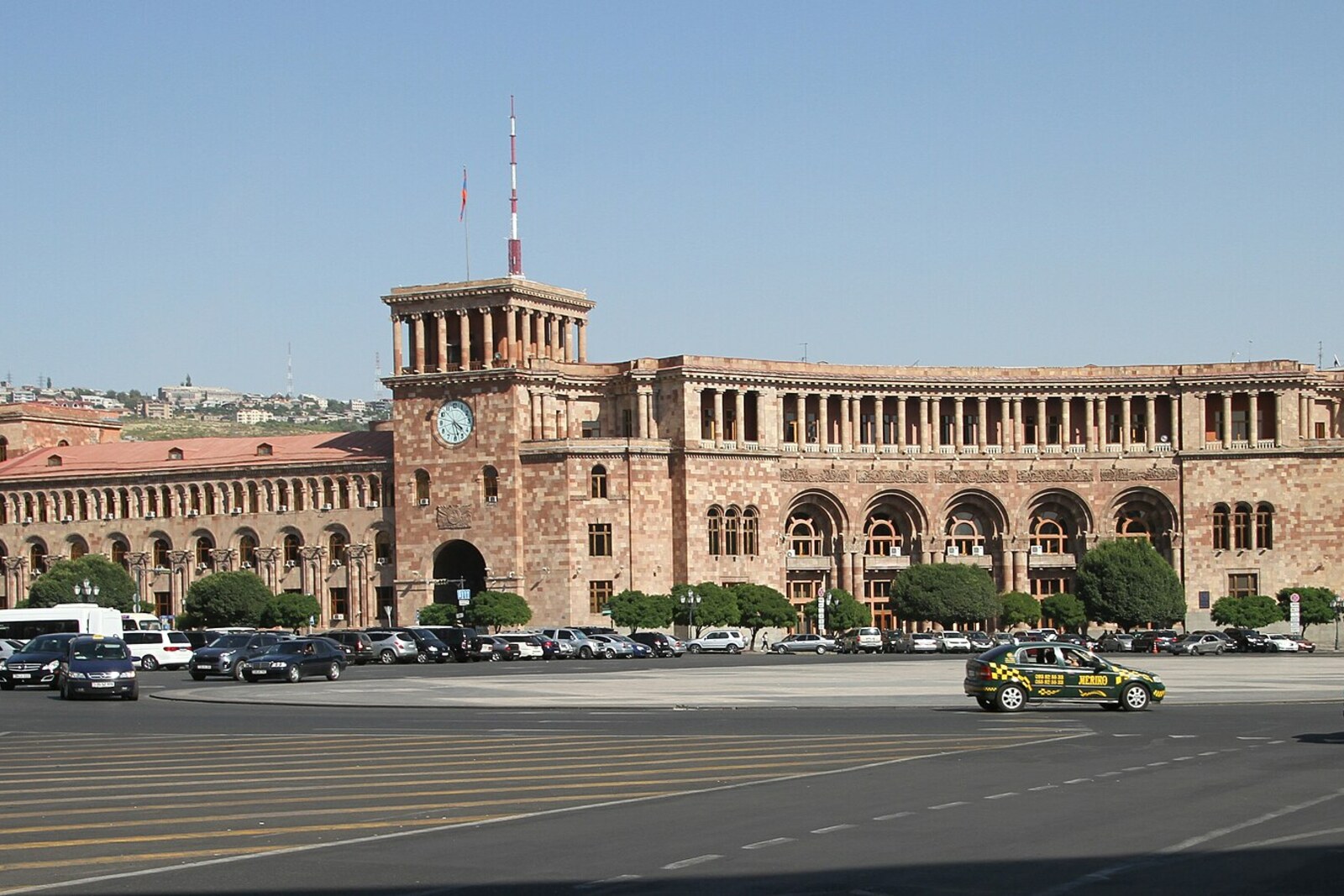
Look around first
What to notice
- Government House with its clock tower
- The oval line of the square
- The museum building
- Major streets converging on the square
The story of the place
Yerevan's master plan is set into the stone around the square: Alexander Tamanian designated this place for the administrative center before the ensemble acquired its familiar appearance. Government House rose first, and its curved line, height, and repeating arches became the measure for the neighboring facades. After the architect's death, other masters continued the work, and had to relate the new buildings to the curve already established. That is why the arches of the government building and the museum facade belong to one long construction project, completed by more than one author.
The square consists of two spaces with different functions. The oval roadway distributes traffic between the central streets, while the long pool in front of the museums turns the other half into an open-air auditorium. The pink building with the clock tower houses the government of the Republic of Armenia; the Republic in the square's name is precisely the state whose institutions are gathered around it. Opposite, the History Museum of Armenia and the National Gallery of Armenia occupy a single building.
Alexander Tamanian established this arrangement. In nineteen twenty-four, the architect placed the administrative center of Yerevan's new master plan here. Government House was begun first: its curve determined the line of the square, while the height and rhythm of its arches became a condition for those who later designed the remaining buildings. Tamanian died while the ensemble still consisted of unfinished parts. Other architects completed the surroundings, but they had to respond to the facade already built.
The pool appeared in front of the museums in nineteen fifty-three and at first remained an ordinary fountain. Sixteen years later, radio engineer Abram Abramyan moved from Kharkiv to Yerevan—a Doctor of Technical Sciences and professor who earned his living through research and teaching. The city executive committee assigned his group to prepare the fountain for the fiftieth anniversary of the Armenian SSR. Abramyan took on a task for which hydraulics alone were not enough: the pumps, lighting, and music recording had to be connected by a single automated system.
The error would have shown up not in a laboratory. The entire main square would have seen the malfunction during the anniversary display. The engineers made the music the controlling part of the system: the height of the jets, the volume, and the changes of color depended on it. In nineteen seventy, the first automatic color-and-music fountain of its kind in the Soviet Union began operating.
After the Yerevan launch, Moscow, Batumi, Sochi, and Kharkiv began ordering similar complexes from the group. A working model was shown in Buenos Aires, and in nineteen seventy-eight Abramyan and his staff received the State Prize of the Armenian SSR in Science and Technology. For the engineers, side work alongside university teaching became a separate profession.
The old automation system has not survived to the present day: the pumps, pipes, and controls were replaced repeatedly, especially during the major reconstruction of the early twenty-first century. But the pool remains in front of the same museum facade, and the connection devised by Abramyan's team has been preserved literally: by day, the administrative square receives traffic and official ceremonies; in the evening, its museum half once again becomes an auditorium.
Useful on site
Open urban space; access around the clock, with individual sections possibly closed for ceremonies and events.
Checked: June 24, 2026. Check the official source before visiting.Walk around the edge of the square: its shape and the changing shades of the stone are easier to notice while moving.