 Guide On Map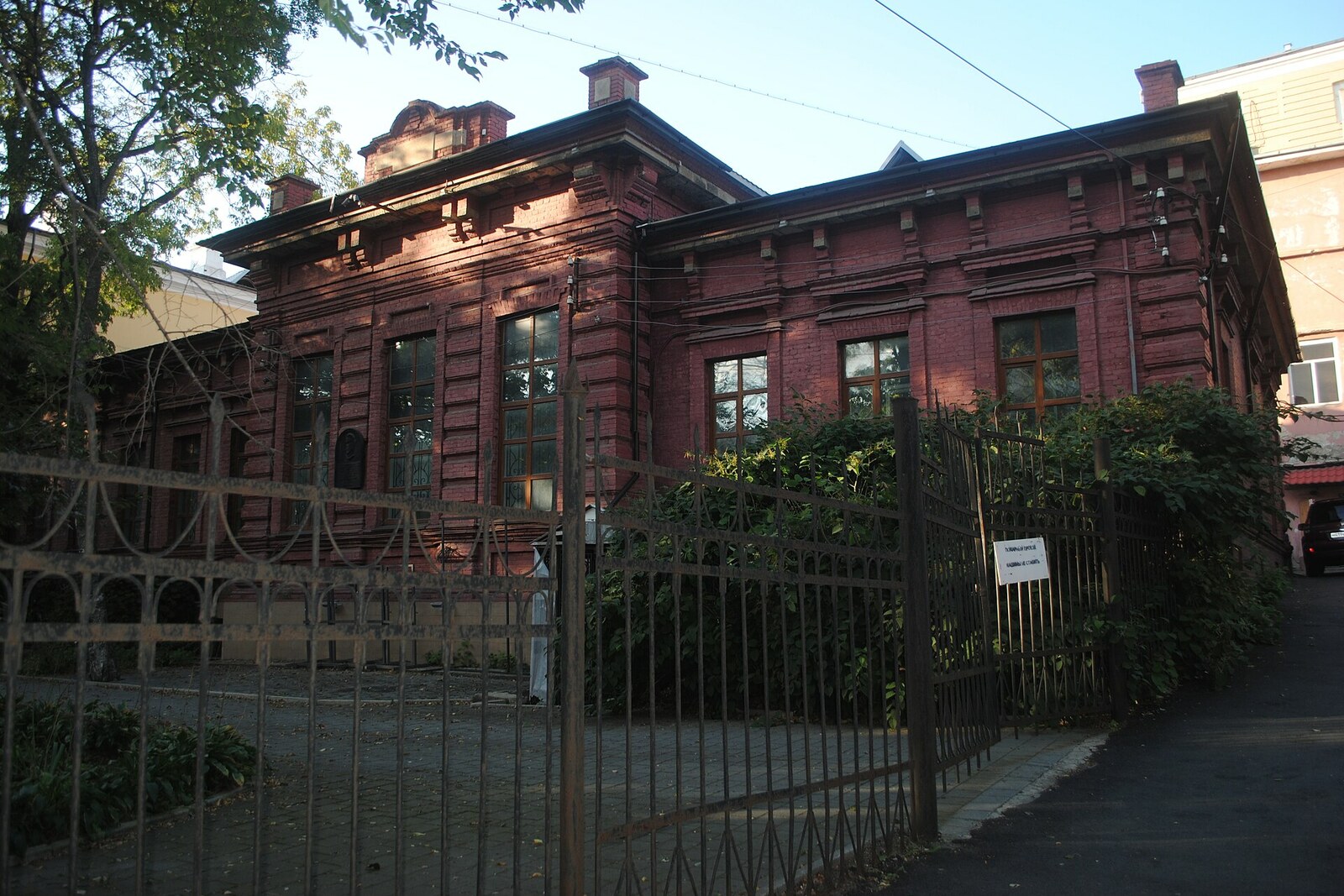
Look around first
What to notice
- Building facade
- Weapons and awards
- Letters and documents
- Photographs of the fortifications
The story of the place
Behind the building's facade are objects and evidence relating to Vladivostok Fortress: weapons, awards, letters, and photographs. Its more than one hundred separate sites are scattered across hills, the coast, and Russian Island; there can be no single overview of it. The visitor center brings this dispersed system together in one place, adding present-day footage of the fortifications to old documents. Here you can learn who created the forts and decide which one to continue to next.
The museum needed a home of its own after its collection had to be packed into crates and taken to the merchant Mikhail Shevelev. Before that, the finds had been stored in a room at the boys' gymnasium, but renovations began there. Objects were already being collected, researchers were already setting out on expeditions, yet there was nowhere to put what they brought back.
It all began in December eighteen eighty-three. The naval mechanic Aleksandr Ustinov proposed opening a museum in Vladivostok through the Vladivostok newspaper. The city was not yet even a quarter of a century old. There were almost no professional scholars here, so people with different occupations and sources of income took up the work. Fyodor Busse headed the Resettlement Administration and led the new Society for the Study of the Amur Region. The teacher Vasiliy Margaritov took charge of the museum collections. Together with military personnel, doctors, and entrepreneurs, they collected archaeological finds, plant and mineral specimens, everyday objects of Indigenous peoples, books, and maps.
When the crates ended up with Mikhail Shevelev, it became clear that temporary rooms would no longer do. There was not enough money for a separate building, and members of the society began turning everything they knew how to do and everything they owned into a construction fund. Colonel Ivan Nadarov organized an exhibition of paintings from private collections and raised five hundred twenty-one rubles. Aleksandr Belyaev staged amateur performances at the Zolotoy Rog Theatre. The merchant Mikhail Yankovsky gave a horse; other townspeople gave one hundred boards, twenty barrels of cement, ten crates of glass, and discounted bricks. Of the roughly thirty thousand rubles raised for the museum, twenty-five thousand came from Vladivostok residents.
In June eighteen eighty-eight, a silver plaque with a commemorative inscription was placed in the foundation of the building. Two years later, townspeople were admitted to the first public museum in the Russian Far East. The exhibits no longer lay in other people's rooms and crates, and the collections assembled by the founders later entered the holdings of the Arseniev Museum of Far East History.
The Visitor Center of Vladivostok Fortress now operates in this building. The fortress itself consists of more than one hundred structures scattered across the city's hills, coastline, and Russian Island, so it is impossible to see it all from a single point. Here, museum staff bring its parts together: they show weapons, awards, letters, documents, photographs, and modern footage of the fortifications, explain who designed and built the forts, and say where to go next.
The fortress's objects have again been gathered in the very building that Vladivostok residents once constructed for scattered evidence of a region that had scarcely been studied. A silver plaque lay in its foundation, while the cost of its walls included theater tickets, paintings, a horse, cement, and ten crates of glass.
Useful on site
Daily 10:00–19:00, ticket office until 18:30. Full ticket — 400 rubles; special rate for citizens of Russia — 200 rubles; concessionary — 100 rubles.
Checked: June 24, 2026. Check the official source before visiting.The exhibition is visited separately, but the battery's layout and the outer fortifications can be understood without entering. On uneven sections, keep to the equipped walkways.