 Guide On Map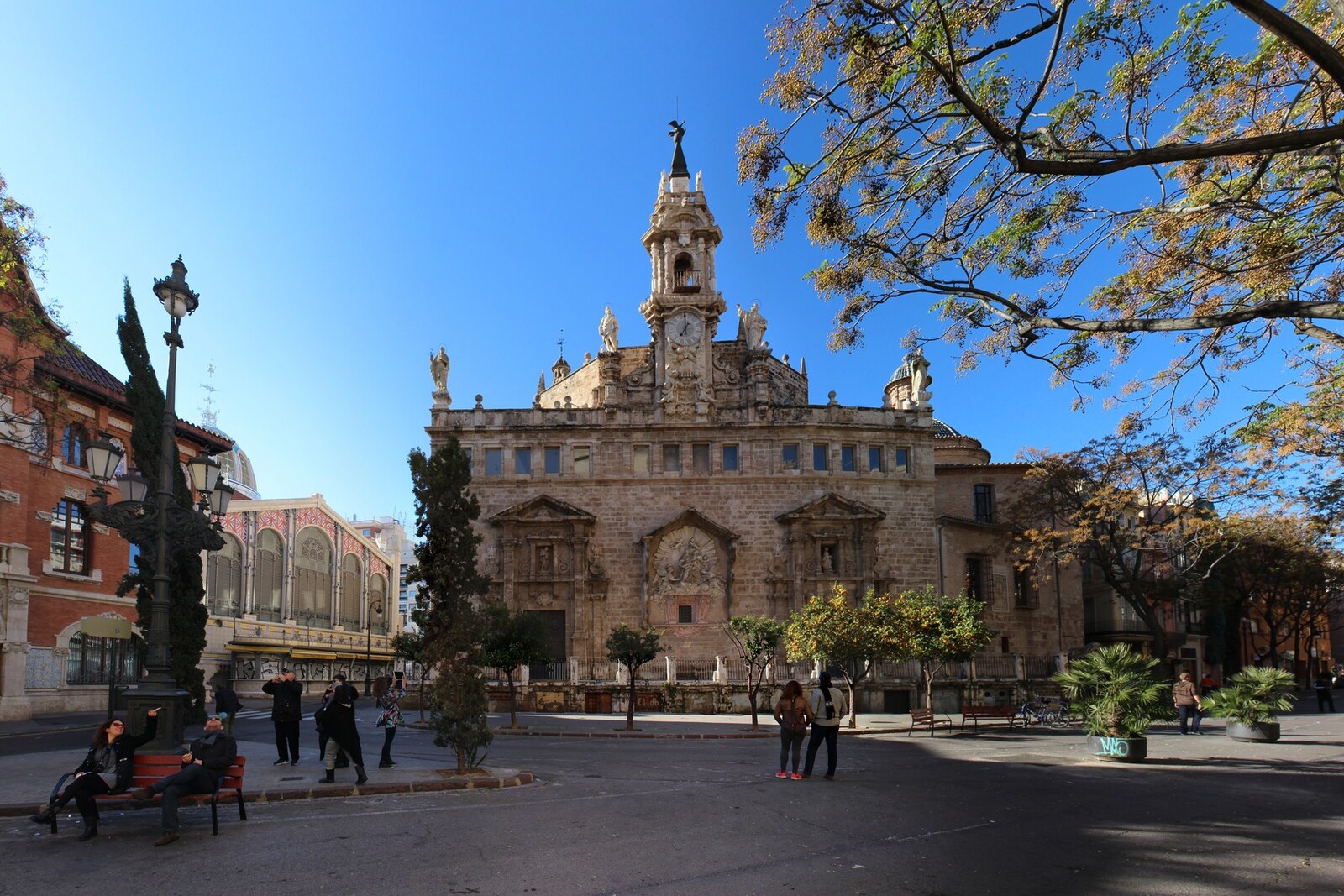
Look around first
What to notice
- Figures of the two Johns
- Clock tower
- Eagle with an inkwell and quill
- Vault painting
The story of the place
The name “Santos Juanes” means “holy Johns.” After the conquest of Valencia, a former mosque in the suburb of Boatella was converted into a Christian church and dedicated to John the Baptist and John the Apostle. Market trade took place nearby, so the church was also known as Saint John at the Market. The clock tower separates the figures of both patrons on the façade facing the market; the Baptist is accompanied by a lamb, while the Apostle is identified by an eagle with an inkwell and quill instead of a weather vane.
In sixteen ninety-seven, Antonio Palomino—a court painter to Carlos II and an expert in fresco painting—was called here. The parish council asked him to assess the work of the brothers Vicente Guilló and Eugenio Guilló. Palomino's opinion would determine whether the brothers kept the largest commission of their workshop.
The contract with the Guillós had been signed four years earlier. The brothers came from Vinaròs and made their living painting churches. Here they were given the nave vault and the space above the altar. By sixteen ninety-five, they had already filled eleven of the twelve lunettes—semicircular sections beneath the vault—with painted columns, cornices, and figures. A parishioner standing below was meant to feel as though the real architecture continued upward.
The commissioners were dissatisfied. In a detailed technical opinion, Palomino confirmed their concerns. He wrote that in many places the brothers had used tempera on dry plaster instead of true fresco, made the figures too small, and calculated the distance from the floor poorly. From below, the composition broke apart and became incomprehensible.
Vicente Guilló refused to accept this verdict. A long dispute with the parish began: the artist had already spent years on the work and expected to receive the agreed payment. The council secured the termination of the contract, but paid him more than one thousand eight hundred Valencian livres—local monetary units. Vicente did not live to see the new painting: in sixteen ninety-eight, he died in Valencia and was buried in this same church. Eugenio became the administrator of his brother's estate, left the city, and returned to Vinaròs.
The vacant commission went to the man who had issued the negative opinion. Under the contract of sixteen ninety-nine, Palomino was assigned five thousand livres and another four hundred for an assistant. He turned the vault into a single scene of New Jerusalem, with angels, saints, and Archangel Michael's battle with the dragon. It was based on the Book of Revelation—a book that church tradition associates with one of the church's patrons.
The Spanish name “Santos Juanes” means “holy Johns.” The first is John the Baptist, the preacher who baptized Jesus in the Jordan River. The second is John the Apostle; Christian tradition attributes the fourth Gospel and the Book of Revelation to him. After the conquest of Valencia by the troops of Jaume I, a former mosque in the suburb of Boatella was turned into a Christian church and dedicated to both of them. Market trade took place nearby, so another name was also used: Saint John at the Market.
On the market façade, the two patrons stand on either side of the clock tower. John the Baptist is identified by a lamb; John the Apostle by an eagle with an inkwell and quill, placed at the top instead of an ordinary weather vane. Inside, Palomino's painting rises above the surviving fragments of the Guilló brothers' eleven lunettes: the work of the artists who lost the commission remained directly beneath the work of their judge.
Useful on site
Exterior viewing is open as an urban space; a tourist visit to Church of Santos Juanes after the restoration operates on official tickets/hours and may give way to services or events.
Checked: June 27, 2026. Check the official source before visiting.This is an active church and a restoration site: the interior may not be fully accessible. During a service, remain at the façade and do not play the audio aloud.