 Guide On Map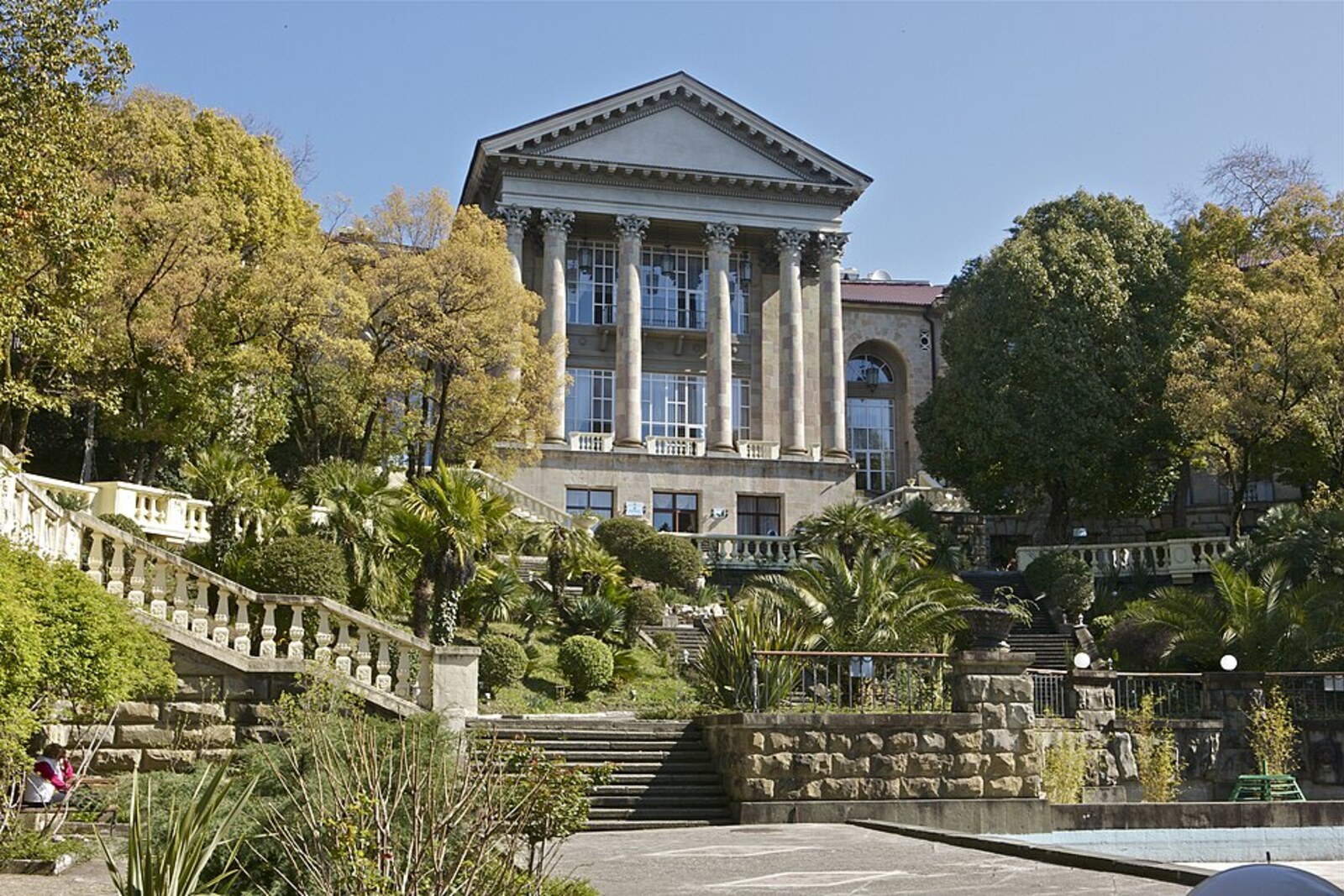
Look around first
What to notice
- Six-column portico
- Broad staircases
- Corinthian capitals
- Five-pointed stars among the leaves
The story of the place
On the slope of Bytkha stands a sanatorium ensemble with a main building and two residential wings; broad staircases descend from it down the slope. The Corinthian capitals of the six-column portico are decorated with five-pointed stars among the leaves. The health resort received workers from metallurgical enterprises in factory towns, while its proximity to Matsesta made it possible to prescribe treatment with the local mineral waters. Beneath a glass roof, a pool with sea water is in operation.
Georgy Bitov earned his living calculating factory structures, but wanted to design entire buildings. After the war, he returned from evacuation to Leningrad and joined Gipromez—an institute where ferrous-metallurgy enterprises were calculated. His son recalled that his father, a committed non-party man, never made a great career and painfully felt himself to be an architect without buildings.
In nineteen forty-eight, Bitov's usual department assigned Gipromez an unusual job. The People's Commissariat for Ferrous Metallurgy, which ran the industry's factories, received a plot on the slope of Bytkha for a sanatorium for its workers. It was chosen near Matsesta so that vacationers could be prescribed treatment with the local mineral waters. That was how Bitov came to Sochi: people who designed metallurgical plants now had to create a place where factory workers could restore their health.
Yakov Svirsky became the project's chief architect, charged with carrying the competition design through to construction. He and Bitov could not find common ground. A troubling phrase survives in family records: the question was being decided whether Bitov would continue working. For him, that meant losing a rare chance to leave the role of structural engineer behind. He remained with the project and traveled to the construction site. He took his wife among the still unfinished buildings, showed her sketches of a large sports complex with a swimming pool, and lamented that he had come to real architecture too late.
The completed sanatorium gained the first indoor swimming pool at the Sochi resort, beneath a glass roof, supplied with fresh and sea water. The main building was connected to two residential wings, and broad staircases descended down the slope before the six-column portico. Five-pointed stars were set among the leaves on the Corinthian capitals.
In the summer of nineteen fifty-six, a state commission accepted the three-hundred-fifty-bed complex. The first vacationers arrived the following day. Nine vouchers out of ten went to workers and employees of metallurgical enterprises: from Magnitogorsk, Chelyabinsk, Novokuznetsk, and other factory towns. After construction was complete, Bitov returned to Leningrad and never lived in Sochi again. In the family, the sanatorium was called the peak of his creative work and his swan song.
Behind the columns, a clinical sanatorium is still operating, and after repairs the pool has once again been filled with sea water. The word “Metallurg” on its sign refers to the people for whom Bitov received his principal architectural commission.
Useful on site
Operating sanatorium; public access to the grounds without accommodation or prior arrangement has not been confirmed.
Checked: June 24, 2026. Check the official source before visiting.Look for the best accessible view from the official entrance and the street. Do not go beyond the barrier gate for the pool, park, or interior staircases.