 Guide On Map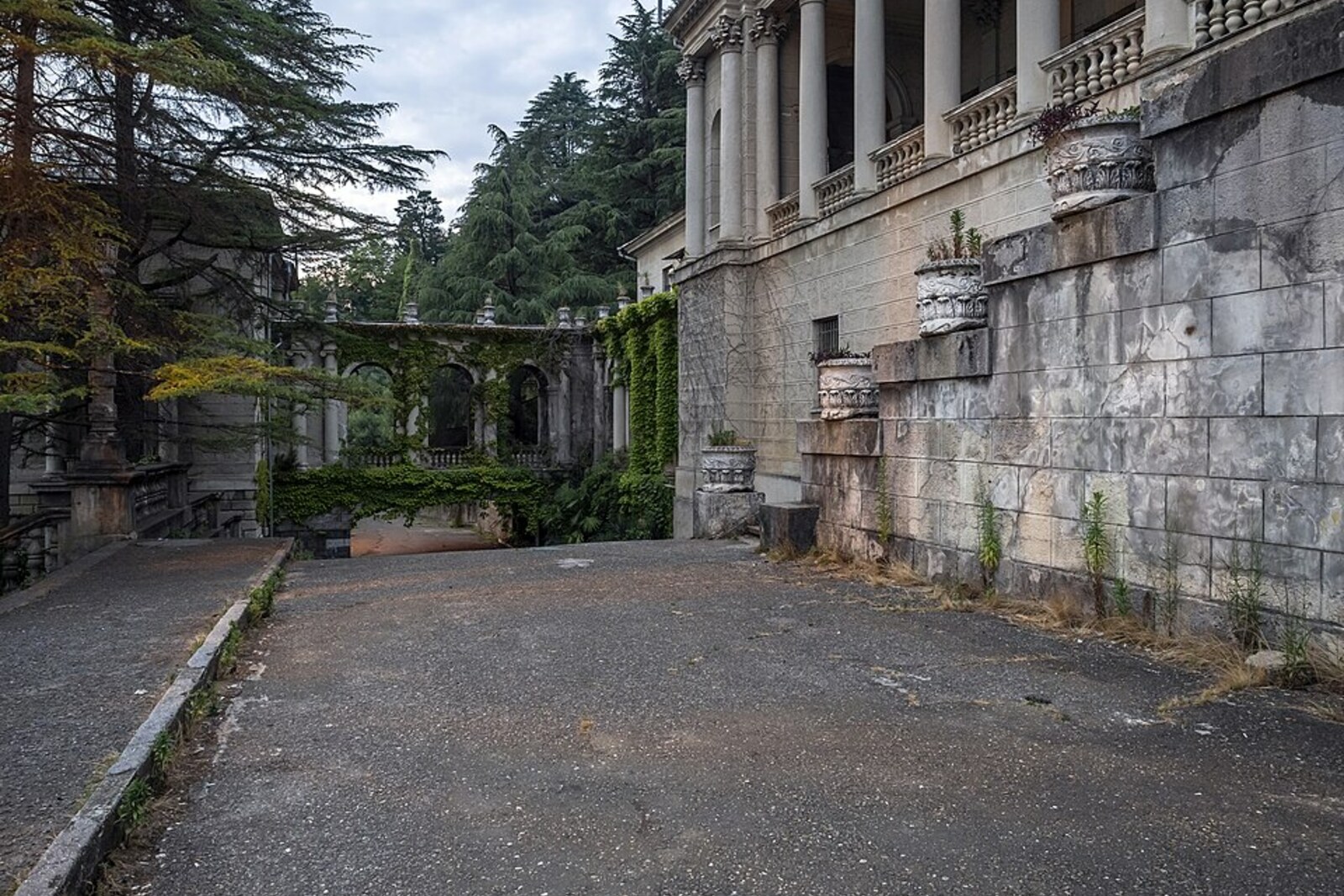
Look around first
What to notice
- Grand staircase
- Colonnades
- Fountain
- Central and side buildings
The story of the place
On the southwestern slope of Bytkha, the Ordzhonikidze Sanatorium was built on a site leveled among the hills and reinforced with retaining walls against landslides. A staircase leads to facades with columns, and the main building and two residential buildings are still grouped around the fountain. The open galleries and the position on the slope gave the rooms sun and a view toward the sea. The health resort is closed now, but the entire ensemble has retained the layout of a large resort house.
The grand staircase, colonnades, and fountain lead to a former health resort for miners. The central building housed a club and dining hall, while the side buildings contained rooms for vacationers. People who earned their living underground and at heavy-industry enterprises came here on vouchers for treatment and recuperation.
The sanatorium is named for Grigory Konstantinovich Ordzhonikidze, who was usually called Sergo. He headed the People's Commissariat of Heavy Industry, the agency that ran mines, metallurgical plants, and heavy-machine building. Ordzhonikidze pressed for workers in his sector to have their own large health resort in Sochi.
The project had emerged before his involvement. In December nineteen thirty-two, engineers presented a plan for a sanatorium called Gorno-Rud-Soyuz. Ordzhonikidze studied it, took responsibility for organizing the construction, and laid the first stone in nineteen thirty-three. He personally chose the site on the southwestern slope of Bytkha. Because of that choice, the slope had to be reinforced against landslides and a level site for the buildings created among the hills, but the rooms received sun, open galleries, and a view toward the sea.
Construction was expected to be completed in a year and a half. It dragged on: materials were scarce, and the foundations and retaining walls were built with almost no machinery. Ordzhonikidze died in February nineteen thirty-seven, without living to see the opening. By the end of that same year, the sanatorium received its first vacationers, and its former departmental name was replaced with the name of the man who had taken responsibility for the project and chosen this slope for it.
The sanatorium does not receive vacationers now. The central club-and-dining-hall building and two accommodation buildings still form the very complex for miners around the fountain. Ordzhonikidze did not see a single guest arrival here; his name greeted the first patients in his place.
Useful on site
The grounds are closed to mass visits; viewing is only possible from the public side of the fence.
Checked: June 24, 2026. Check the official source before visiting.View the complex only from publicly accessible space. The grounds are unsafe and closed; do not look for ways in or expect to get close to the fountain or the funicular.