 Guide On Map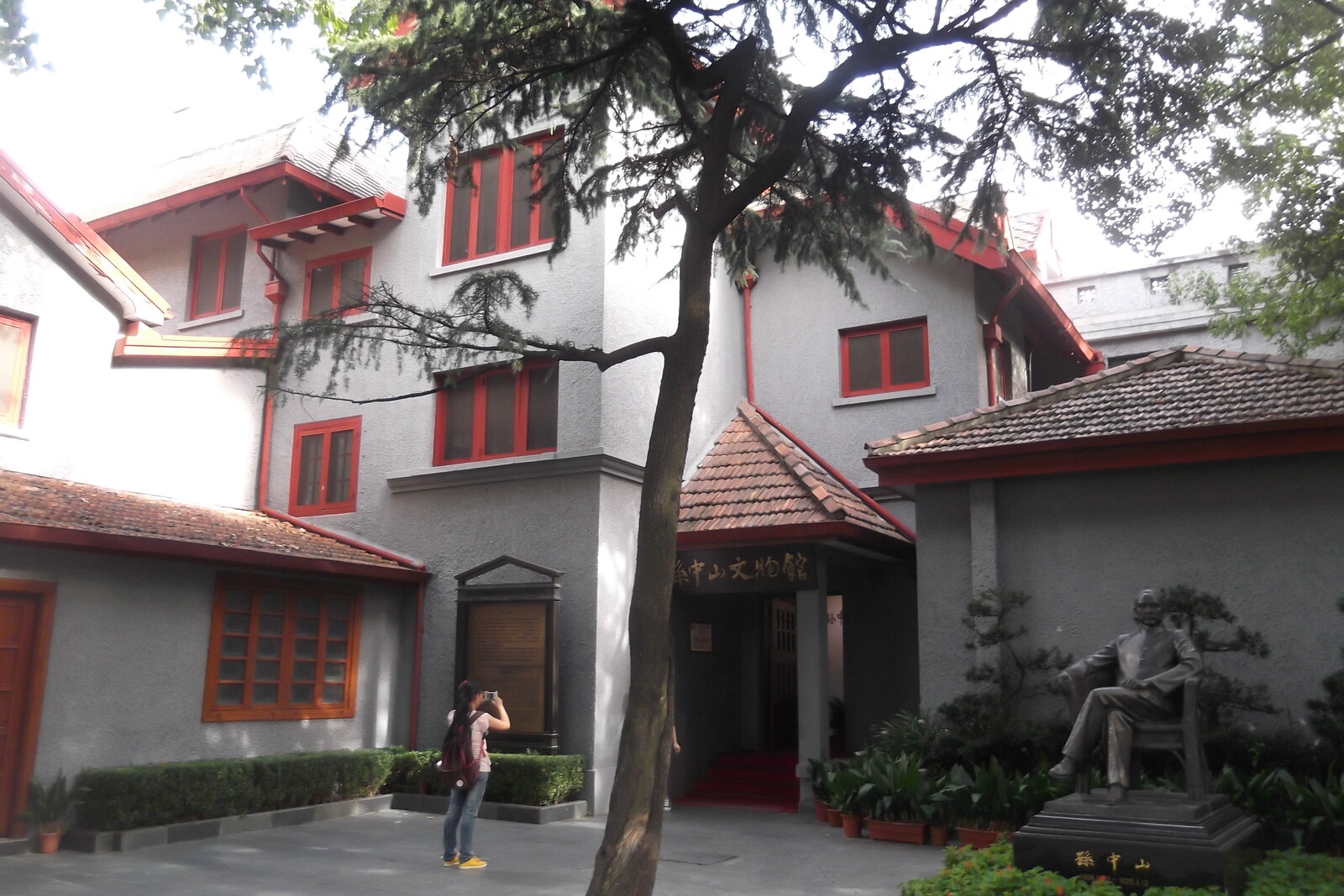
Look around first
What to notice
- Gray two-story villa
- Writing desk
- Armchair in the study
The story of the place
Sun Yat-sen did not buy the gray two-story villa behind the fence himself. In nineteen eighteen, four Chinese people living in Canada raised sixteen thousand yuan and gave the house to the leader of the Kuomintang—the party with which Sun was trying to unite the fragmented Republic of China. He had not previously owned a home of his own. The address was different then: number twenty-nine Molière Road, in the French part of Shanghai, with its separate administration. Sun moved in here with his wife, Soong Ching-ling.
In the summer of nineteen twenty-two, he had to return here after a military defeat. Sun intended to lead troops north from Guangzhou and bring the provinces under a single government. His former ally, Chen Jiongming, commander of the Guangdong army, opposed this campaign and wanted to preserve the province's autonomy. In June, Chen's soldiers shelled Sun's residence in Guangzhou. Sun escaped aboard the gunboat Yongfeng and remained on board for almost two months, until a British ship took him through Hong Kong to Shanghai.
In August, he was back in this house. He still had a famous name and a party, but the Guangzhou army had submitted to Chen Jiongming. Sun needed money, weapons, and people capable of turning the Kuomintang into a disciplined organization.
That was how Adolf Joffe came here: a representative of the Soviet Government in China, seeking a reliable partner for Moscow. In January nineteen twenty-three, he met with Sun several times. On January twenty-second, Joffe came to this house for lunch; the negotiations continued in the second-floor study.
Sun agreed to accept Soviet assistance, but he did not intend to introduce a Soviet system in China. The joint statement published on January twenty-sixth said so directly: Sun maintained that conditions for a communist order did not exist in China, and Joffe declared that he shared Sun's view. In return, the Soviet side promised to support China's unification and independence. This formula allowed Sun to gain a foreign ally without abandoning his own program.
A few weeks later, Sun's supporters retook Guangzhou, and he returned there. In the fall, the adviser Mikhail Borodin arrived and helped restructure the Kuomintang. The Soviet side sent funds, weapons, and military specialists. In nineteen twenty-four, Sun and his new advisers opened the Whampoa Military Academy, and Chinese communists gained the right to join the Kuomintang as individual members. Sun died in the spring of nineteen twenty-five and did not see the Northern Expedition, launched by the army created under him. The alliance between the two parties collapsed in nineteen twenty-seven.
After her husband's death, Soong Ching-ling sent a telegram to Shanghai demanding that his writing desk and armchair not be moved from their former places. Later, she herself restored the arrangement of the rooms for the memorial museum. Most of the objects inside belonged to the couple, while the study upstairs was furnished according to her recollections—the place where Sun Yat-sen and Joffe reached an agreement in January nineteen twenty-three.
Useful on site
Tue–Sun 09:00–17:00, admission until 16:30; closed Mon except on public holidays. Adult ticket — 20 yuan.
Checked: June 28, 2026. Check the official source before visiting.The memorial interiors require a separate visit under the site's rules; when the entrance is closed, the house can still be understood from the street as the residential scale of big politics.