 Guide On Map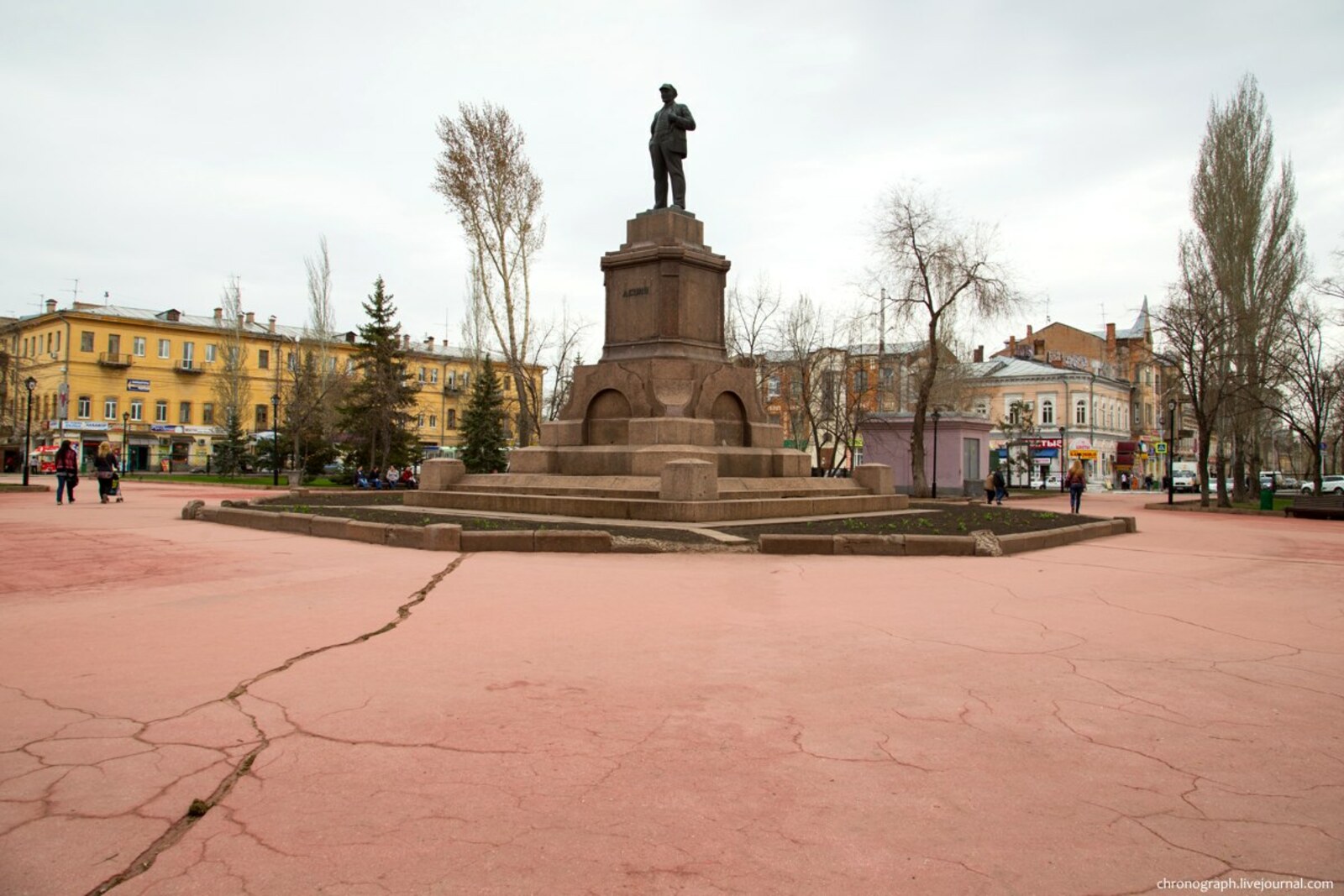
Look around first
What to notice
- Circular park
- Granite pedestal
- Bronze figure
The story of the place
The center of the square is occupied by a circular park, with a stone base standing inside it. The circle is thirty-eight meters in diameter, with flower beds and a fountain laid out around it. Along the sides of the square stood the provincial chancery, the district court, notaries' offices, hotels, and newspaper editorial offices. Earlier, a shopping arcade and market shops stood on this same site.
The granite base in the center of the circular park is older than the bronze figure that now stands on it. It was made for a different monument—to Aleksandr II.
Until the middle of the nineteenth century, this was a place of trade. A shopping arcade stood in the middle of the square, with rows of shops along its sides. Then city officials moved the market to Sennaya Square, and around the newly cleared space they placed an administrative office and the governor's residence, the district court, notaries' offices, hotels, and newspaper editorial offices. The square was then called Alekseyevskaya Square, after Saint Aleksii, whom people considered Samara's heavenly patron.
In March eighteen eighty-one, Aleksandr II was killed by a terrorist's bomb. A few weeks later, the Samara City Duma decided to erect a monument to him. The decision remained only on paper for five years, until Pyotr Alabin took charge of raising the money. Alabin was Samara's elected head and sought to turn Alekseyevskaya Square into a well-planned city center.
For Alabin, it was a personal matter. He linked Samara's rapid growth to the reforms of Aleksandr II, above all to the emancipation of the peasants from serfdom. In addition, by the emperor's order, Alabin received two hundred fifty rubles each year to raise seven children. These payments had begun long before the collection of donations, but the city head's gratitude had a distinctly family-related price.
Alabin published appeals for voluntary contributions in the newspapers and personally monitored the arrival of the money. By the autumn of eighteen eighty-six, residents of the Samara Governorate had collected tens of thousands of rubles. The project was commissioned from the Moscow sculptor Vladimir Sherwood. The emperor stood in a military tunic, leaning on a saber, while four bronze figures stood at the base. A Russian peasant crossed himself after emancipation from serfdom, a Bulgarian woman trampled an Ottoman banner, a Circassian broke a saber, and a Central Asian woman removed her veil. In this way, the commissioners listed the deeds of the reign for which they were raising money.
Before the unveiling, Sherwood asked permission to reproduce the emperor's statue for another provincial city. The Samara deputies refused: the whole governorate had paid for the monument, so the right to decide its appearance belonged to the donors. The sculptor lost a second commission, but Samara received the only copy of the composition.
For the monument, Alabin ordered a circular park, thirty-eight meters in diameter, to be laid out, with flower beds and a fountain. On August thirtieth, eighteen eighty-nine, Samara's first monument was unveiled here.
The bronze Aleksandr and the four figures at the base are no longer here. What remains is the circular park and the granite pedestal—the very one whose right of ownership the Samara deputies disputed with the sculptor Sherwood.
Useful on site
Open urban space, accessible around the clock.
Checked: June 24, 2026. Check the official source before visiting.The square is freely accessible. Walk around the monument and look not only at the sculpture, but also at the old stone base.