 Guide On Map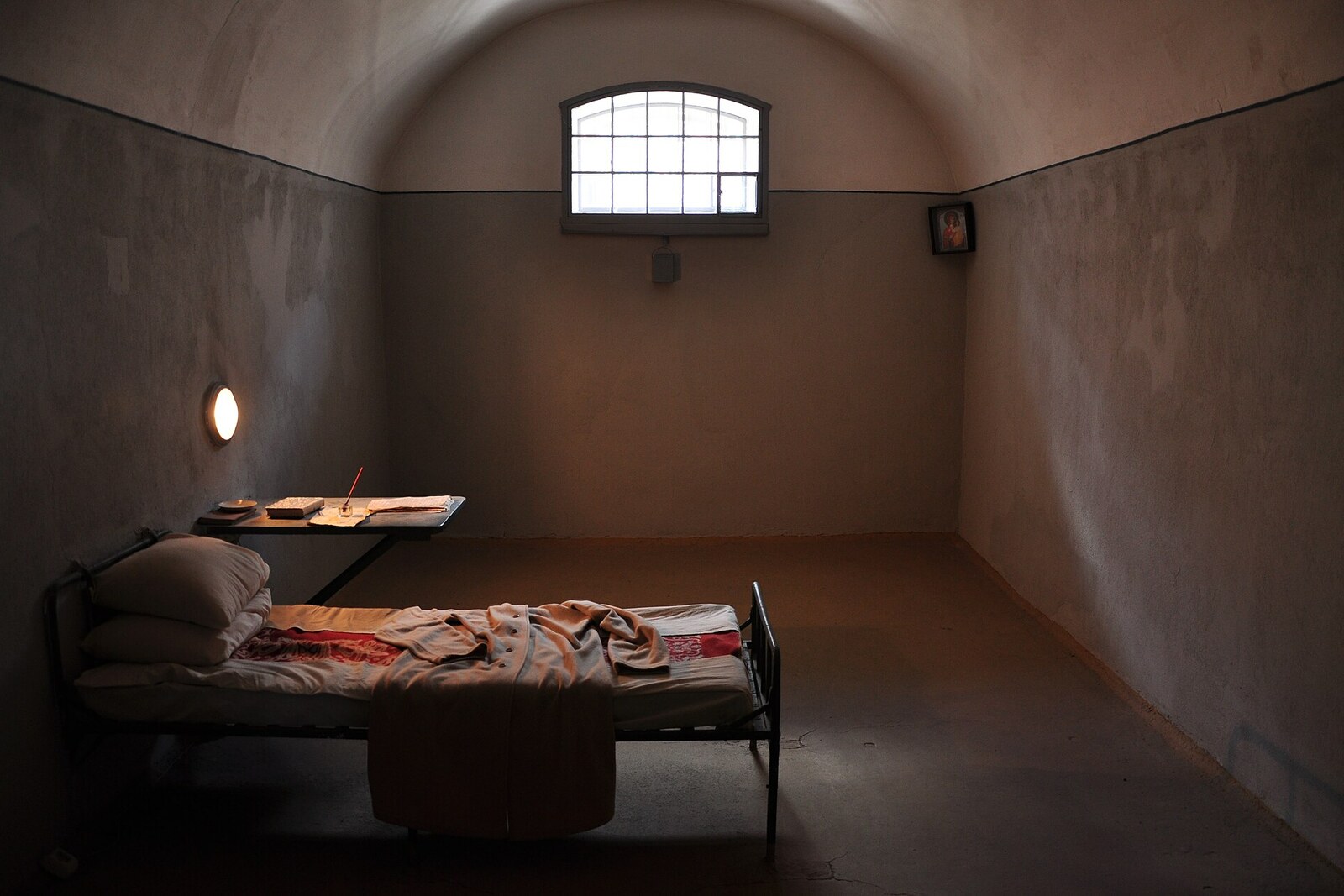
Look around first
What to notice
- The pentagonal prison building
- Solitary cells
- Doors with food hatches
- Guard observation flaps
The story of the place
Behind the walls of Trubetskoy Bastion, a five-sided building survives, set up where the fortress's inner fortifications once ran. People accused in political cases were brought here even before trial; sixty-nine cells were meant to keep them apart, preventing them from exchanging testimony or warning their comrades. In the museum corridors, doors with food hatches and flaps above them remain, through which a guard watched each person held in solitary confinement.
On February eighth, eighteen ninety-seven, a gendarme brought a kerosene lamp into a solitary cell. It was allotted to the prisoner for the evening. Twenty-seven-year-old Maria Vetrova waited until the attendant had left, poured kerosene over herself, and set her clothes on fire. Four days later, she died in the prison hospital.
Before her arrest, Vetrova had earned her living as a teacher at a girls' school for four years. She then left her post, enrolled in the Bestuzhev Higher Courses for Women in Saint Petersburg, and taught workers to read and write for free at a Sunday school. At the same time, she joined an underground group of People's Will members that distributed prohibited publications. After an illegal printing press in Lakhta was crushed, Vetrova was arrested: a suitcase containing such literature was kept with her. The investigators wanted the names of the group's members. During interrogations, she denied her guilt and named no one.
On January twenty-third, Vetrova was transferred here. The prison was built inside Trubetskoy Bastion in eighteen seventy through eighteen seventy-two as a remand prison for people accused of political crimes. Most had not yet received a sentence. Sixty-nine solitary cells made it possible to keep those under investigation apart so that they could not coordinate their testimony or warn their comrades. Behind a door with a food hatch was one person; above the hatch was a flap through which a guard watched that person. Guards were forbidden to speak with prisoners.
Vetrova asked to be returned to the House of Preliminary Detention, where she had been held before her transfer to the fortress. Her request was refused. A few days before her death, a guard informed the authorities that the prisoner had changed sharply; the prison doctor examined her, but she was not taken out of the solitary cell. On the evening of February eighth, the guards opened the door only after Vetrova had caught fire.
Her friends at the Bestuzhev Courses learned of her death. On March fourth, several thousand students and women attending the courses came to Kazan Cathedral for a memorial service. When they were not permitted to hold it, those gathered went out into the street with wreaths, singing “Eternal Memory.” Such demonstrations were repeated for several years afterward and came to be known as the Vetrova demonstrations.
Trubetskoy in the prison's name is not the surname of a prisoner, but of Prince Yuri Trubetskoy, who oversaw the construction of this section of the fortress in seventeen oh three. Later, the bastion's inner walls were dismantled, and a pentagonal prison building was placed in their stead. Its authentic cells, doors, and corridors are now part of the museum display. Kerosene lamps disappeared from here immediately after Maria Vetrova's death: they were replaced with candles, and electricity was installed in the cells in nineteen oh four.
Useful on site
Daily 10:00–19:00, no days off; ticket office until 18:30. In 2026, a separate ticket: 500 ₽ adult, 400 ₽ pupil or student at a Russian university, 400 ₽ Russian pensioner.
Checked: June 24, 2026. Check the official source before visiting.Admission to the museum prison is arranged separately. Inside, speak quietly and do not block the passage; if the building is closed, finish the account at its exterior facade.