 Guide On Map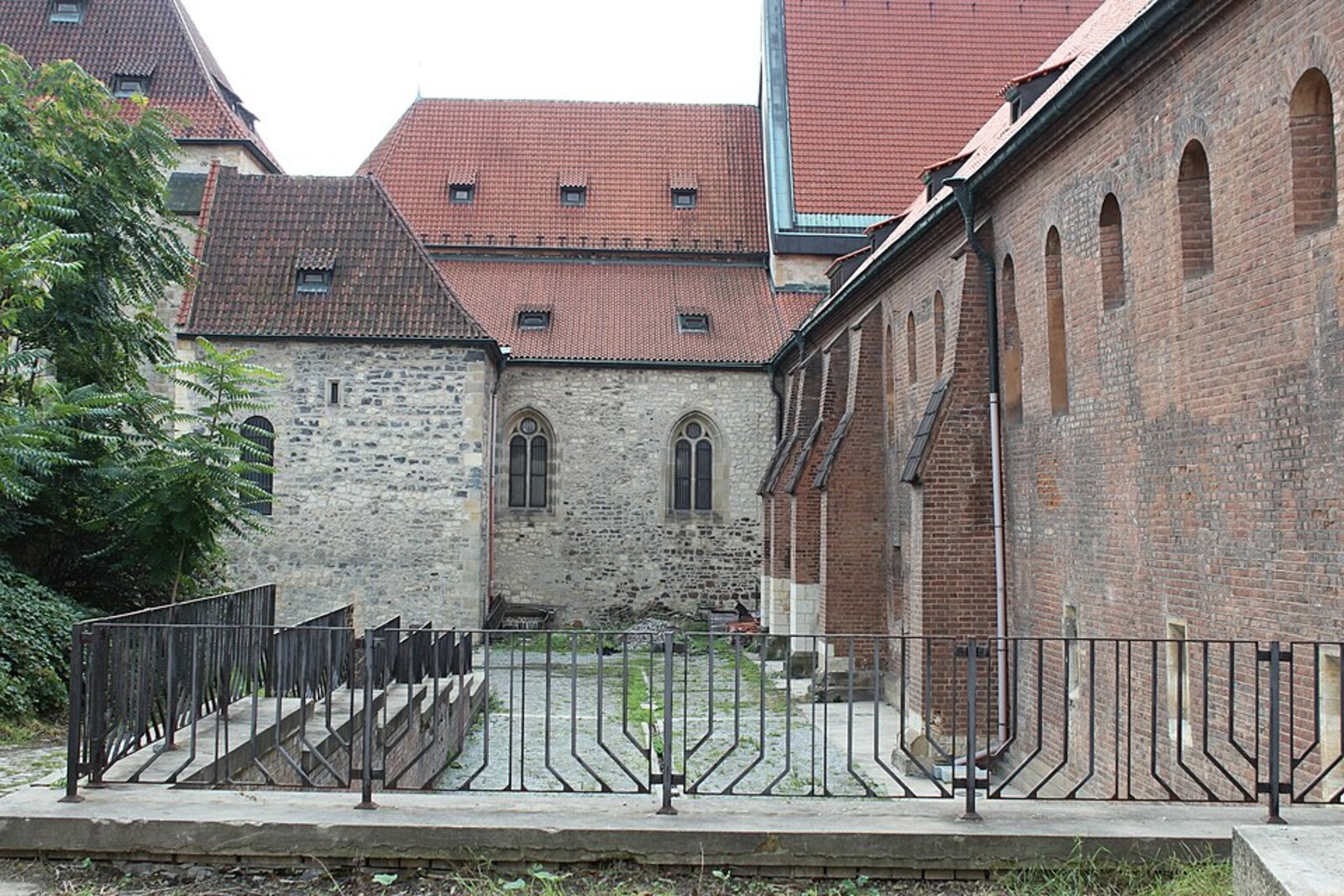
Look around first
What to notice
- Sisters’ refectory
- Convent kitchen
- Franciscans’ covered gallery
- Chapel of the Virgin Mary
The story of the place
By the Vltava, part of a medieval complex survives, with a women’s convent, a church, a hospital for the sick, and quarters for Franciscan brothers. The sisters’ refectory, the convent kitchen, and fragments of the covered gallery are visible; the hospital wing has been lost. These halls now contain the medieval-art collection of National Gallery Prague.
In May twelve thirty-five, Pope Gregory IX ordered that the women’s community behind these walls be given a hospital with all its income. For a medieval convent, such a grant meant a secure supply of food, land, and money. The abbess Agnes of Bohemia began seeking the repeal of the pope’s decision.
Agnes was the daughter of the Czech king Přemysl Otakar I. As a child, her relatives included her several times in negotiations over dynastic marriages; her final prospective husband was Emperor Frederick II. Agnes received the pope’s permission to refuse the marriage and directed her dowry toward construction here, by the Vltava. On land given by her brother, King Wenceslaus I, a hospital for the poor and sick, the Church of St Francis, a women’s convent, and quarters for Franciscan brothers were built.
In twelve thirty-four, Agnes entered the convent she had founded and became its abbess. The women’s community followed the example of Clare of Assisi, the leader of sisters who had decided to live without personal or communal property. They later came to be called the Poor Clares.
Agnes separated the two institutions in advance. The hospital received land and a regular income: the sick had to be fed every day. She left the convent with nothing. The sisters were enclosed, could not go through the city themselves to collect alms, and depended on donations from Prague residents and help from the Franciscans. Agnes founded the hospital, but she could not personally make the rounds of its wards. Laypeople and the brothers cared for the sick; the Czech Knights of the Cross with the Red Star later grew out of this brotherhood.
Gregory IX considered the arrangement too risky. If donations stopped, the church would have to support the starving nuns. That was why he attached the hospital’s income to the convent. For Agnes, this destroyed the way of life she had chosen: poverty here was a binding rule, not a temporary lack of money.
She wrote to Clare of Assisi. Agnes’s own letters have been lost, but four replies from Clare survive. Clare advised her not to yield and to seek influential intermediaries. Agnes then enlisted her brother Wenceslaus I. The Czech king appealed to the pope, and at that moment Gregory needed his support in the conflict with Emperor Frederick II. In twelve thirty-eight, the pope granted the Prague sisters the “Privilege of Poverty”—the official right not to accept land or regular support. The hospital retained its separate economic base, and the convent continued to live on gifts.
Agnes remained here until her death in twelve eighty-two. The complex bears the name of its founder; the Catholic Church canonized her only in nineteen eighty-nine. Today, the surviving rooms house the medieval-art collection of National Gallery Prague. The sisters’ refectory, the kitchen, and parts of the Franciscans’ covered gallery survive. The hospital building has disappeared.
Agnes was buried in the convent’s Chapel of the Virgin Mary. According to a later tradition, before the Hussite Wars the sisters moved her remains to a hiding place. Exactly where is unknown. Archaeologists found the tomb intended for Agnes empty.
Useful on site
Museum Tue–Sun 10:00-18:00, Mon closed; the garden has seasonal hours.
Checked: June 26, 2026. Check the official source before visiting.The complex is associated with a museum visit, but its spatial character can also be felt in the courtyards. Keep quiet and do not hurry across the passages with uneven paving.