 Guide On Map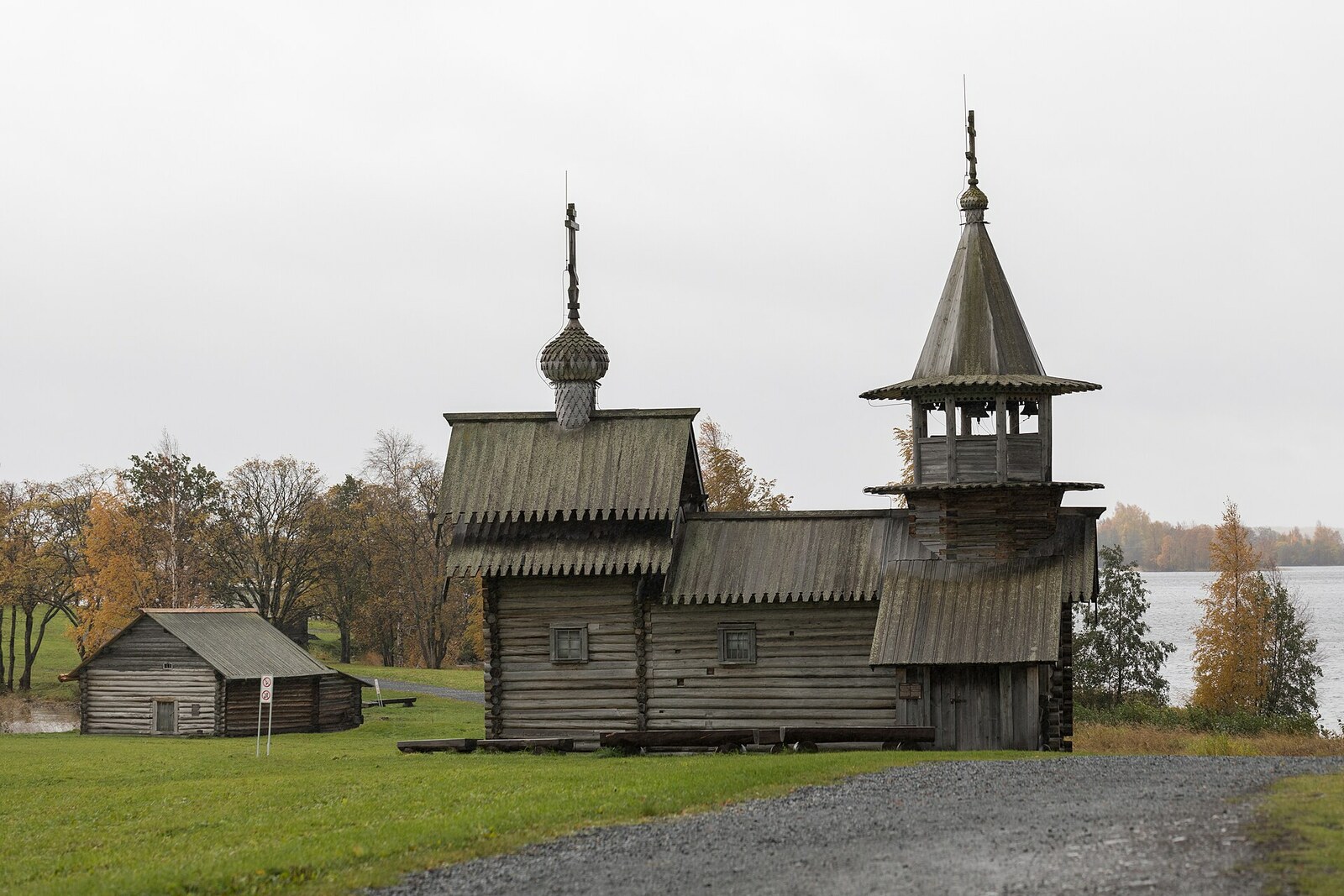
Look around first
What to notice
- The iconostasis
- The icon of Mikhail, Archangel, on a white horse
- The inscription on the icon’s lower margin
The story of the place
This small wooden log structure does not stand here on its native lakeshore: it was brought from Lelikozero and assembled on Kizhi Island, thirty-two kilometers from the former village. Inside, the iconostasis with an image of Mikhail, Archangel, on a white horse occupies the main wall. Such chapels served the neighbors as houses of prayer when the parish church was far away and there was no resident priest. Here they read the Book of Hours and held prayer services and funeral rites, but without an altar they did not hold liturgies or wedding ceremonies.
In sixteen seventy-one, the village of Lelikozero had not yet appeared in the surviving documents. Seven years later, scribes would call it a “new settlement”—a recently founded village. But on May second, sixteen seventy-one, a patronal icon had already been painted for the local chapel. Its lower margin states that the commission was made by Timofei Larionov, with his brothers and neighbors.
Larionov’s position is not named in the inscription. He speaks on behalf of residents who needed their own place for communal prayer. In northern settlements, the parish church could be far away, and there was no resident priest at the chapel. The residents chose an elder, gave him the key, gathered before the iconostasis on Sundays and feast days, and read the Book of Hours. A priest came on special days. There was no altar here, so no liturgy or wedding ceremony was performed; the chapel hosted prayer services, funeral rites, and the neighbors’ everyday prayers.
The icon commissioned by Larionov explains the chapel’s dedication. Mikhail, Archangel, is the leader of the heavenly host. Here he is depicted as a red-faced rider on a white horse with red wings. He holds a cross and a spear; Satan lies defeated below, and sixteen scenes of Mikhail’s deeds are arranged around him. For the people of Lelikozero, Mikhail was the heavenly protector of the new community. November twenty-first, the day of his veneration, became the village’s patronal feast day.
The icon gave researchers rare precision: it made it possible to establish that the oldest part of the log structure already existed in sixteen seventy-one. The carpenters’ names have not survived, but the patron and his neighbors left the date right inside the house of prayer they built.
In nineteen sixty-one, museum conservators dismantled the chapel in Lelikozero, transported it to Kizhi Island, and reassembled it. It now stands thirty-two kilometers from the former village. No one documented the exact arrangement of the old interior before dismantling, so museum staff later reconstructed it by analogy with other Zaonezhye chapels. The patronal icon was returned to its original place in the lower row of the iconostasis. On the image transferred to Kizhi Island, Timofei Larionov, his brothers, and his neighbors are still named—the people thanks to whom the new village gained the Chapel of Archangel Mikhail.
Useful on site
The museum grounds are open year-round: 01.11–30.04 10:00–16:00; 01.05–11.05 10:00–18:00; 12.05–31.08 08:00–19:00; 01.09–30.09 10:00–17:00; 01.10–31.10 10:00–16:00. Exterior viewing is available during the grounds’ opening hours; access to the interior and viewing of the iconographic “heaven” depend on the program, the condition of the structure, and museum authorization.
Checked: June 24, 2026. Check the official source before visiting.The iconostasis and the “heaven” are visible only when the interior is accessible. Move carefully inside, and do not touch the walls, tyabla, or paintings.