 Guide On Map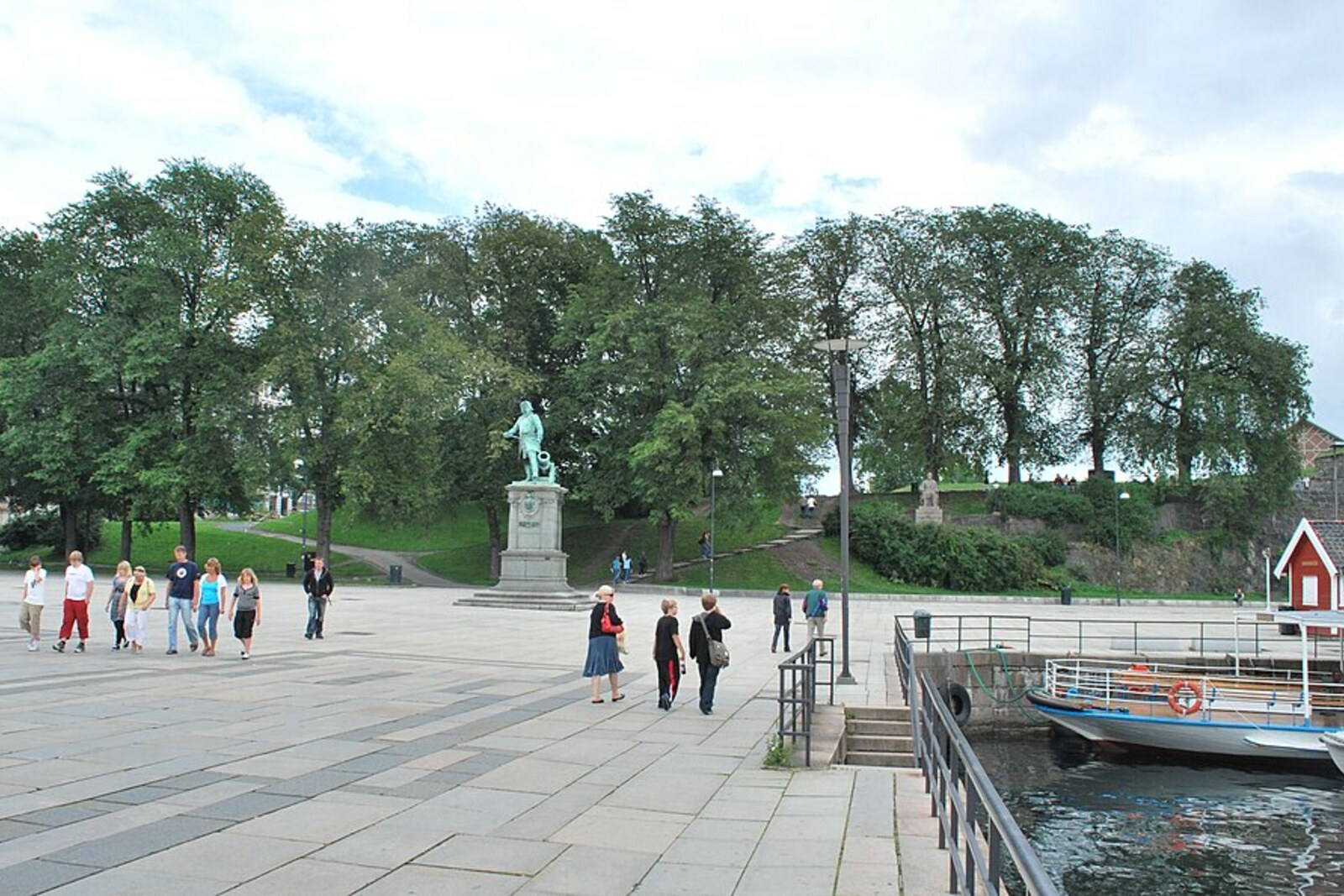
Look around first
What to notice
- City Hall façade
- Honnørbrygga
- The pier’s side stairways
The story of the place
In front of the City Hall façade, a broad space opens toward the fjord, left for civic ceremonies and large gatherings. The building’s axis continues to a small pier between two long piers. Its side stairways receive boats, and official guests of Oslo still arrive here by water. So the square connects City Hall with the harbor not only visually, but also through its purpose.
A straight line runs from the middle of Oslo City Hall toward the fjord. It ends at a small pier between two long city piers. This is Honnørbrygga—the ceremonial landing pier. The side stairways are for disembarking from boats, and the place itself is intended for official receptions of those arriving in Oslo by sea. The name Rådhusplassen literally translates as City Hall Square. The open space between City Hall and the pier was left for civic ceremonies and large gatherings.
Construction of the present Honnørbrygga began in nineteen thirty-six together with the new City Hall complex. It was ready by the beginning of the summer of nineteen forty. But on April ninth, German troops occupied Oslo.
Norwegian King Haakon VII tried to preserve the country’s legitimate government. The occupiers demanded that he dismiss the sitting cabinet and appoint Vidkun Quisling as prime minister—a Norwegian politician who hoped to lead the country with the occupiers’ support. This required the king’s consent: his signature would give the new cabinet an appearance of legitimacy.
Haakon lived by his constitutional role. He received the Norwegian crown after the union with Sweden was dissolved, and he believed it was his duty to rule through a government trusted by the elected parliament. At a meeting of ministers, the king stated that he would abdicate rather than appoint Quisling. What he was risking was precisely the crown and, if captured, the ability to act independently. The ministers supported his refusal. The next day, German aircraft bombed Nybergsund, where the king and cabinet were staying.
When it became impossible to continue military operations in Norway itself, Haakon, the crown prince, and the government left for the United Kingdom. They departed the country on June seventh, nineteen forty. In London, the cabinet directed Norwegian forces and the merchant fleet, while the king addressed his compatriots by radio. He explained his flight simply: if they had remained, they would have become prisoners and could no longer represent a free Norway.
Five years later, Haakon was returning with the same thought and a heavy doubt. His granddaughter, Princess Astrid, who was sailing with him, recalled that her grandfather did not know how he would be received. He believed that many Norwegians had died after his refusal, and he feared that people would blame him for it.
On June seventh, nineteen forty-five, the British cruiser HMS Norfolk entered the Oslofjord. As it approached the city, boats decorated with flags gathered around it. At Honnørbrygga, Haakon was met by Crown Prince Olav, already returned to the country, and by people who filled the waterfront and the square.
After disembarking, the king spoke here, at Rådhusplassen. He recalled why he had agreed to exile exactly five years earlier: in captivity, he would have kept his title but lost the ability to perform the duties of king. The date of his return carried another meaning as well. On June seventh, nineteen five, the Norwegian parliament dissolved the union with Sweden; after that, Haakon received the Norwegian crown. Now his departure and return fell on the same date.
Those gathered accepted him, and Haakon did not abdicate: he performed the duties of king until nineteen fifty-seven. Honnørbrygga still lies exactly on the axis of Oslo City Hall, with the same side stairways. Official guests arriving in Oslo by water are still received here.
Useful on site
The square is always open; the interiors of Oslo City Hall are usually accessible daily 09:00–16:00, but parts of the building may close because of events and security checks.
Checked: June 15, 2026. Check the official source before visiting.The main proportions are easy to read from outside. See the interiors and murals only when entry is available; do not tie completion of the whole route to it.