 Guide On Map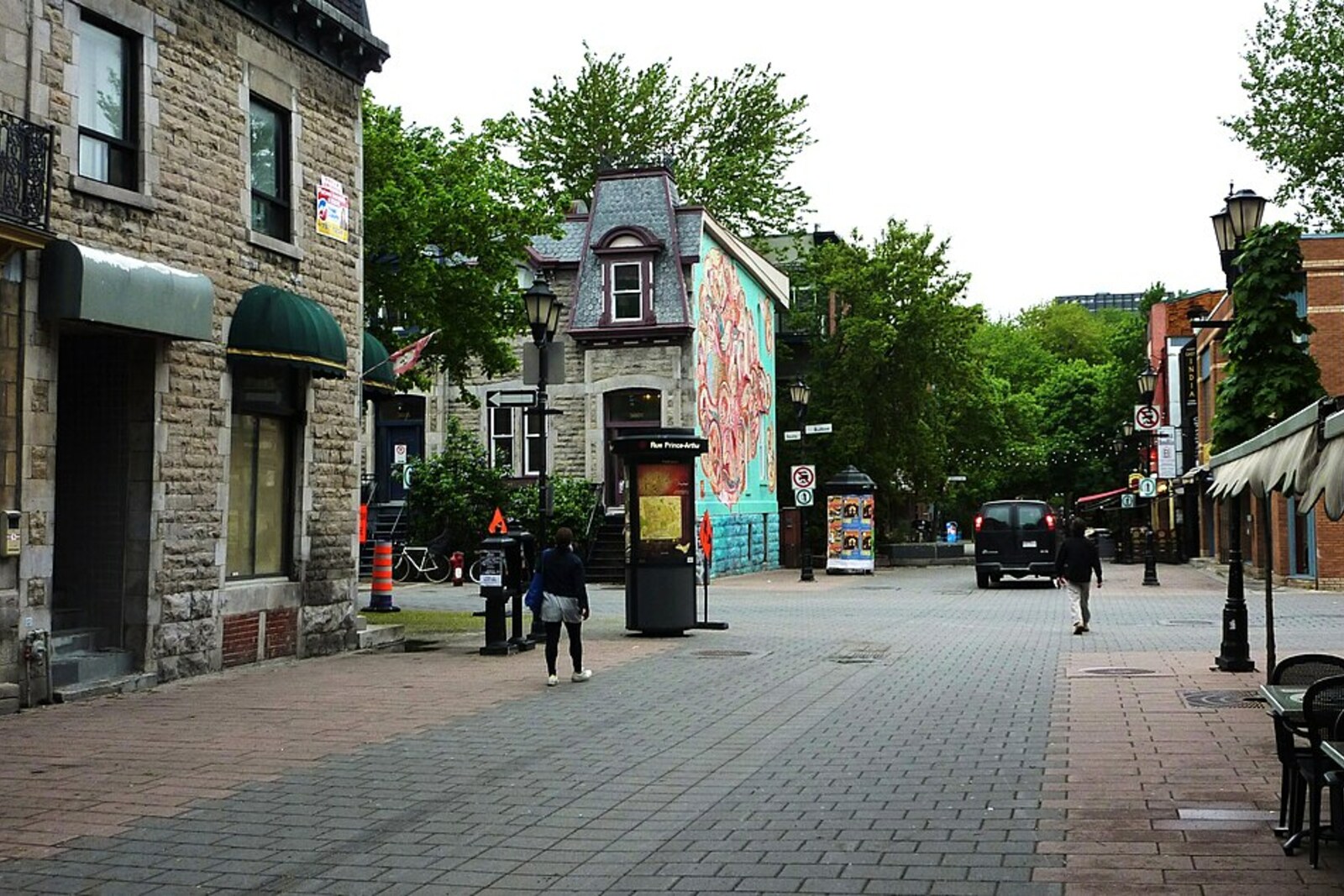
Look around first
What to notice
- Terraces in the middle of the street
- Pedestrian roadway
- Shop façades
- Restaurant façades
The story of the place
The short stretch of Prince-Arthur Street is closed to cars: a pedestrian roadway runs between the façades of small restaurants and shops, while terraces occupy the middle of the street. It was named after Prince Arthur, Queen Victoria’s third son, who served in Montreal as an officer; different parts of the street were previously called Baggs Street and Courville Street. Restaurant guests sit on the terraces, while passersby walk along the roadway between the establishments.
In nineteen seventy, the merchant Larry Duprey opened one of Montreal’s first hippie shops here: Live from Earth. It sold leather jackets, hand-dyed T-shirts, secondhand clothes, and smoking supplies. Duprey hoped to live off these sales, although he had chosen a risky location. According to his recollections, premises on the block between De Bullion Street and Coloniale Avenue stood empty, while Chinese laundries and Jewish tailors’ workshops remained among the older businesses. He considered his own shop roughly the third new store on an almost stagnant street.
Customers came nonetheless. Secondhand-clothing and leather-goods shops opened after Live from Earth, followed by restaurants; one of the first was the Greek Demos. By nineteen seventy-four, the façade of Duprey’s shop, with its homemade sign, was already being photographed for a guidebook to Montreal nightlife and the underground scene. Students, artists, and owners of small businesses created here what they themselves called a village: several blocks where people could buy clothes, magazines, and music from people in the same circle.
In the late seventies, the city executive committee tasked planners with finding a street for a permanent pedestrian zone. They chose Prince-Arthur Street precisely because merchants had already drawn visitors here. The local business association initially supported the idea. For two years, officials tested removable barriers and examined what would happen to traffic, parking, and the safety of neighboring homes. From nineteen seventy-nine onward, cars were no longer allowed onto this stretch, and in nineteen eighty-two a permanent pedestrian street opened, intended chiefly for restaurants and tourists.
Duprey did not like the result. In a nineteen ninety-nine interview, he called the traffic closure a mistake: the mix of workshops, shops, and cars from which his village had grown disappeared. By then, he himself was selling hemp goods on du Parc Avenue. The entrepreneur brought people here, and then the circle of establishments he had created was set in stone and regulations without him.
The prince in the name had nothing to do with this story. Prince Arthur, Queen Victoria’s third son and the future Duke of Connaught, arrived in Montreal as a nineteen-year-old officer in August eighteen sixty-nine to join the 1st Battalion, Rifle Brigade. On September eighth, eighteen ninety, city officials gave his name to a street whose sections had previously been called Baggs Street and Courville Street. Arthur later returned to Canada as governor general.
The Live from Earth sign is no longer here. The block itself remains, between De Bullion Street and Coloniale Avenue and closed to cars, while after the nineteen seventeen reconstruction, spaces for restaurant terraces were arranged in the middle of the street—where the roadway ran in the days of Duprey’s shop.
Useful on site
The city page does not list separate hours; this is an open pedestrian street, and business hours vary by establishment.
Checked: June 30, 2026. Check the official source before visiting.This is a working street, not a museum set: do not obstruct visitors or establishment staff. You do not need to go inside for the story.