 Guide On Map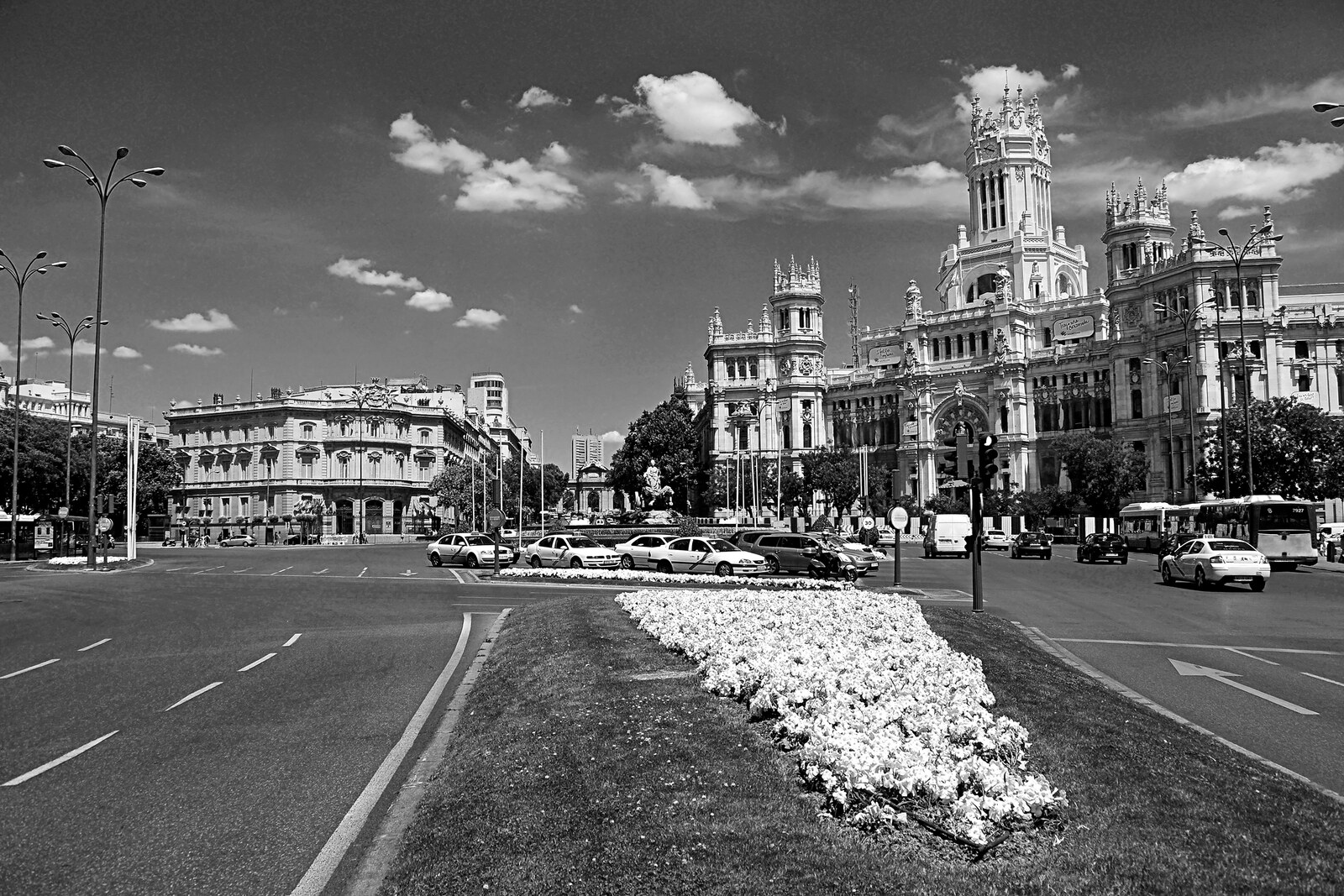
Look around first
What to notice
- Façade of the former Palace of Communications
- Small pockmarks in the façade stone
- Cibeles Fountain
- Lions beside the chariot
The story of the place
In the middle of the broad intersection stands a stone chariot: a goddess wearing a crown of city walls holds keys and a scepter, while harnessed lions pull her forward. The square took its name from this figure, although it previously bore the names of the city itself and Castelar. The fountain was first located by Buenavista Palace, and by the end of the nineteenth century it had been moved here and turned toward Calle de Alcalá. The lions are called Atalanta and Hippomenes; an ancient myth made them the goddess's eternal companions.
The white palace with towers, occupying the eastern side of the square, now serves as Madrid City Council. In nineteen thirty-nine, it was the Palace of Communications: the country's main post office, telegraph office, and telephone exchange. Nearby stood the Bank of Spain and the Ministry of War and Ministry of the Navy. This proximity turned the square and fountain into one of the city's most important hubs—and into a battlefield when the opponents were no longer fighting for Madrid, but against one another.
At the beginning of March, the Spanish Civil War was in its third year. Francisco Franco's troops controlled most of Spain and surrounded the capital, which the Spanish Republic still held. The head of government, Juan Negrín, wanted to continue the resistance, refusing to agree to end it without guarantees. Segismundo Casado, a career officer and commander of the republican Army of the Centre, considered the war lost. He hoped to remove Negrín and negotiate acceptable terms of surrender with Franco.
On March fifth, Casado announced the creation of the National Defence Council—a temporary body meant to replace the government and end the war. Units subordinate to him occupied the Palace of Communications, the Bank of Spain, and the neighboring ministries. For Casado, this was a military mutiny within a war that was already being lost: in defeat, he would lose both his command and the opportunity to conduct the negotiations himself.
Negrín's supporters struck back. On March eighth, units led by communist commanders moved toward the square from the north and along Calle de Alcalá. The guns of Casado's supporters stood right beside Cybele. The advancing forces captured the Palace of Communications for several hours, but their opponents held on in the neighboring buildings. The postal halls and telegraph equipment were needed by both sides for the same reason the building had been erected here: whoever controlled communications could issue orders to the rest of Madrid.
The outcome was decided by Cipriano Mera—a former bricklayer who became commander of the Fourth Army Corps. He, too, wanted to end the resistance and supported Casado. Mera withdrew units from the Guadalajara sector of the front and sent them to the capital. By March twelfth, the government's supporters had laid down their arms.
Casado gained the city, but not the terms for which he had raised the mutiny. Franco demanded unconditional surrender. On March twenty-eighth, Madrid was surrendered; two days later, Casado left Spain aboard a British warship. Mera also went into exile and later again earned his living as a bricklayer in Paris. Small pockmarks from the gunfire of those March days remain on the white façade of the former Palace of Communications.
No one saw the goddess herself during the battle. After damage from bombardments, municipal specialists enclosed the fountain in a brick shell and sandbags. This protection stood in the middle of the square until the end of the war. The stone group was then uncovered, cleaned, and restored.
The square received its current name precisely from the fountain. It was first called Plaza de Madrid, then Plaza de Castelar. The fountain once stood by Buenavista Palace and was moved to the center of the intersection and turned toward Calle de Alcalá only at the end of the nineteenth century.
Cibeles is the Spanish form of the name Cybele, the ancient Phrygian mother goddess and patron of the earth and fertility. On her head is a crown in the shape of city walls; in her hands are a scepter and keys. The two lions are called Atalanta and Hippomenes.
According to the myth, Atalanta agreed to marry only the man who defeated her in a race. Hippomenes received three golden apples from Aphrodite and threw them in front of his opponent; Atalanta stopped to pick up the apples and lost. Later, the lovers defiled Cybele's sanctuary, and the enraged goddess turned them into lions, forever harnessed to her chariot. This is an ancient myth, not a Madrid event.
The white pockmarks remain on the former Palace of Communications; below them, Cybele holds the keys, and Atalanta and Hippomenes pull her stone chariot.
Useful on site
The square and fountain are accessible around the clock; during holidays, parades, Real Madrid match celebrations, and work on Calle de Alcalá, access to certain viewpoints may be restricted.
Checked: June 27, 2026. Check the official source before visiting.View the fountain from the sidewalks around the perimeter of the square: heavy traffic leaves no reason to approach it across the roadway.