 Guide On Map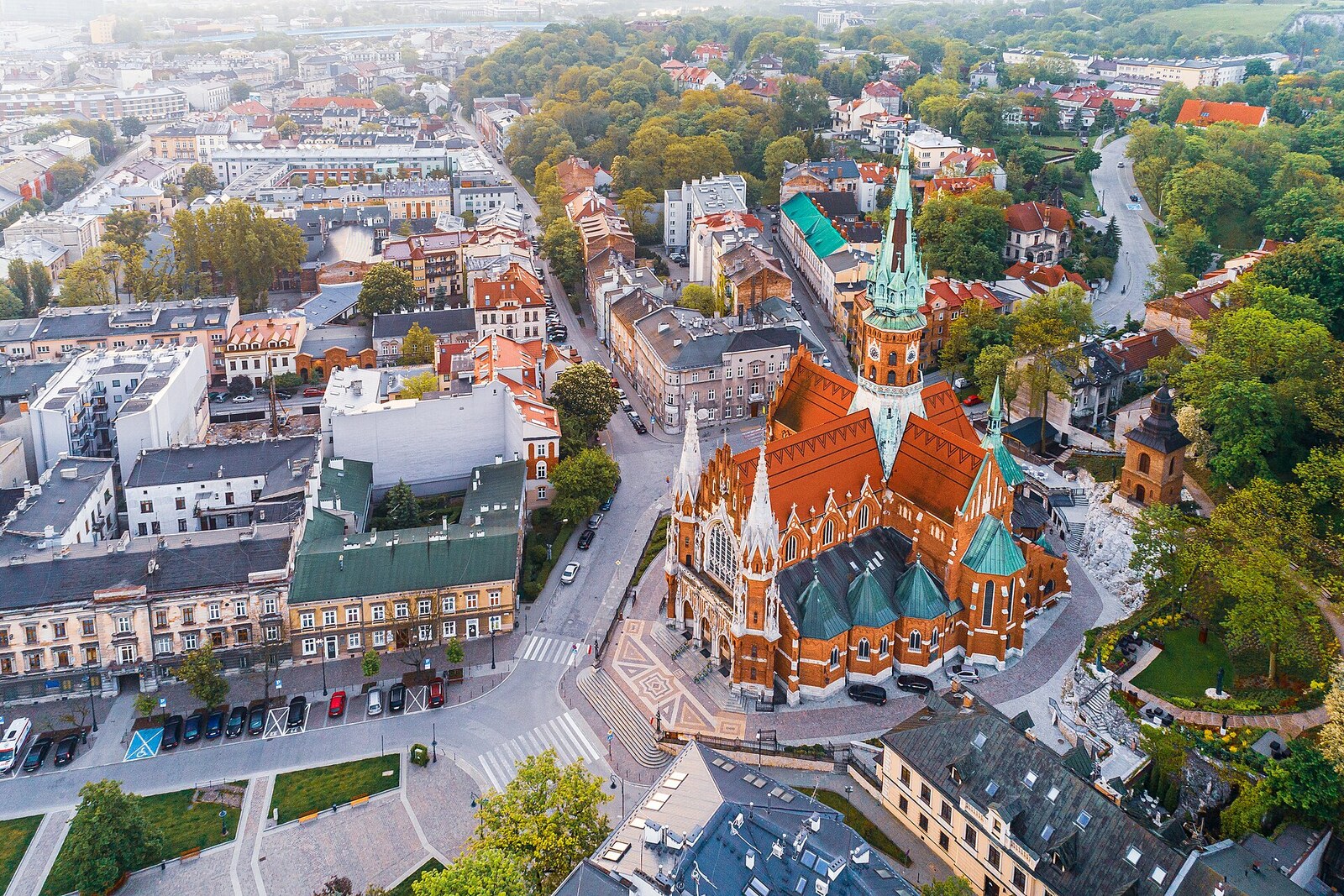
Look around first
What to notice
- Tall central tower
- Inscription above the entrance
- Brick bell tower behind the church
The story of the place
Masses are now held in the church for the Podgórze parish, and its sanctuary status connects it with Joseph, the patron of families. The central tower rises above the roof; its top echoes the features of the tower of St. Mary's Church across the Vistula River. Only the freestanding brick bell tower, built in eighteen seventy-nine, survives from the former church.
Architect Jan Sas-Zubrzycki prepared the design of the tall tower before you for Warsaw. He entered the competition for the Church of the Holiest Saviour, won second prize, and the design remained on paper. In Krakow, the drawings were exhibited at the Palace of Art, where Antoni Gruszecki saw them—parish priest of the Podgórze parish, who needed to replace the unsafe old church.
The first church had stood on this site since eighteen thirty-two. The builders had made serious mistakes: the vaults cracked, the walls threatened to collapse, and the building itself could no longer hold the parish. As early as eighteen ninety-two, the building committee selected a modest design with one tower, but there was not enough money even for that.
Gruszecki suggested that Sas-Zubrzycki bring here the design that had not been used in Warsaw. The estimate was almost three times the amount that had been raised. The architect simplified some of the solutions, Podgórze's city council took out a loan and undertook to pay the interest, and the residents of the town itself and the surrounding villages agreed to contribute to the costs. The parish priest risked leaving a large parish without a permanent church: in nineteen oh five, the old church was dismantled, and until construction was completed, Masses were held in the chapel at the priest's house.
After four years and eight months, the parishioners received a building that was consecrated in October nineteen oh nine. The Warsaw competition design became the main church of Podgórze, which was still independent at the time. Sas-Zubrzycki retained the tall central tower and gave its top features of the tower of St. Mary's Church on the opposite bank of the Vistula River. Gruszecki achieved exactly the scale that the earlier committee had rejected because of the lack of funds.
Joseph in the church's name is Mary's husband in the Gospels, who took upon himself the care of her and the infant Jesus. The present church inherited this dedication from its predecessor. In the main altar stands a figure of the saint carved in nineteen oh nine, and the church itself remains an active parish and bears the status of St. Joseph's Church sanctuary—Joseph being the patron of families.
Behind the present building, a separate brick bell tower from eighteen seventy-nine has survived—the only intact part of the former church. Above the entrance to the new church are carved the words: “Support it, do not let it fall.” For a church built to replace a cracked one, this is a literal inscription.
Useful on site
Accessible outside at all times; interior access depends on services, the parish schedule, and events.
Checked: June 26, 2026. Check the official source before visiting.The main architectural story can be understood from the square. If the church is open, enter quietly and do not disturb the service; it is better to regard viewing the interior as a separate opportunity, not a required part of the route.