 Guide On Map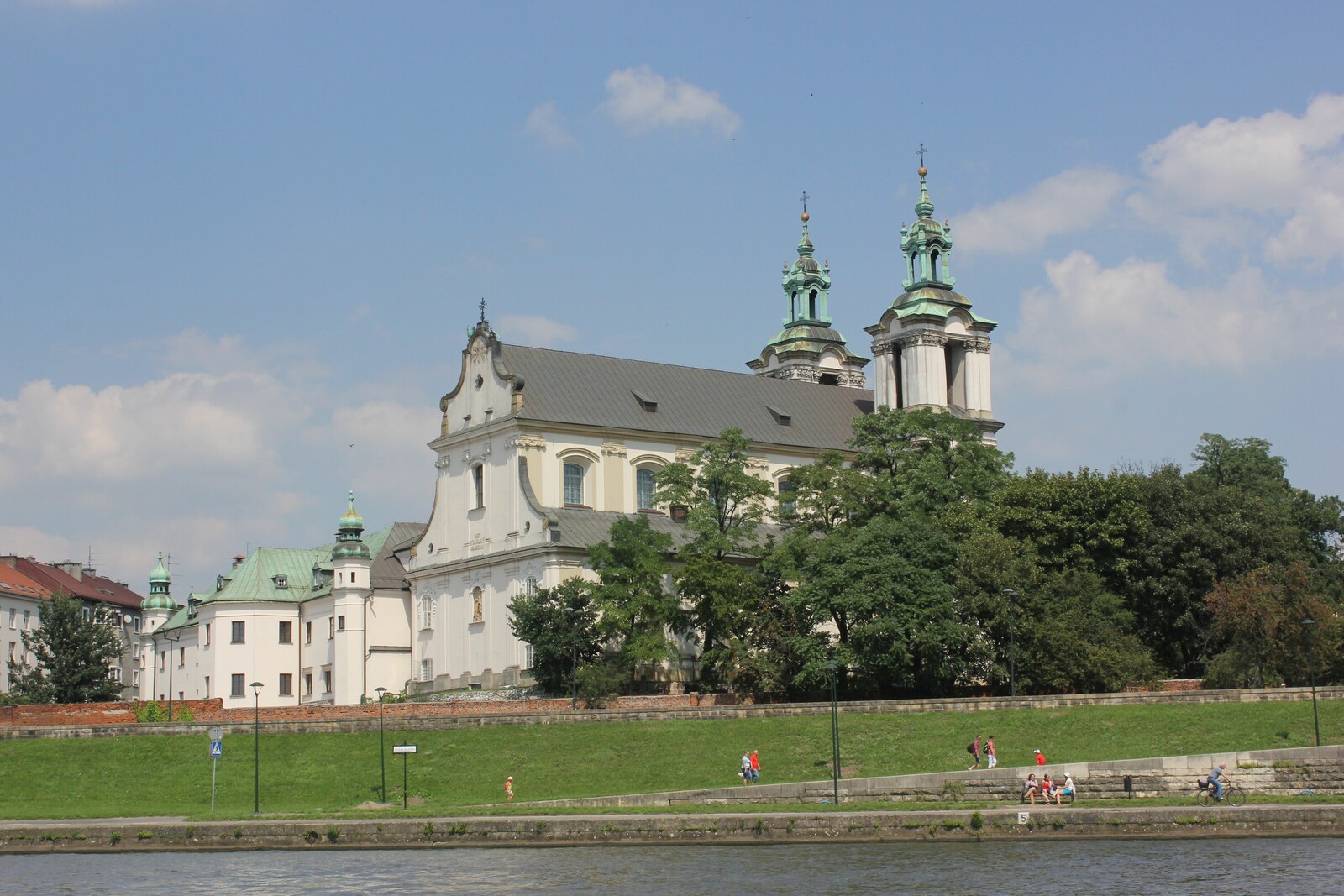
Look around first
What to notice
- The Baroque façade of the basilica
- The stairway to the church
- Stone fragments behind glass
The story of the place
The staircase leads to the Baroque façade of the basilica, built on a limestone outcrop by the Vistula River, from which Skałka took its name. The Church of St. Michael the Archangel once stood here; the medieval building was completely dismantled, and the present church was later built in its place. In a side chapel, behind glass, lie several stones that tradition attributes to the altar steps of that former church.
Every May, a procession bearing the reliquary of St. Stanisław comes here from Wawel Cathedral. The route is unusual: his remains leave their tomb and return to the place where the bishop was killed. This joins two points in Krakow in one story—the grave at Wawel and Skałka.
The name “Skałka” means a small rock. Once, a limestone rise stood here above the low bank of the Vistula River, and the Church of St. Michael the Archangel stood on it. That is where the present basilica got its first name. The second—St. Stanisław, bishop and martyr—appeared after the killing that tradition links to this church.
In ten seventy-nine, two men who had once acted together turned against each other. Bolesław II the Generous had already ruled for two decades and had worn the royal crown for only three years. He had secured it after a long break in Polish coronations and risked losing the achievement of his entire reign. Stanisław had held the Krakow bishopric for seven years, having received it with Bolesław's own consent. The see came with lands, revenues, clergy, and a place beside the monarch: a charge of treason threatened the bishop's rank, the upkeep of his court, and his life.
The reason for the break has not been established. The account closest in time was left by the chronicler Gallus Anonymus about forty years after the events. He deliberately declined to give the details, but called Stanisław a traitor and condemned the king at the same time: according to him, Bolesław added one sin to another by ordering the bishop's body parts cut off as punishment for treason. Historians still dispute whether Stanisław took part in a conspiracy of nobles, defended people punished by the king, or whether the clash had another cause. All that can be said with confidence is that Bolesław regarded the bishop as a traitor and ordered that he be killed.
The scene at the altar is known from a later account by Wincenty Kadłubek, written more than a century afterward. According to tradition, the royal servants did not dare attack Stanisław during Mass, and Bolesław himself entered the Church of St. Michael and dealt him a fatal blow. The bishop's body was then cut up and scattered. It is Skałka that Kadłubek names as the place of the killing; the chronicle closest to the events names no location. Thus, Stanisław's death on the king's orders is a historical event, while Bolesław's personal blow at this altar is church tradition.
The killing did not save the crown. Bolesław's opponents rose in revolt, and in the same year he fled to Hungary. His younger brother Władysław I Herman took the Polish throne, and the deposed king died in exile two or three years later. Stanisław was first buried here; later, his remains were moved to Wawel Cathedral. In twelve fifty-three, Pope Innocent IV declared him a saint.
By then, a legend had arisen that four eagles guarded the scattered remains until the body parts were miraculously joined together. When the Polish lands were divided among princes, the legend came to be retold as a promise of their future reunification. Skałka became a shrine, and future kings came here from Wawel in a penitential procession before their coronation—along a route linking the new monarch to the killing after which his predecessor lost the crown.
The present Baroque basilica was built much later; the medieval church was dismantled to its foundations. In a side chapel, stone fragments that tradition considers to be the steps of the old altar are displayed behind glass. What has endured more reliably is the spatial connection itself: St. Stanisław's relics are at Wawel, but once a year they are still carried back to limestone Skałka.
Useful on site
The church is usually open for prayer during the day; the crypt and monastery tours operate on a separate schedule, mainly on weekends. Check the monastery website for the tour schedule and payment before visiting; part of the route uses stairs.
Checked: June 29, 2026. Check the official source before visiting.Keep quiet inside and do not disturb services. Consider visiting the crypt separately: access to it may differ from access to the church.