 Guide On Map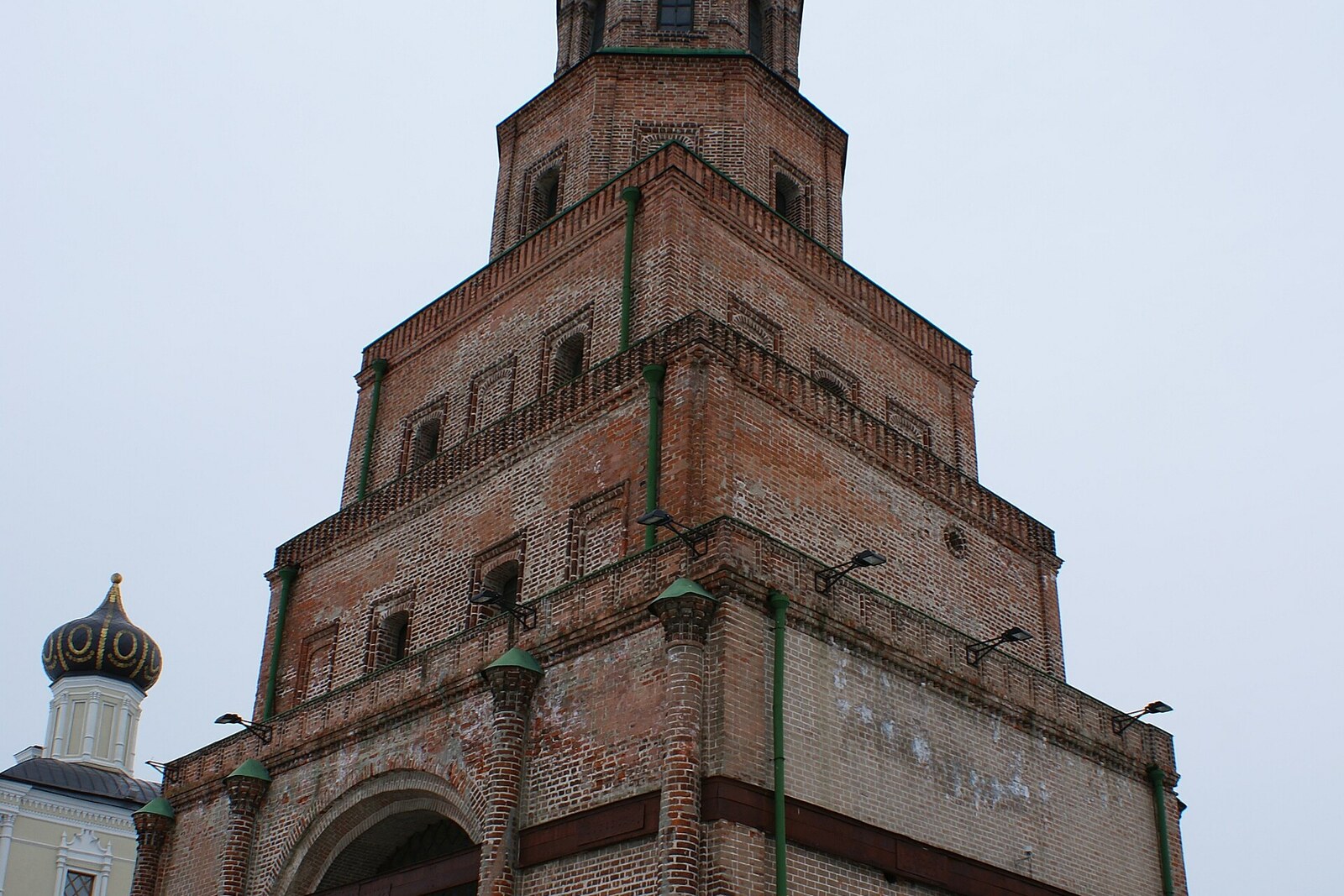
Look around first
What to notice
- Red brick tower
- Lower gateway arch
- Upper watch platform
- Spire
The story of the place
Syuyumbike did not jump from this tower. According to a city legend, the Moscow tsar Ivan IV demanded that the ruler of Kazan become his wife. She agreed on the condition that a seven-tier tower be built for her in seven days, then climbed to the top and threw herself down. This is a legend. Syuyumbike was taken from Kazan alive in fifteen fifty-one, one year before the city was captured. Most researchers date the present brick tower to the late seventeenth or early eighteenth century.
Syuyumbike really did live nearby. Behind the present arch stood the Khan's Court, and beneath the tower archaeologists found the remains of an earlier gateway structure. When her husband, Safa Giray, Khan of Kazan, died in fifteen forty-nine, the throne passed to their underage son, Utyamysh Giray. Syuyumbike became regent: she ruled the khanate in the child's name and sought to ensure that he kept the throne. Her position rested on her son's right to inherit from his father and on the armed support of the late khan's followers. She had no right of her own to occupy the khan's throne.
After several Moscow campaigns and the appearance of a fortress in Sviyazhsk, Syuyumbike's government was isolated. Part of the Kazan nobility decided to make an agreement with Moscow and return Shah Ali to the throne—the ruler of Kasimov, who had already ruled Kazan and wanted to have it again. Syuyumbike tried to flee with her son to her father, the ruler of the Nogai Horde, but she was captured. The new Kazan government handed the mother and child over to Ivan IV; on August eleventh, fifteen fifty-one, they were sent to Moscow. Syuyumbike's followers were executed.
Mother and son were separated. Utyamysh was baptized under the name Aleksandr; he died in Moscow at the age of twenty. Syuyumbike was forcibly married off to Shah Ali and taken to Kasimov. Her father Yusuf wrote to Ivan IV, trying to get his daughter and grandson back, but received a refusal. Almost no reliable information about Syuyumbike's final years has survived.
The tower above the gate was built later for another residence. Through the lower arch, people entered the courtyard of the ober-commandant, the head of the Kremlin garrison, while from the upper platform sentries watched the approaches to the city from the Volga side. On old plans, the structure was called just that: the gateway tower of the ober-commandant's house with a spire.
In eighteen thirty-two, the authors of a Kazan journal published the romantic name “Sumbekina Tower.” Guidebook compilers repeated the story of the ruler's death, and the new name displaced the official one. On ordinary days, the tower is now unused. During the memorial prayer for those killed in the capture of Kazan, the azan—the Muslim call to prayer—is recited from it. The red watchtower appeared after Syuyumbike; her name remained above the gates of the Khan's Court, where she ruled in her son's name.
Useful on site
The tower is viewed from outside; regular public access to climb it is not announced.
Checked: date not specified. Check the official source before visiting.Do not try to check the lean by standing right next to it: step back and compare the tower's vertical line with the neighboring buildings.