 Guide On Map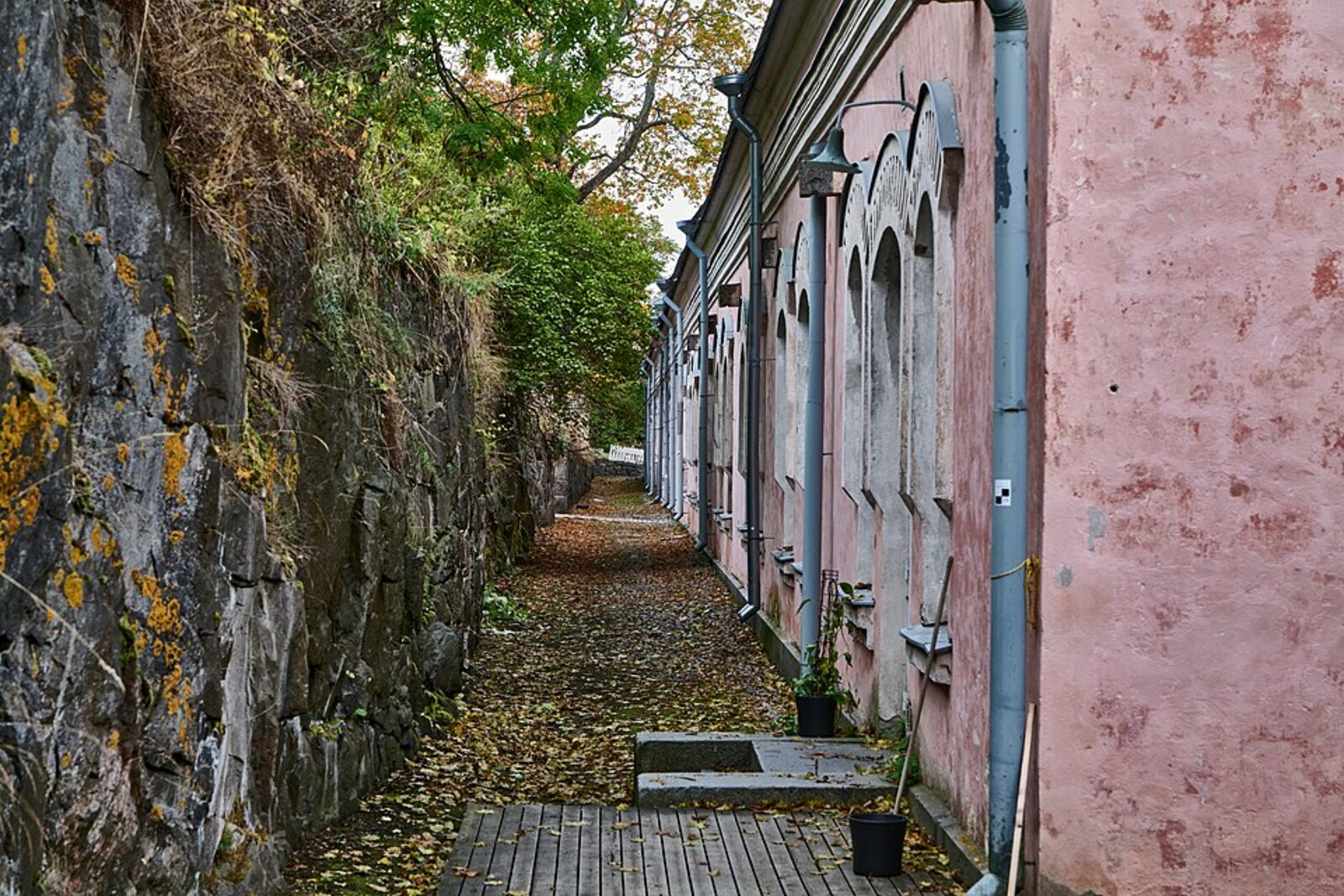
Look around first
What to notice
- The arch beneath the clock tower
- Vaulted rooms on either side of the passage
- The long barracks façade
- The jetty in front of the building
The story of the place
Beside the jetty stretches a long building with a clock tower, and the road into the fortress passes beneath it. On either side of this passage are hidden vaulted casemates that housed soldiers’ sleeping quarters, a kitchen, an office, a guard, and cells for detainees. Later, mine troops lived and studied here, while the former military premises now house a ferry waiting room, a café, a gallery, and a visitor center. The ferry still arrives directly at this shore.
In eighteen sixty-two, Greifon, an architect with the Russian military department, was tasked with redesigning the entrance to Sveaborg—this was what Suomenlinna was called at the time. On the narrow strip between the jetty and the rock, he had to fit gates, the main guardhouse, and accommodation for two hundred fifty soldiers.
Under Swedish rule, King’s Gate at the fortress’s southern tip served as the ceremonial entrance. The Russian garrison created an everyday entrance on the northern side, facing Helsinki. Military personnel, officials, suppliers, and detainees came ashore here. Everyone had to be received, checked, and sent onward, without leaving the jetty unguarded.
When work began six years later, military builders demolished the former guardhouse and cut away part of the rock behind it. At the same time, they built a jetty, roads, courtyards, stables, and a waterfront boulevard. By eighteen seventy, a long barracks building with an arch beneath the clock tower stood on the shore.
On either side of the passage, Greifon laid out fourteen transverse vaulted rooms—seven on each side. They contained soldiers’ sleeping quarters, a kitchen, an office, and lavatories. The main guardhouse occupied a separate section: rooms for the guards and the duty officer, detention cells, and rooms for detainees. After a shift, a soldier lay down here in a government-issue bed; a person brought in by the guard stayed in the same building, but behind a cell door. The architect brought the entire routine of the main entrance together under one roof.
In eighteen ninety, the military authorities temporarily housed a mine company here, which serviced the fortress’s sea barriers. For it, soldiers dismantled the former guardroom, some of the partitions, and the stoves. In the casemates they set up a medic’s reception room, shoemaking and tailoring workshops, and two classrooms; lessons continued in the mine museum and workrooms. The company gained a place where it could live, study, receive medical care, and repair uniforms without leaving the military harbor.
Finnish military personnel used Jetty Barracks until nineteen seventy-two. The same vaulted rooms now contain a visitor center, a ferry waiting room, a gallery, a café, and a restaurant. The guards and cells are no longer here, but the ferry still arrives at the jetty in front of the building, and the road into the fortress begins beneath the clock tower—where Greifon led it between two rows of casemates.
Useful on site
Outside around the clock. Visitor Centre: as of 2026-06-30, the stated hours are 10:00–18:00 daily; hours may vary by season and events.
Checked: June 30, 2026. Check the official source before visiting.View the façade from the publicly accessible side and do not block the passage for people arriving from the ferry. The account does not require entering the building.