 Guide On Map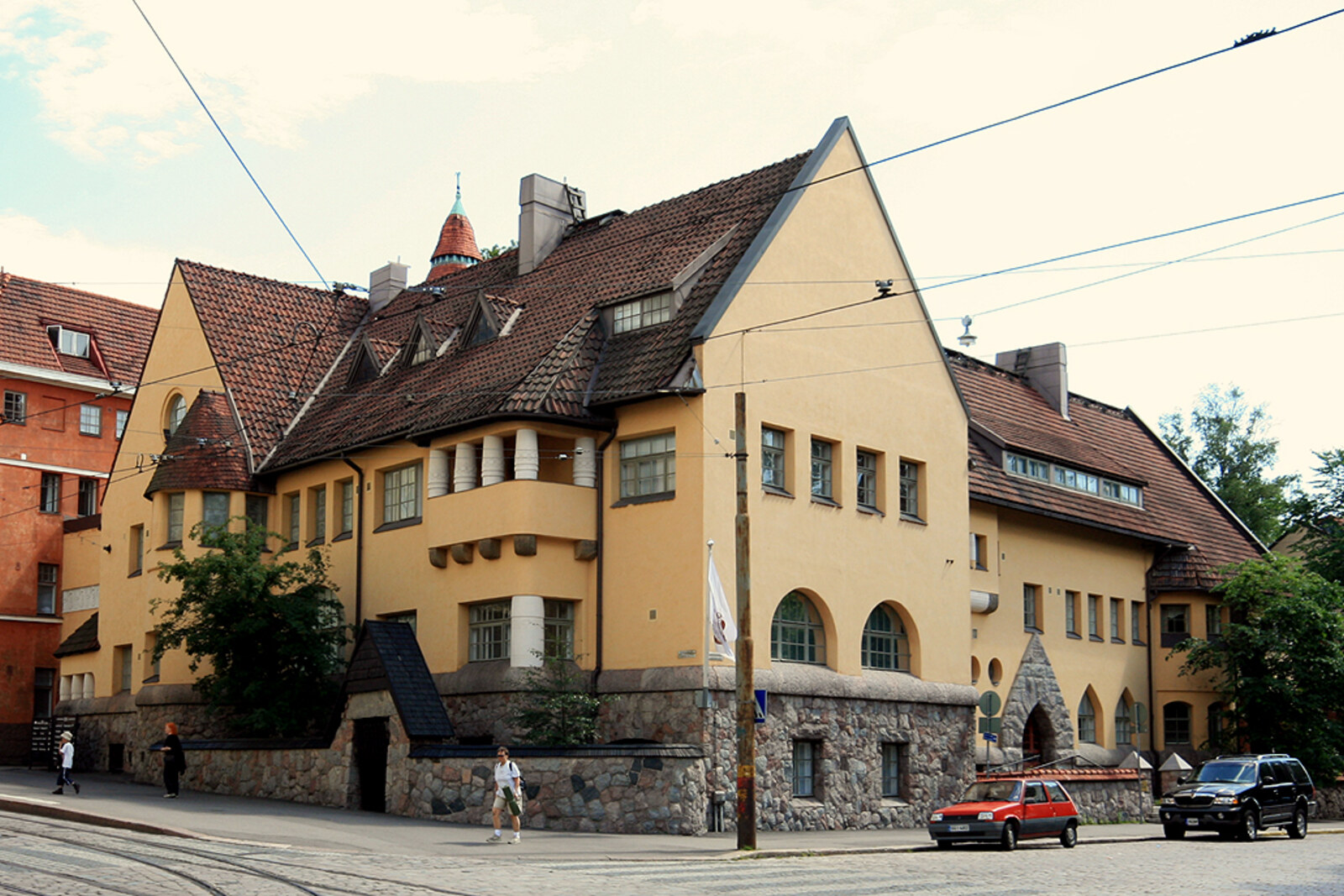
Look around first
What to notice
- Pale-yellow building
- Asymmetrical windows
- Steep roof
- Turrets
The story of the place
The clinic took its name from Eira Hospital, Stockholm, which in turn was named for a healer from ancient Norse songs; later, the neighboring district was also given this name, although it begins beyond a different administrative boundary. The pale-yellow building, with its turrets, steep roof, and windows of different shapes, looks more like a home than a clinic. Yet from its opening, patient rooms, operating rooms, and a maternity ward have functioned inside; the private hospital occupies it today as well, keeping patients after procedures around the clock.
In the spring of nineteen oh four, the surgeon Eino Sandelin and the physician Wilhelm Zilliacus returned from Copenhagen with an unusual brief for an architect: to build a hospital without long corridors or an institutional layout.
Sandelin earned his living through surgery and private consultations. He performed his first operations for his own patients at Mrs Fröjdman's modest clinic. He then joined a group of Swedish-speaking doctors who opened a small private hospital in a wooden house. The rooms were lit by candles, and water was carried by hand. The doctors needed proper operating rooms, while patients needed rooms where illness would not turn a person into an inhabitant of a grim institution.
Sandelin and Zilliacus studied Copenhagen's private hospitals, chose an empty plot on what was then the outskirts of Helsinki, and commissioned Lars Sonck to design the project. Sonck fulfilled the clients' main wish: the hospital was to resemble a large home. He replaced straight corridors with small halls, alcoves, and rooms of different shapes. This arrangement accounts for the asymmetrical windows, steep roof, and turrets of the pale-yellow building.
On June eighth, nineteen oh five, the first patient was admitted here. Inside were twenty-five patient rooms, two operating rooms, and a maternity ward. Patients liked the home-like layout, but staff had to go around corners and move between closely connected rooms. According to hospital tradition, when Sonck himself became a patient here in nineteen forty-eight, he feared meeting staff members who remembered these inconveniences.
Sandelin remained on the hospital board for almost three decades. In nineteen thirty-seven, he himself fell ill. His wife wrote in the family book that on August first they went straight to Eira Hospital. Doctors found a lung abscess. After several weeks of treatment, bleeding began; on October fifteenth, the surgeon died in the hospital he had once commissioned for his patients.
The founders borrowed the name from Eira Hospital, Stockholm. It traces back to Eir—the healer and patron of the medical arts in the ancient Norse songs of the Edda. Later, the clinic's name became established as the name of the neighboring district, although the hospital itself is formally located in Ullanlinna.
Sonck's original building is still occupied by a private hospital: doctors see patients here, perform operations, and keep patients after procedures around the clock. The long corridors that Sandelin rejected after the trip to Copenhagen are still absent inside.
Useful on site
This is an operating private hospital; the interior is accessible to patients only.
Checked: June 17, 2026. Check the official source before visiting.View the building from outside only: the hospital is operating, and its interior spaces are not part of the route.