 Guide On Map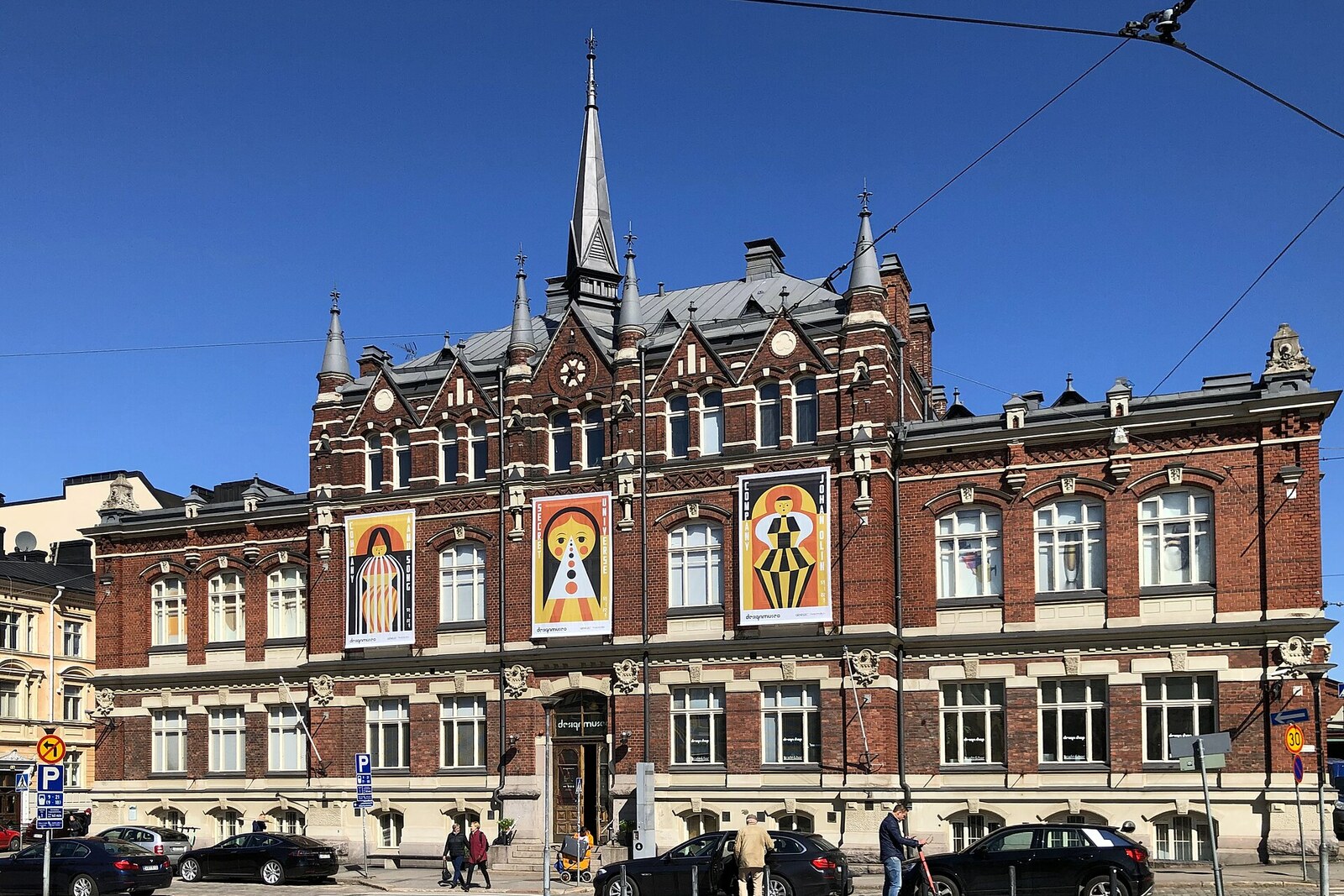
Look around first
What to notice
- Red-brick façade
- Tall window openings
- Pointed-arch details
- Entrance from the Kasarmikatu side
The story of the place
At first, girls and boys studied in this red-brick building with tall pointed-arch windows: the private school gave them a shared nine-year course and the right to take the matriculation examination for university admission. The windows were made so tall for the daylight and ventilation that teachers required for the classrooms. When the school moved out, the classrooms were converted into exhibition halls, and the teaching collection of applied arts, which began with purchases at the Vienna World's Fair, was moved here. Architecture & Design Museum Helsinki now operates in the former school.
Tove Jansson spent nine school years in this building. The future artist and creator of the Moomins wrote essays well, but not all her teachers liked her drawings. At fifteen, Jansson decided she would not wait for the school's approval. In nineteen thirty, she left without a matriculation certificate, moved in with an uncle in Stockholm, and enrolled in an arts and crafts school. A relative provided her with housing; her future depended on whether she could turn drawing into a profession.
The school prepared pupils precisely for the certificate Jansson had refused. In Swedish, it was called Läroverket för gossar och flickor (Broberg School), and it was nicknamed Broberg School after its first principal, Karl Theodor Broberg. Broberg, a pastor and educator, advocated coeducation for both sexes. When the school opened in eighteen eighty-three, it was the first educational institution of its kind in Finland.
At the time, a girl's usual path more often ended at a girls' school. It was thought that girls could not be burdened as heavily as boys: men were expected to provide the family income, while women supposedly did not need university. Broberg set up a nine-year course after which both young men and young women could take the matriculation examination and enter university. It was a private school, so the principal had to persuade parents to entrust their own children to the new system.
In eighteen ninety-five, the school acquired this building. Architect Gustaf Nyström provided tall window openings: teachers demanded plenty of daylight and good ventilation for the classrooms. The red brick and pointed-arch details belong not to museum decoration but to the original school building.
Tove Jansson studied here from nineteen twenty-one to nineteen thirty. After three years in Stockholm, she continued her art education in Helsinki and Paris, and worked as an illustrator, painter, and cartoonist. In nineteen forty-five, the first book about the Moomins was published. Drawing, which some schoolteachers did not consider her strong suit, became her craft and source of income.
After several mergers, the school left the building in nineteen seventy-seven. Architect Olli Borg converted the classrooms into exhibition halls, and on June twelfth, nineteen seventy-nine, the Museum of Applied Arts opened here. Its collection began with seven hundred thirty-two objects bought at the Vienna World's Fair to train future craftspeople. The teaching collection moved into the vacated school.
In January twenty twenty-four, this museum was merged with the Museum of Finnish Architecture. This created the current name—Architecture & Design Museum Helsinki. Its staff collect and study objects, drawings, photographs, archives, and architectural models, and organize permanent and temporary exhibitions.
Until November first, twenty twenty-six, the former Jansson school hosts the exhibition Escape to Moominvalley, about the spaces she imagined for her characters. In the museum studio, visitors learn ink and watercolor techniques from her works. Drawing has returned to the same building as a subject of study and exhibition.
Useful on site
Tue 11:00–20:00, Wed–Sun 11:00–18:00, Mon closed; hours may change on event days.
Checked: June 17, 2026. Check the official source before visiting.The exhibitions require a separate visit; if the museum is unavailable, viewing the former school from outside still supports the story.