 Guide On Map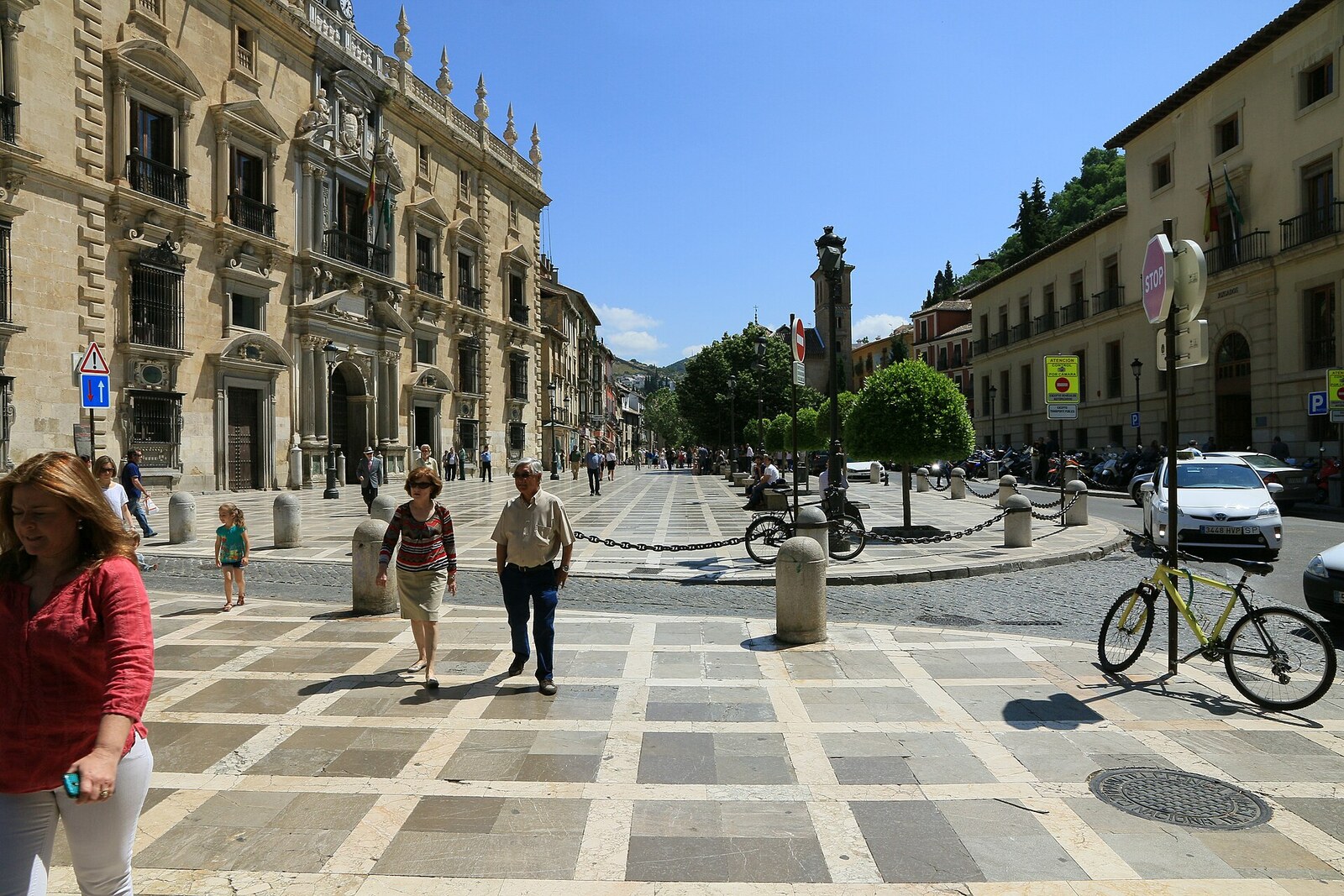
Look around first
What to notice
- The façade of the Royal Chancery of Granada
- The beginning of Calle Elvira
- The square's open space
The story of the place
On June nineteenth, seventeen oh five, the judges of the Royal Chancery of Granada ordered all exits from Plaza Nueva blocked. At six in the morning, six alleged leaders of the conspiracy were hanged here simultaneously. Previously, if several people were to be executed, the order was decided by lot and the condemned were brought out one at a time. This time, the judges ordered a common gallows prepared: the entire square was to see the punishment at once.
Two claimants were then fighting for the Spanish crown. Philip V, who ruled in Madrid, wanted to keep the throne; Archduke Charles sought it for himself. Charles's supporters planned to raise Granada during the Feast of Corpus Christi, when the streets were filled with people. They intended to arrest the royal governor, the president of the Chancery, and other city leaders, and then declare Granada Charles's city. The participants expected the inhabitants and Anglo-Dutch troops from ships off the coast of Andalusia to join them.
The conspiracy was uncovered before the uprising. More than one hundred people were arrested in the city and surrounding area. Philip V dismissed José Uriarte, president of the Chancery: the king believed that Uriarte had allowed preparations for a rebellion in the city for which he was responsible. The new president had not yet arrived when the remaining judges hastily handed down the first sentences.
The people sent to the gallows made their living through crafts and trade. They included the Italian doctor Antonio María Carambona and the weaponsmith Francisco de Soto, who earned his living making and selling blades; a shopkeeper, a tailor, a bookseller, and a shoemaker were executed alongside them. Suspects from the nobility and clergy escaped this fate. The judges chose simultaneous execution to keep Charles's other supporters from rising. In November, five more condemned people were hanged here. The royal governor ordered the bodies of all eleven executed people dismembered and their heads displayed on Granada's busiest streets. The heads were taken down only after the war ended.
The square suited such a sentence because it was created as an open space before the main royal court. At the beginning of the sixteenth century, the city council vaulted over part of the Darro River and laid out a new square above the river—hence the name Plaza Nueva. Later, the palace of the Royal Chancery of Granada, the highest appellate court, was built along its side, and the city gallows were erected nearby.
In seventeen oh five, the execution site was still called Plazuela de San Gil and adjoined Plaza Nueva at the beginning of Calle Elvira. It is now one continuous square. The gallows were removed in eighteen twelve, the Church of San Gil was demolished later, and the open area by Calle Elvira took their place. No sign of the execution remains there. But the judges' palace still stands opposite: the High Court of Justice of Andalusia now sits there, and the Darro River still flows beneath the paving slabs of Plaza Nueva.
Useful on site
Open around the clock, free admission.
Checked: June 17, 2026. Check the official source before visiting.The river cannot be seen from the square: it runs beneath the stone paving. For listening, choose the edge of the space near the façade of the Royal Chancery of Granada, away from through traffic.