 Guide On Map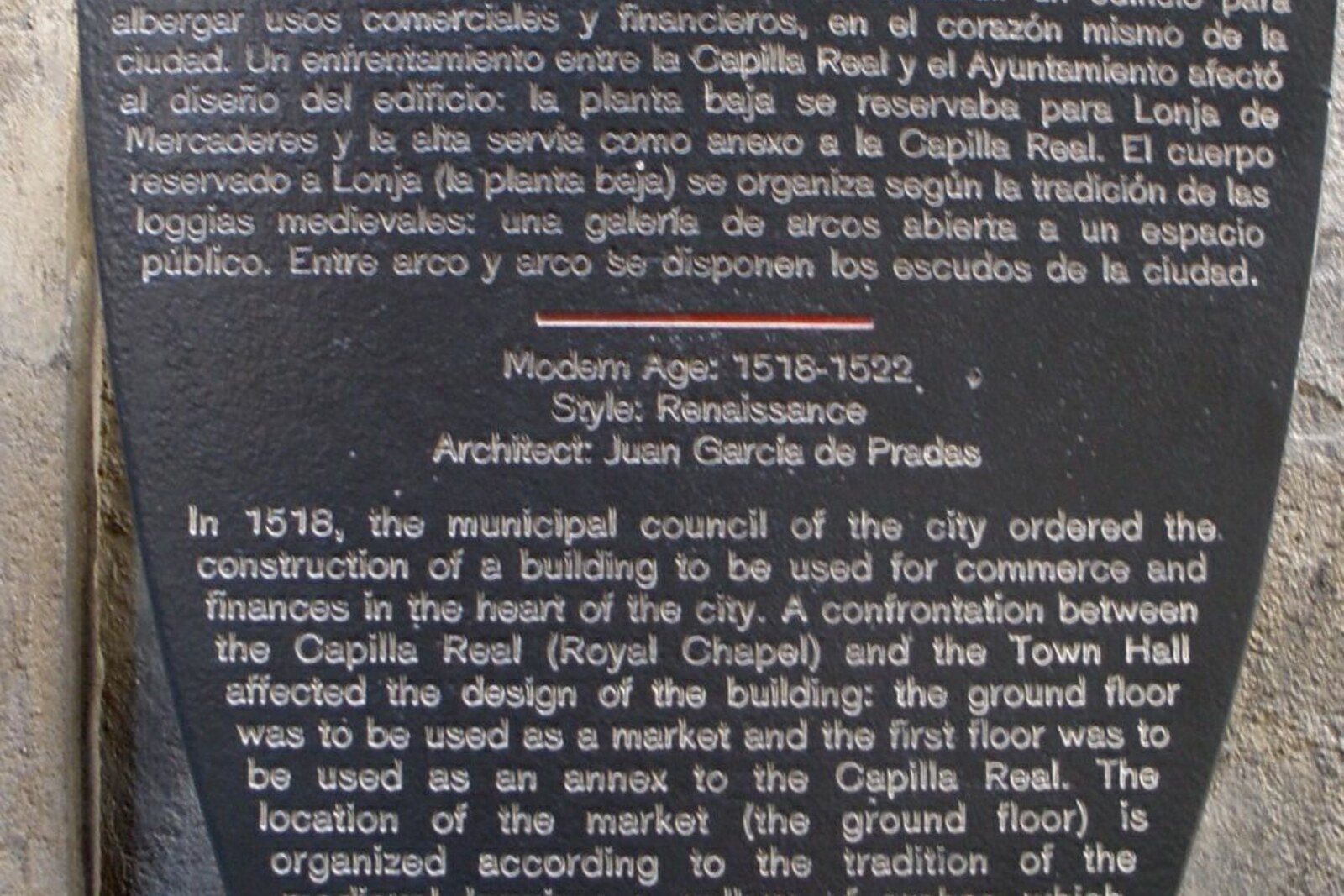
Look around first
What to notice
- The open lower gallery
- The coats of arms of Granada
- The upper level
- The symbols of the Catholic Monarchs
The story of the place
The coats of arms of Granada between the arches stand beside the symbols of the Catholic Monarchs on the upper level: the facade preserves the time when merchants’ transactions occupied the lower open gallery, while the rooms of the Royal Chapel of Granada stood above. Here, contracts and payments were settled, and the weights and measures of goods from the neighboring Alcaicería were checked. Trade remained here only briefly; later, the former hall of transactions became the entrance to the Royal Chapel of Granada.
In October fifteen eighteen, the Genoese merchant Esteban Centurione came to Granada’s city council with a proposal to open a bank. He had made his fortune in maritime trade, sending large consignments of Granada silk overseas through Seville. Now, together with his brother Carlo Centurione, he wanted to accept deposits and handle settlements between merchants under a city license.
The Centurione brothers promised to pay the council ten thousand maravedís every year and offered security of twenty thousand ducats. This money served as a guarantee: if a banker failed to meet his obligations, his property would be liable. Other Genoese financiers immediately joined the brothers. The council allowed the partnership to operate from fifteen nineteen to fifteen twenty-six.
The site for the bank and trading hall was chosen opposite the former Madrasa of Granada, where the city council met at the time. The Alcaicería stood nearby: silk bought there could be turned here into a contract, a payment, and a surety. Merchants were meant to gather in the hall, while a city inspector certified weights and measures. Hence the name: Lonja de Mercaderes means a merchants’ exchange, a house for concluding deals.
But the same site was needed by the canons of the Royal Chapel of Granada. They were responsible for services at the royal tombs, wanted to establish a sacristy here, and claimed that commercial negotiations would interfere with church services. The dispute with the city council changed the building itself. The merchants were given the lower open gallery, and rooms for the chapel were allowed above it. The coats of arms of Granada were placed between the arches on the lower level, with the symbols of the Catholic Monarchs above.
Builders completed the Lonja de Mercaderes in fifteen twenty-two. However, the trading hall proved unsuitable for its intended purpose. As early as fifteen twenty-eight, the city council stopped using it as an exchange, sold it to the Royal Chapel of Granada, and decided to build a new Lonja by the shops on Bib-Rambla, closer to the Alcaicería. The Centurione merchants served out their banking term, but the premises that had sparked the dispute served trade for only a few years.
People now enter the Royal Chapel of Granada through the former hall of transactions. The city coats of arms remain below, the royal symbols above: the two levels preserve the terms of the agreement between merchants, the council, and the canons, although the merchants left here almost five centuries ago.
Useful on site
Exterior viewing only; the interior is closed to visitors without special permission.
Checked: June 17, 2026. Check the official source before visiting.The main architectural details are easy to examine from the street. Step back a few paces from the portal to see the entire facade without getting in the way of people entering.