 Guide On Map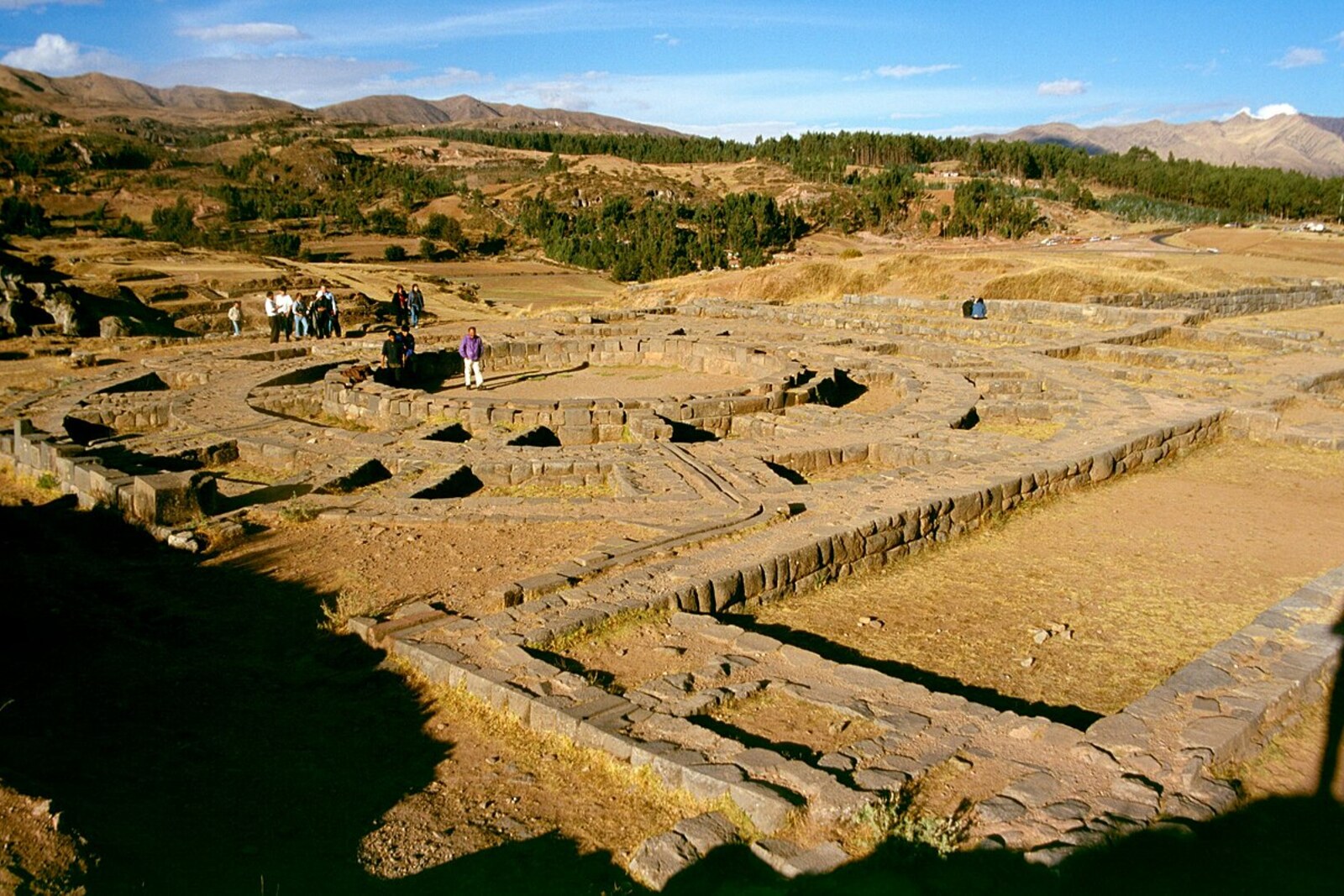
Look around first
What to notice
- Rings of low masonry
- Concentric walls
- Stone channels
The story of the place
The stone channels lead to the center of Muyucmarca: water once came here through them, then spread out to five small springs outside. Muyucmarca occupied the middle of Sacsayhuamán’s upper complex; it contained ceremonial rooms and storerooms, and rulers stayed here as they climbed up. Narrow passageways survive between the concentric walls, but the form of the vanished multistory section must be reconstructed from conflicting descriptions. The residents of Cusco dismantled the upper parts of Sacsayhuamán for stone to build churches and houses, so archaeologists found only the sunken masonry beneath the ground.
The rings of low masonry before us are the foundation of a vanished building. In May fifteen thirty-six, upper stories rose above this spot, and the assault on Sacsayhuamán ended among them.
Pedro Pizarro, a participant in the battle and a future chronicler, writes that one of the last tower fortifications was commanded by an Inca nobleman. The Spaniards called such men orejones—“big-eared”: the right to wear large ear ornaments marked their membership in the nobility. Pedro did not record the captain’s name. Later tradition called him Cahuide and linked his final battle to Muyucmarca.
Cahuide defended himself with weapons taken from dead Spaniards: a sword, a shield, and a helmet. He also still had an Inca mace. While Hernando Pizarro’s men set up ladders, the captain ran across the upper platform to wherever another attacker appeared. The defenders were already surrendering and trying to climb down from the walls; Cahuide struck them with his mace and threw them down. By Pedro Pizarro’s count, more than thirty people died this way. To the captain, the surrender of his own men meant that there would soon be no one left to hold the tower.
Hernando ordered three or four ladders to be set against it at once. Cahuide had to be taken alive; the commander even swore not to kill the prisoner. While the captain fought off one ascent, the Spaniards reached the top from two other sides. Seeing them on the platform, Cahuide threw down his weapons, covered his head and face with his cloak, and jumped. He died, and the invaders gained the tower without a captive commander.
Pedro Pizarro himself did not specify in which of the three upper buildings this happened. Muyucmarca as the site of Cahuide’s jump is therefore a traditional identification, not a precise location from an eyewitness account. Something else is known: Muyucmarca was the central structure of the entire upper complex. Garcilaso de la Vega translated its name as “round fortress” and recalled that two more towers stood on either side. Pedro Sancho de la Hoz, who saw Sacsayhuamán before the battle, described the main building differently—as a four- or five-tiered cube. The circular foundation is beyond doubt; the form of the vanished upper stories remains a matter of reconstruction.
In peacetime, this place contained rooms for ceremonies, storerooms, and a water system. According to Garcilaso’s account, rulers stayed in Muyucmarca when they went up to Sacsayhuamán, and pure water brought from afar entered the structure. Archaeologists found channels: water came to the center of the circular structure, then spread out to five small springs outside. Narrow passageways ran between the concentric walls. During the battle, these passageways, the ladders, and the upper platform turned the ceremonial building into a fortification where several ascents could be defended in turn.
After the conquest, the residents of Cusco dismantled the upper parts of Sacsayhuamán: dressed stone was carried away for churches and city houses. The underground and sunken masonry of Muyucmarca survived. In nineteen thirty-four, the archaeologist Luis Valcárcel uncovered the circular foundation, which had until then been concealed by earth. The stone edge from which the Inca captain jumped is no longer here; Pedro Pizarro did not record above which of the three foundations it stood.
Useful on site
DDC Cusco lists the hours for Sacsayhuamán Park as 07:00-17:30; check the current schedule and COSITUC ticket before setting out.
Opening hours by day
Follow the permitted route around the foundation and do not step on the masonry. To imagine the lost tower, look at the whole circle rather than at a single course.