 Guide On Map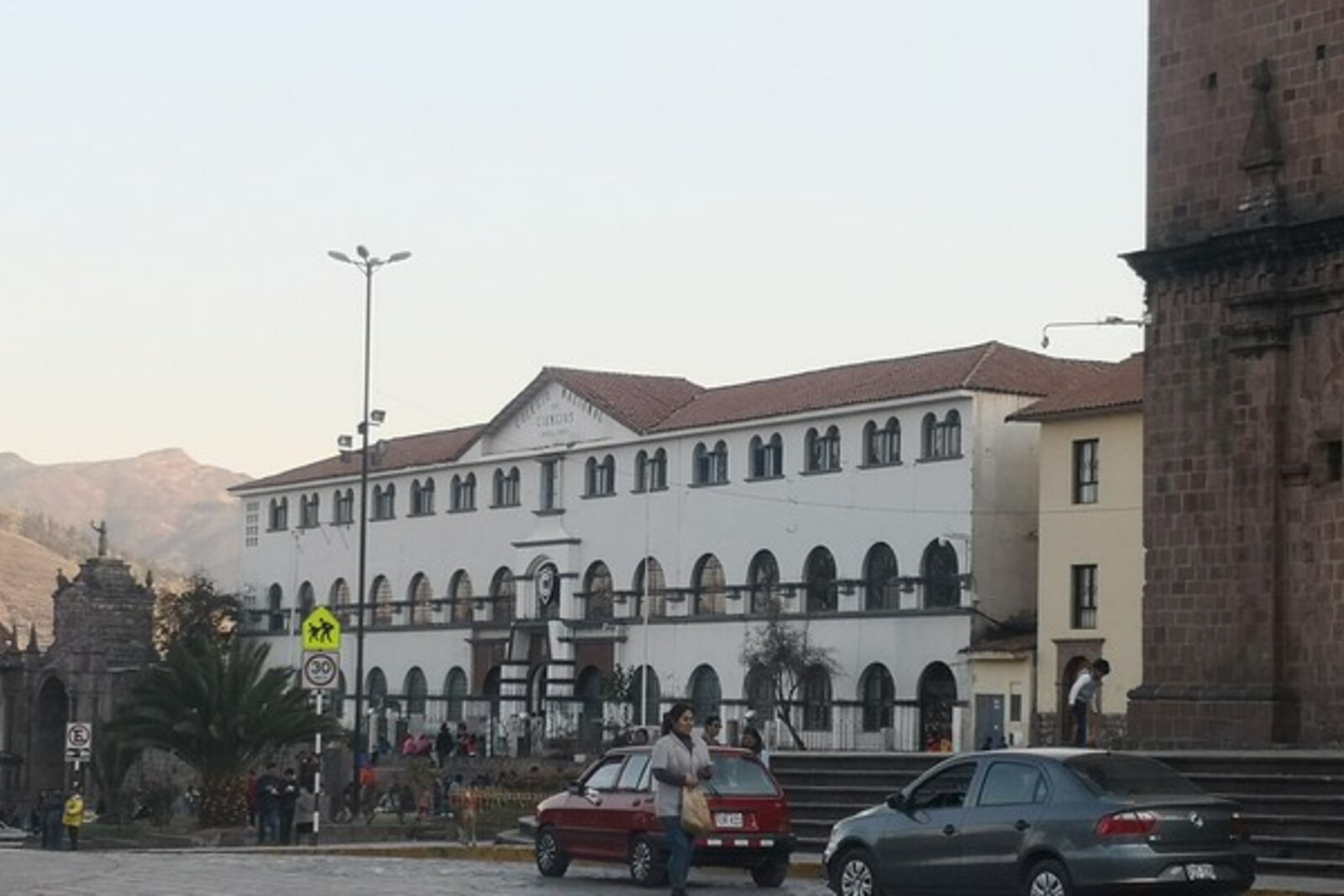
Look around first
What to notice
- School façade
- A sign with two Cs
- The neighboring church façade
The story of the place
At Plaza San Francisco, classes are held within walls that once belonged to the Franciscan Colegio de San Buenaventura. The school moved here when its former home began to fall into ruin, and the current buildings were constructed only after the earthquake that destroyed the old structure. The façade retains a sign made of two Cs, the college's old emblem.
Behind the façade is an active public school. Its full historical name is Colegio Nacional de Ciencias y Artes. In eighteen twenty-five, Simón Bolívar ordered the merger of two old educational institutions: Colegio de San Bernardo, created for the sons and grandsons of Spanish conquistadors and Creoles, and Colegio de San Francisco de Borja, where the sons of indigenous caciques—hereditary local rulers—were taught. Bolívar wanted to bring every branch of learning together in one institution; that is how sciences and arts entered its name.
At first, classes were held in the former house of the Society of Jesus. The school did not move to this site until eighteen forty-two: its previous building was falling into ruin, and the Franciscans ceded it part of the former Colegio de San Buenaventura.
It was here that a name was born which is now more often heard in football stands. In eighteen ninety-eight, the English missionary William Hewitt Newell arrived in Cusco. He came with his wife Fanny, taught, and together with fellow countrymen opened a photography studio and a shop selling English goods. At this school, Newell became a physical education teacher and introduced the pupils to several English games. Football captivated them most of all.
The schoolchildren formed the Unión Cienciana team. Cienciano was what a student of Colegio de Ciencias was called, so the team name literally meant “Union of Ciencias students.” The club itself traces its history to July eighth, nineteen oh one—the anniversary of the school's founding. A year later, the team played its first official match against Athletic Club.
Newell did get to see that match. In the same year, his third daughter was born, and at the end of September he fell ill with typhoid fever. On October first, the teacher died at the age of thirty-two. The team continued playing without its founder, moved out of the schoolyard into city competitions, and retained the school's name. A century later, Cienciano won the Copa Sudamericana and then the Recopa Sudamericana, defeating River Plate and Boca Juniors in the decisive matches.
Newell never saw the school buildings that stand here now: the earthquake of nineteen fifty destroyed the former school, and the pupils returned to the reconstructed building in nineteen fifty-nine. The site, the institution, and the emblem made of two Cs have survived; it was created for the college and inherited by the football club. Cienciano's uniform still says where the team came from: this school on Plaza San Francisco.
Useful on site
The façade is accessible year-round; this is an active school, so visitors are not allowed inside.
Checked: June 28, 2026. Check the official source before visiting.This is an active school: view the building from the street, do not block the entrance, and do not enter the grounds without an invitation.