 Guide On Map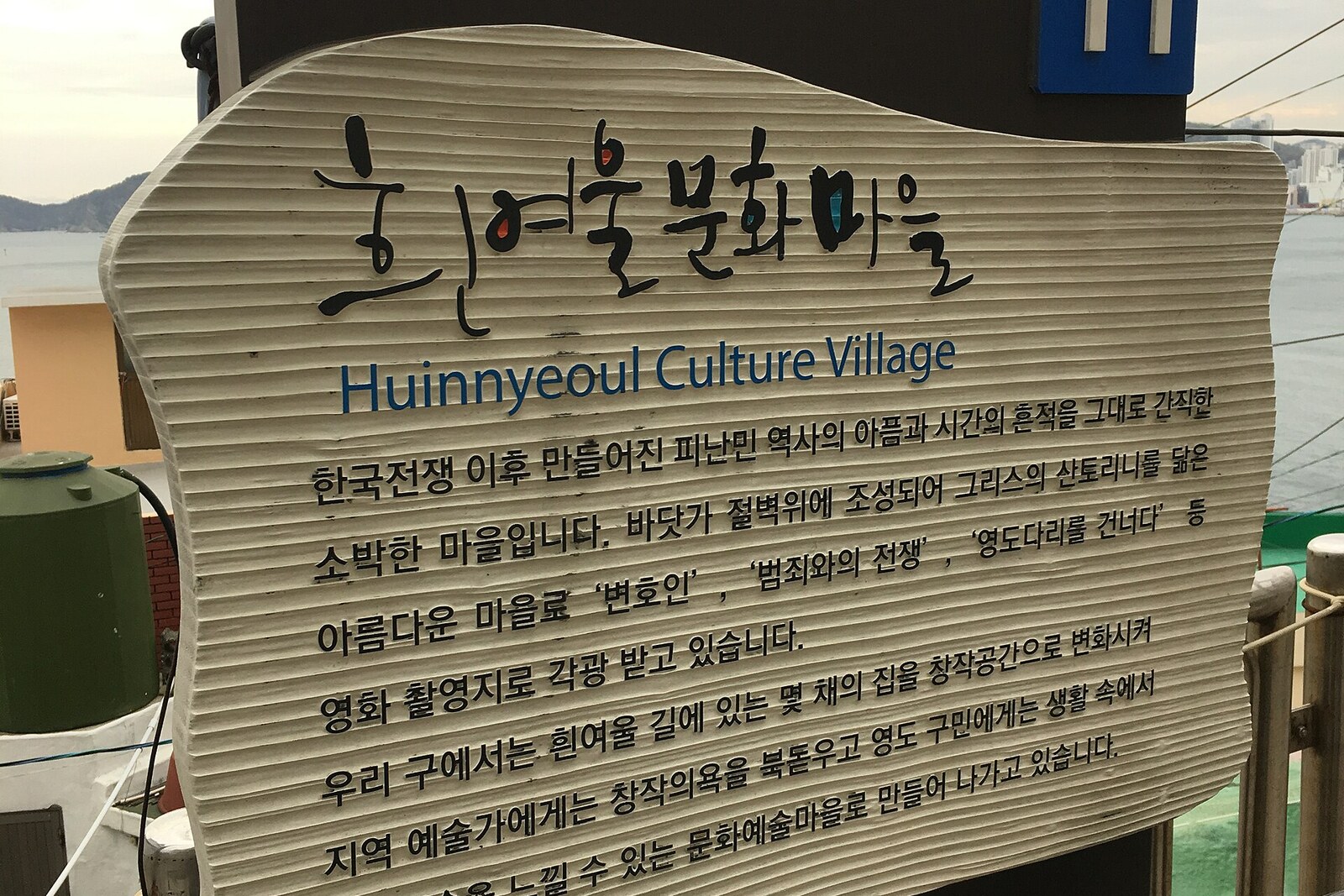
Look around first
What to notice
- Baengnyeonsa Temple
- Low houses by the entrance
- White facades
The story of the place
Beyond the white facades by Baengnyeonsa Temple stretches a residential slope where low houses stand so close together that the street becomes a passage between them. When Busan was crowded with people who had lost their homes, this site, too steep for ordinary development, was settled and built up by its residents themselves. Fast streams once ran from Bongnaesan to the sea before the houses were built, turning white on the slope; the name Huinnyeoul, “white rapids,” remains from them.
The word “cultural” at this entrance appeared thanks to people who had nowhere to work. On December twenty-seventh, two thousand eleven, five workshops opened in three vacant houses beside Baengnyeonsa Temple. One went to thirty-four-year-old craftswoman Seo Mi-jin. She had no space of her own: she made her work at home, adjusting to the other members of her family. After a competitive selection process, she received a separate room of only a few square meters.
The vacant houses appeared here as the result of another human story. During the Korean War, refugees who had lost their homes looked for a place in overcrowded Busan. They occupied a slope considered too steep for development and built homes on it themselves. Nearly nine houses out of ten had no official permit. People gained a roof over their heads, but later such buildings could not be properly rebuilt or incorporated into a large renewal project. Some became vacant.
In two thousand eleven, city and district officials decided to give several such houses to artists. Forty-five million won was allocated to renovate three buildings with a combined area of one hundred sixteen square meters. Workers removed the old wallpaper, painted the walls, installed water and sewer lines, and fitted sinks and toilets. Five Busan craftspeople moved into the rooms. About two hundred residents and representatives of the local cultural scene came to the opening. A year later, four residents exhibited fourteen works created here at a local gallery.
The name “Huinnyeoul” refers to what existed here before the workshops and houses. Several streams ran from Bongnaesan to the sea; the fast water turned white on the slope like falling snow. Hence “Huinnyeoul”—“white rapids.” The word “cultural” was added when the vacant rooms were handed over to craftspeople. The present entrance near Baengnyeonsa Temple stands on the same site where five cramped workshops gave the whole village its name.
Useful on site
The streets are freely accessible; the information center is listed as open 10:00–18:00 and closed on January 1, Seollal, and Chuseok. It is best not to walk through the residential area late in the evening.
Checked: June 30, 2026. Check the official source before visiting.See the retaining structures as part of residential infrastructure; do not step over thresholds or enter courtyards.