 Guide On Map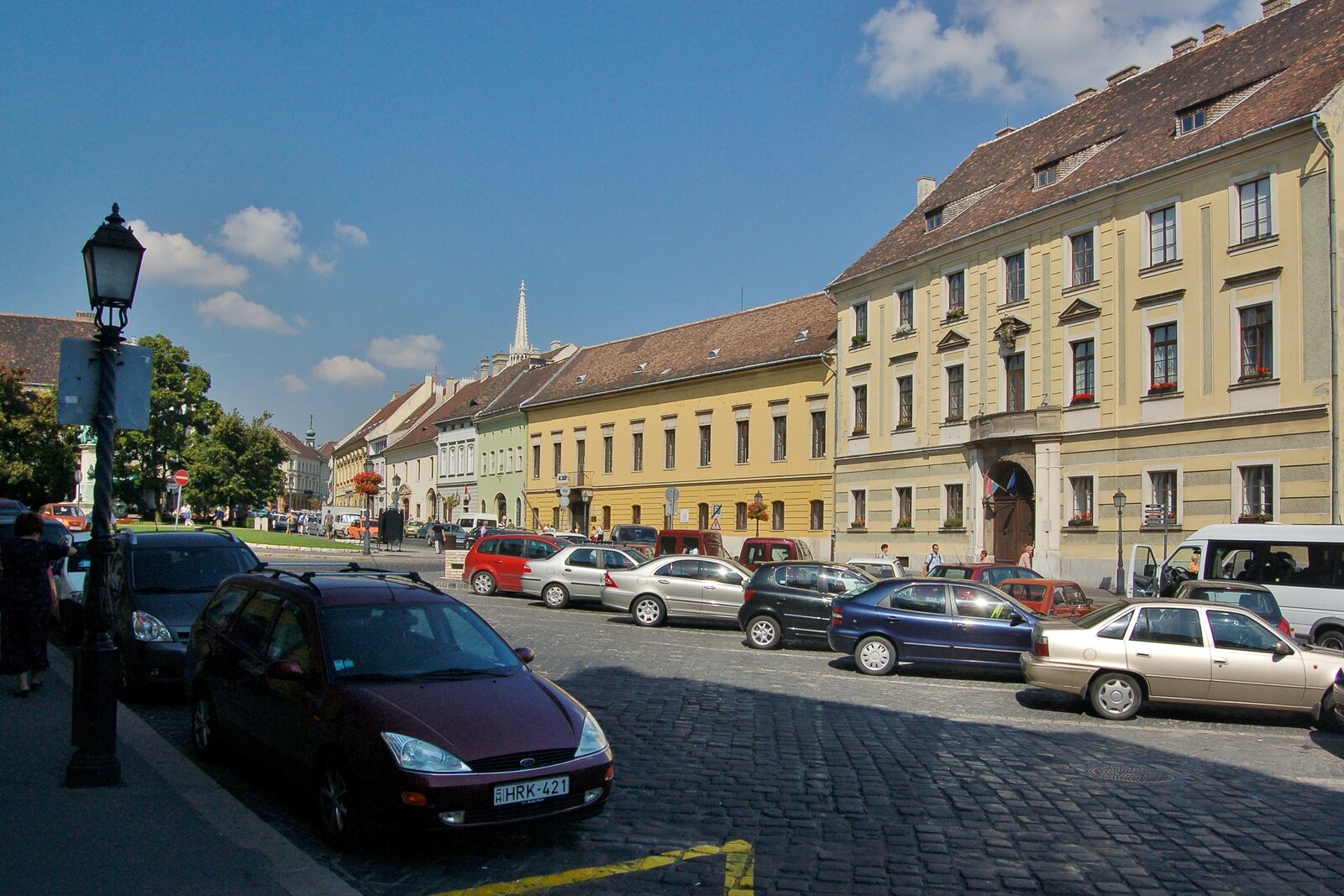
Look around first
What to notice
- The Baroque facade of house No. 15
- The square's open space
The story of the place
On April ninth, fifteen fourteen, here at the medieval St. George's market—the predecessor of today's Dís Square—Cardinal Tamás Bakócz proclaimed a crusade against the Ottoman Empire. Bakócz was Archbishop of Esztergom and a papal legate, that is, a representative of the pope authorized to recruit crusaders. He wanted to raise an army to defend the southern frontier, although he knew in advance that Rome would provide no money, European rulers would send no soldiers, and the royal treasury was empty.
According to a local architectural tradition, the cardinal's Buda residence occupied the plots of today's houses fourteen and fifteen on the square's western side. Nearby stood the court church of St. Sigismund's Church. On April twenty-fourth, Bakócz handed a consecrated white banner with a red cross to György Dózsa there. Dózsa was a frontier cavalry commander from the fortress of Nándorfehérvár, present-day Belgrade; his experience of war against the Ottomans and a recent victory in a duel with one of their warriors made him a suitable leader. He was now to lead the assembled people to the southern frontier.
Those who came under the banner were mainly peasants. They lived from the harvest and left their farms at the height of the spring work. Landowners tried to force them back into the fields and threatened to punish the families left at home. Not enough food had been prepared for the growing camp. People who had been promised a campaign against an external enemy and the remission of sins saw that their own lords were blocking their way.
On May tenth, Dózsa led about fifteen thousand crusaders south from near Pest. Five days later, Bakócz, alarmed by the clashes, forbade further recruitment. The royal council then ordered the entire army to disperse. The order came after armed detachments had already moved across the country, and landowners' attempts to stop their peasants had escalated into killings and retaliatory attacks. The crusade turned into an uprising.
In July, Dózsa's army was defeated near Temesvár. The leader himself was captured and executed. Bakócz retained his rank and wealth but lost his former political influence: the campaign that was meant to return him to major European politics became the greatest failure of his career.
The cardinal's residence has not survived in its medieval form. The present Baroque house number fifteen was built later from several old houses; medieval vaults, a cellar, and a kitchen remained inside, but there is no point looking for the balcony from which Bakócz, according to local tradition, addressed those gathered. St. Sigismund's Church also disappeared.
The name “Dís Square” came from another ceremony held here. After Buda returned from Ottoman rule, the main guardhouse of Buda Castle was built on the square's southern side. Soldiers were sent from here to the gates and guard posts; here they were inspected and the ceremonial changing of the guard was held. From seventeen twenty-eight, the square came to be called Paradeplatz—a square for military parades. The Hungarian name “Dís Square” established the same meaning. The guardhouse was demolished long ago; its formations survive in the square's name.
Useful on site
An open city square with no ticket requirement; best read in daylight, when its perimeter, monument, and traces of shell bursts can be made out.
Checked: June 28, 2026. Check the official source before visiting.The underground spaces are not visible from the surface, so do not look for unofficial descents or closed passageways. It is more useful here to walk slowly around the square and compare its present-day voids with the account of the vanished buildings.