 Guide On Map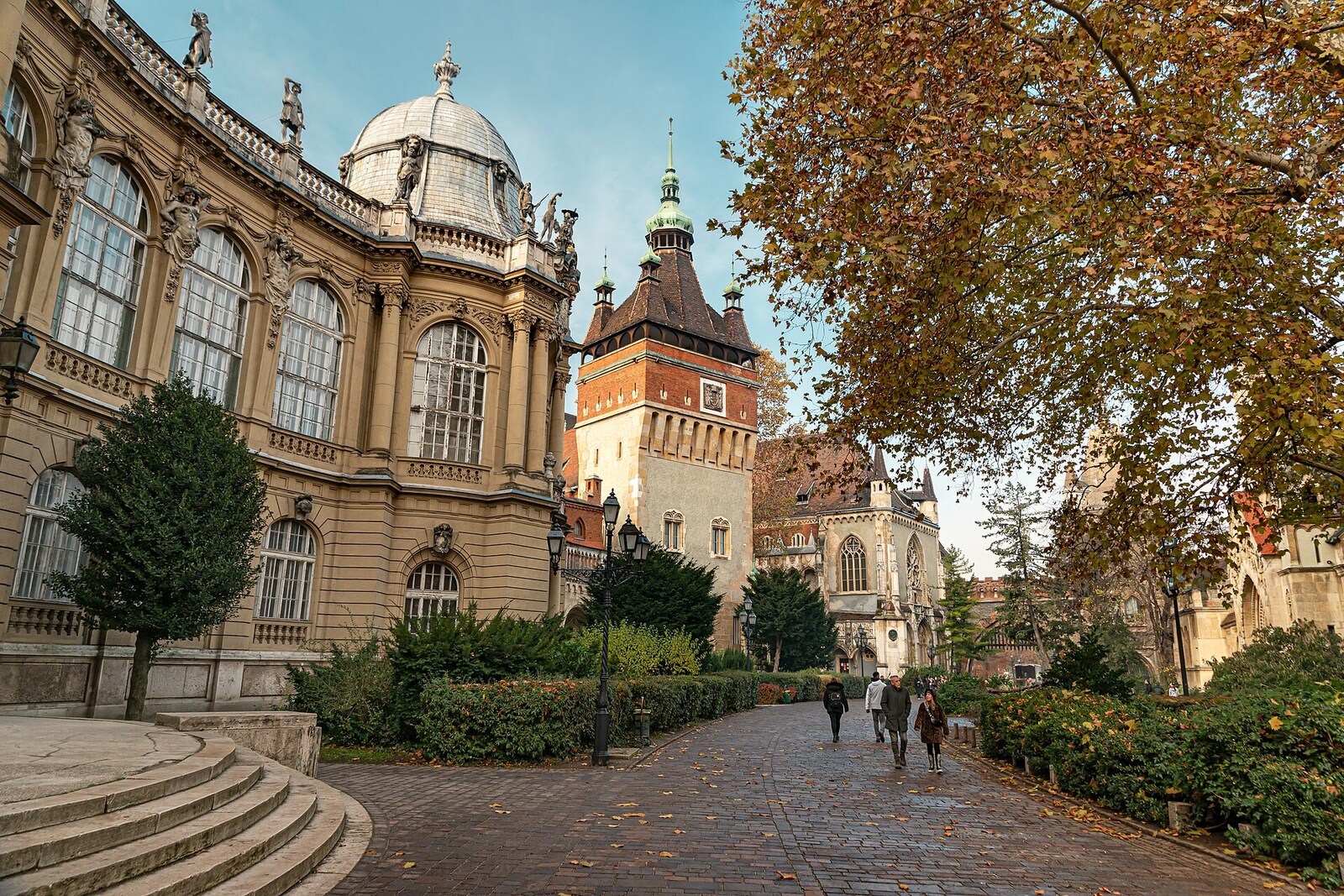
Look around first
What to notice
- Gothic towers
- Romanesque portal
- Renaissance-Baroque building
- Monument to Ignác Alpár
The story of the place
Visitors transferred the name of the Gothic section to the entire island complex in City Park. The towers of that section reproduce fragments of Hunyadi Castle in Transylvania; beside them stand a Romanesque portal and buildings with Renaissance and Baroque motifs. The Hungarian Museum of Agriculture is still housed in these buildings. For farmers, gardeners, and winegrowers, it served as a place to learn about working tools, plants, and methods of cultivating them.
In eighteen ninety-three, the Ministry of Trade announced a competition for the Historical Main Group, a complex of pavilions intended to display a thousand years of Hungarian architecture at the Millennium Exhibition. No one received first prize. Four architects were invited to revise their designs and compete again for the commission.
One of them was Ignác Alpár. He made his living from architectural competitions and private commissions, and this project could bring him recognition across the country. In his first design, Alpár drew on Byzantine and Eastern forms. For the second round, the terms changed: the jury required recognizable parts of buildings from the territory of historical Hungary. The architect set out to study monuments in Transylvania and in the north of the country, then assembled their fragments on one island in City Park.
Alpár exceeded the set budget, and the jury could have awarded the commission to a competitor. Yet he was chosen: he managed to place a large exhibition building around existing clusters of trees and link diverse examples into a single route. The victory really did bring him nationwide recognition; after the Millennium Exhibition, Alpár began receiving commissions for major banks and public buildings.
The complex opened on May first, eighteen ninety-six. Romanesque, Gothic, Renaissance, and Baroque sections came together here: the portal of the church in Ják, the tower of St Catherine's Bastion in Brașov, the balcony of Bardejov Town Hall, and motifs from the palace in Gödöllő. The most striking was the Gothic group, which reproduced parts of Hunyadi Castle in Hunedoara, a Transylvanian town. The public hardly used the official name. Visitors named the entire complex after this Gothic section: Vajdahunyad Castle.
The pavilions were built for one exhibition season, mainly on wooden frames. Within just a few years, the structures had become unsafe. They were closed in July eighteen ninety-nine, and by November the first version of the castle had been dismantled.
By then, a permanent occupant had already appeared inside. The minister of agriculture, Ignác Darányi, had advocated for a museum where farmers, gardeners, and winegrowers could study the tools, plant varieties, and production methods on which their livelihoods depended. During the exhibition, he had already ordered exhibits to be transferred to the future museum and asked agricultural institutions and private owners to add to the collection. By the end of the year, it contained more than twelve thousand objects.
Members of the Hungarian Economic Society persuaded the city to house the museum in the popular Historical Main Group. It opened here in September eighteen ninety-seven and received nearly one hundred seventy thousand people in two and a half years. When the wooden buildings had to close, the staff moved the collection to another building. A group of artists demanded the return of the vanished complex, joined by museum specialists and Darányi.
In nineteen oh two, Alpár was commissioned to design it again. This time, he had to reproduce the familiar facades in stone and brick and adapt the buildings for exhibition halls, storage rooms, and a library. The museum returned here in nineteen oh seven.
The stone towers and inner courtyard belong to the second version of the complex. The Hungarian Museum of Agriculture is still housed in the Gothic and Renaissance-Baroque buildings, and a monument to Ignác Alpár stands nearby. The entire building still bears the name that visitors gave to its short-lived wooden predecessor.
Useful on site
The courtyard functions as an open park stop; the museum at the castle is usually open Tue–Sun 10:00–17:00, Monday closed.
Checked: June 28, 2026. Check the official source before visiting.The courtyard and exterior details provide enough material for the stop; the museum interiors are visited separately.