 Guide On Map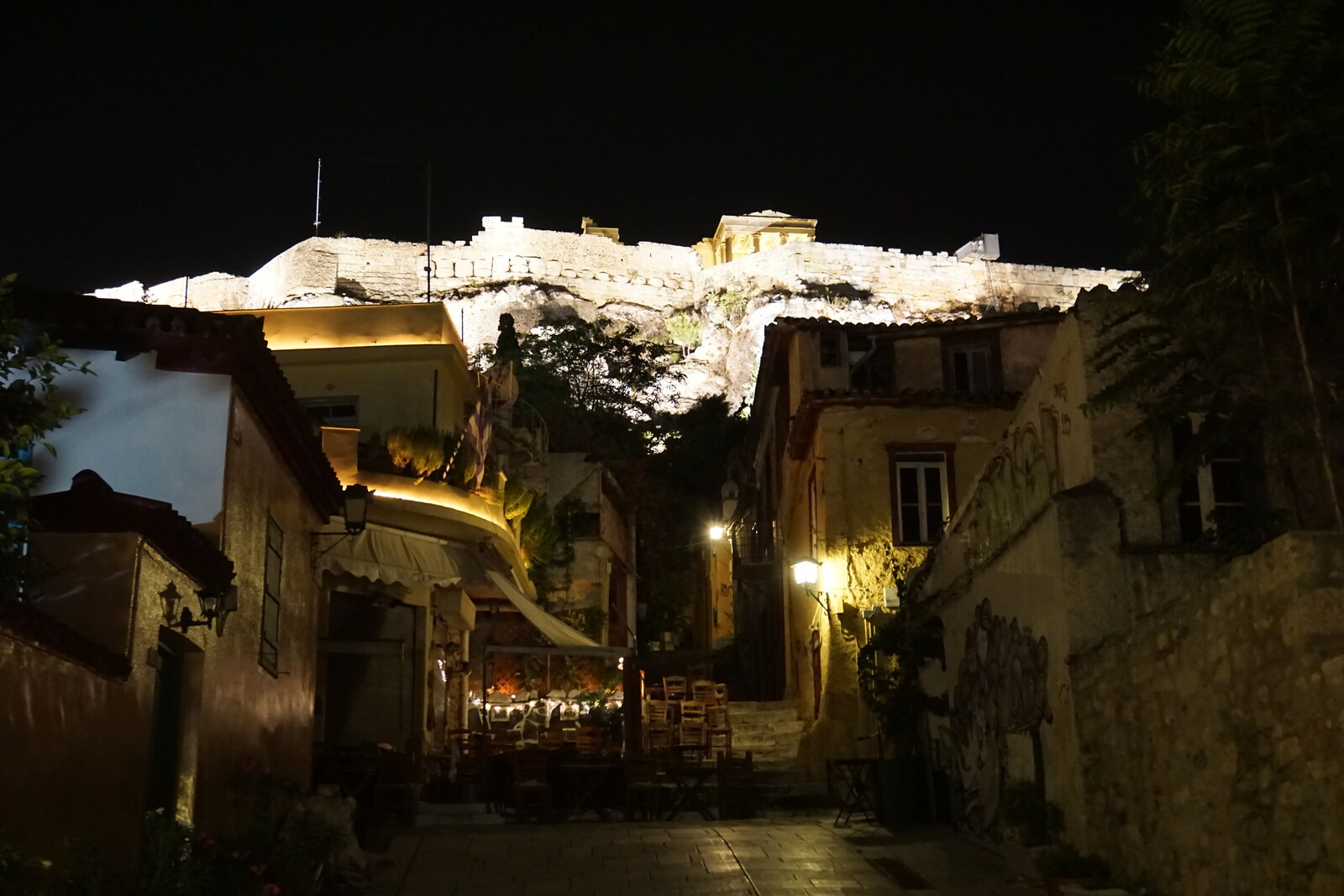
Look around first
What to notice
- Whitewashed house walls
- Stairways between rocks
- Passages one person wide
- House-number plaques
The story of the place
Anafiotika was named after people from Anafi, an island in the Cyclades, who settled beneath the Acropolis of Athens. Their houses occupied a rocky slope without streets marked out in advance: homes were adapted to ledges and rocky outcrops. Between the whitewashed walls, stairways climb upward, and in places the passages narrow to the width of one person. In the twentieth century, part of the neighborhood was demolished for excavations, and now only several dozen residential houses remain.
The carpenter Giorgos Damigos and the mason Markos Sigalas secretly carried building materials up this slope. Building homes beneath the Acropolis of Athens was forbidden. Both craftsmen risked losing everything they had built if officials managed to stop construction before the roof was in place.
They came from Anafi, an island in the Cyclades, when King Otto was turning Athens into the capital of the new Greek state. The palace and city buildings needed people who could work with stone and wood, and King Otto invited craftsmen from Anafi. Damigos earned his living as a carpenter, Sigalas as a mason. The newcomers found work, but affordable housing quickly ran out: after the former working-class suburb was incorporated into the city plan, land there became more expensive.
Around eighteen sixty, a rocky plot on the northeastern slope of the Acropolis of Athens was still vacant. It was intended for archaeological research, so the builders would not have been granted legal permission. Damigos and Sigalas combined their skills: one built the walls, while the other installed the wooden parts and the roof.
According to local tradition, they built the first two houses in a single night. The detail about the night has survived specifically as a tradition; the craftsmen's names and the appearance of the first unauthorized homes here are confirmed by historical accounts. The builders' calculation is clear: at that time, a completed house with a roof could not be demolished at once. By morning, families were inside. When residents of the lower streets reported the buildings, officials began looking for those responsible, but no eviction took place.
Other people from Anafi repeated this method. During the day, they discreetly filled in hollows and leveled ledges; at night, men and women together raised the walls, trying to roof the house before dawn. The builders did not lay out streets in advance: they fitted homes between rocky outcrops. That is how stairways, passages one person wide, dead ends, and roofs almost reached by the neighboring house came to be.
The settlement was called Anafiotika, “the place of the people from Anafi.” The name points to the people who lived and built here, rather than to an exact copy of an island village. The whitewashed walls recall the Cyclades, yet on Anafi itself, houses with vaulted roofs were common; Athenian craftsmen adapted familiar techniques to this slope and the available materials.
In the twentieth century, part of the neighborhood was demolished for excavations, and many plots were expropriated. Several dozen residential houses remain. The passages here still have no names of their own, so an address consists of the settlement's name and a house number: “Anafiotika one,” “Anafiotika two.”
Useful on site
A residential area with no official opening hours; the streets are accessible around the clock, but private property must be respected.
Checked: June 28, 2026. Check the official source before visiting.Stay on publicly accessible paths, speak quietly, and do not use private steps, roofs, or courtyards as photo locations.