 Guide On Map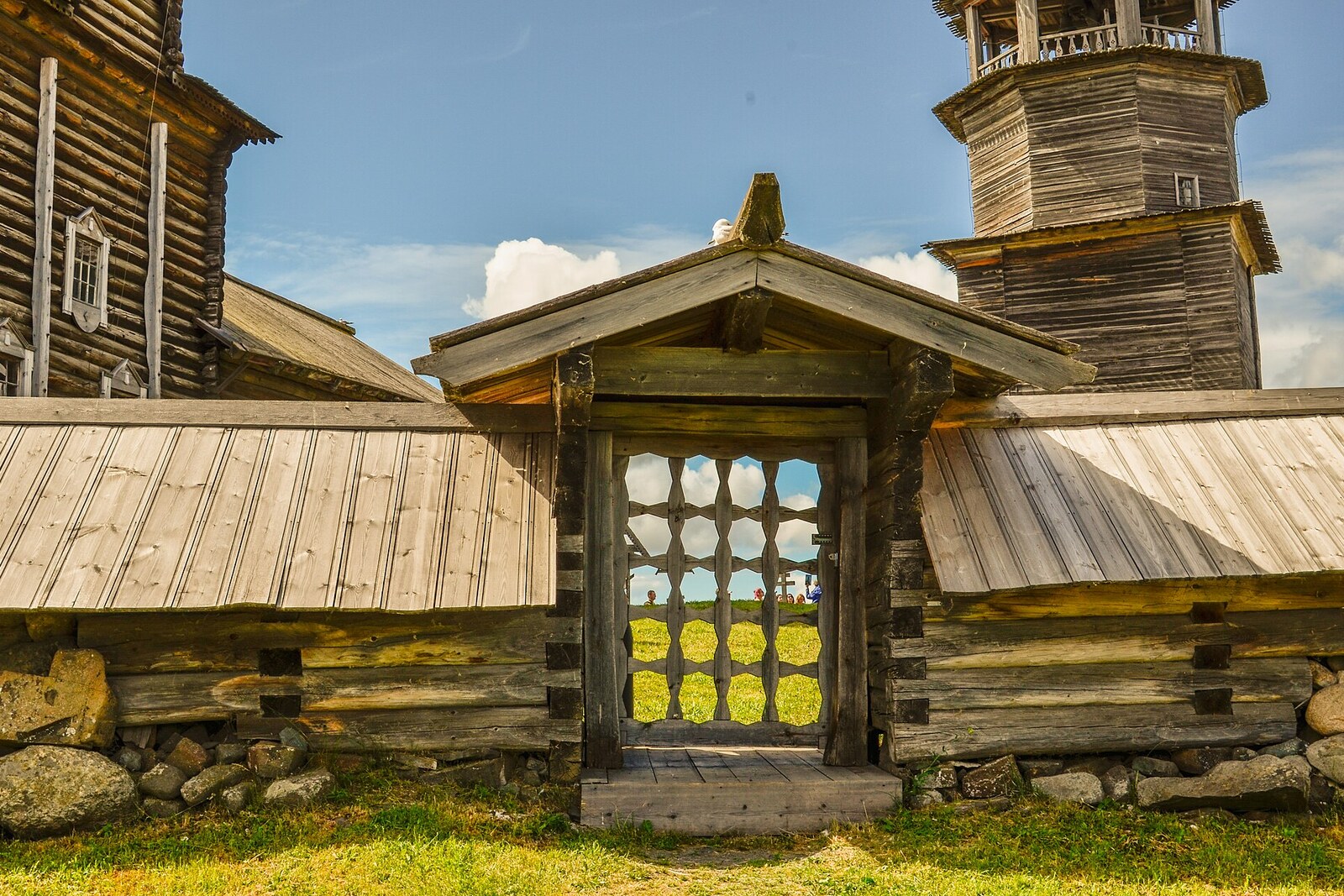
Look around first
What to notice
- Roofed wooden gates
- Pine enclosure walls
- Kizhi boulders beneath the log structure
- Side five-sided rooms
The story of the place
Two side five-sided rooms are sheltered beneath the gate roof, with pine enclosure walls adjoining them. This entrance leads into a parish yard with churches and a cemetery; the gates' present appearance reproduces the main entrance of Ilyinsky Pogost at Vodlozero. The stones in the foundation remained from the enclosure built by local craftsmen in eighteen hundred, while the log structure and gates appeared only in the twentieth century. For a long time, this wooden enclosure was considered a modern reconstruction, until it was recognized as a monument in nineteen ninety-six.
In the mid-nineteen fifties, this entrance confronted restorers with an irreversible choice. A brick arch with an iron grille stood here, a guardhouse was falling apart beside it, and barbed wire ran along the stone enclosure. Beyond the gates lay the pogost—a parish yard with churches and a cemetery. The western entrance was the main one: people approached it from the old pier.
The arch and the stone wall belonged to Kizhi's real history. In eighteen hundred, townsmen from Valdai, the Terskov family, built an enclosure of local fieldstone around the pogost under a contract with the peasants of the surrounding area, and erected four brick entrances. They undertook to make and fire the bricks on site as well. A century later, the peasant Mikhail Afanasyev gave the parish iron doors worth one hundred eighty rubles. By the middle of the twentieth century, however, restorers regarded this entrance as a later alteration that obscured the wooden character of the ensemble.
The Moscow architect Aleksandr Viktorovich Opolovnikov was responsible for the scholarly restoration of Kizhi Pogost and wanted to restore its hewn-log enclosure of the eighteenth century. Not a single reliable fragment of it remained. The architect had an engraving from seventeen eighty-five and two surviving northern enclosures—at Vodlozero and in Pochezero. Opolovnikov had to design the vanished structure from other examples, knowing that workers would dismantle the authentic brick arch for the sake of this version.
The dispute continued during construction. Opponents of the project wanted to leave the lower logs of the churches open to view. The restoration commission chose the enclosure: it was to separate the cemetery and churches from the secular area once again. Mikhail Kuzmich Myshev, head of the Kizhi carpenter-restorers' brigade, and his craftsmen hewed the pine walls, the roofed gates, and the side five-sided rooms for candle shops. By nineteen fifty-nine, the work was complete.
For another thirty-seven years, the new enclosure had no protected status of its own: specialists explicitly called it a modern reconstruction. Only in nineteen ninety-six was it recognized as a monument. The Western Gates of Kizhi Pogost, through which people now enter the pogost, exactly reproduce the main entrance of Ilyinsky Pogost at Vodlozero. Beneath them lie Kizhi boulders from eighteen hundred; everything raised above the stone was hewn by Mikhail Myshev's carpenters in the twentieth century.
Useful on site
The museum grounds are open year-round: 01.11–30.04 10:00–16:00; 01.05–11.05 10:00–18:00; 12.05–31.08 08:00–19:00; 01.09–30.09 10:00–17:00; 01.10–31.10 10:00–16:00. The enclosure can be viewed from outside during the grounds' opening hours; passageways may be directed by museum signage.
Checked: June 24, 2026. Check the official source before visiting.View the enclosure from the path, and do not climb onto the stones or wooden parts. At the entrance, let organized groups pass.