 Guide On Map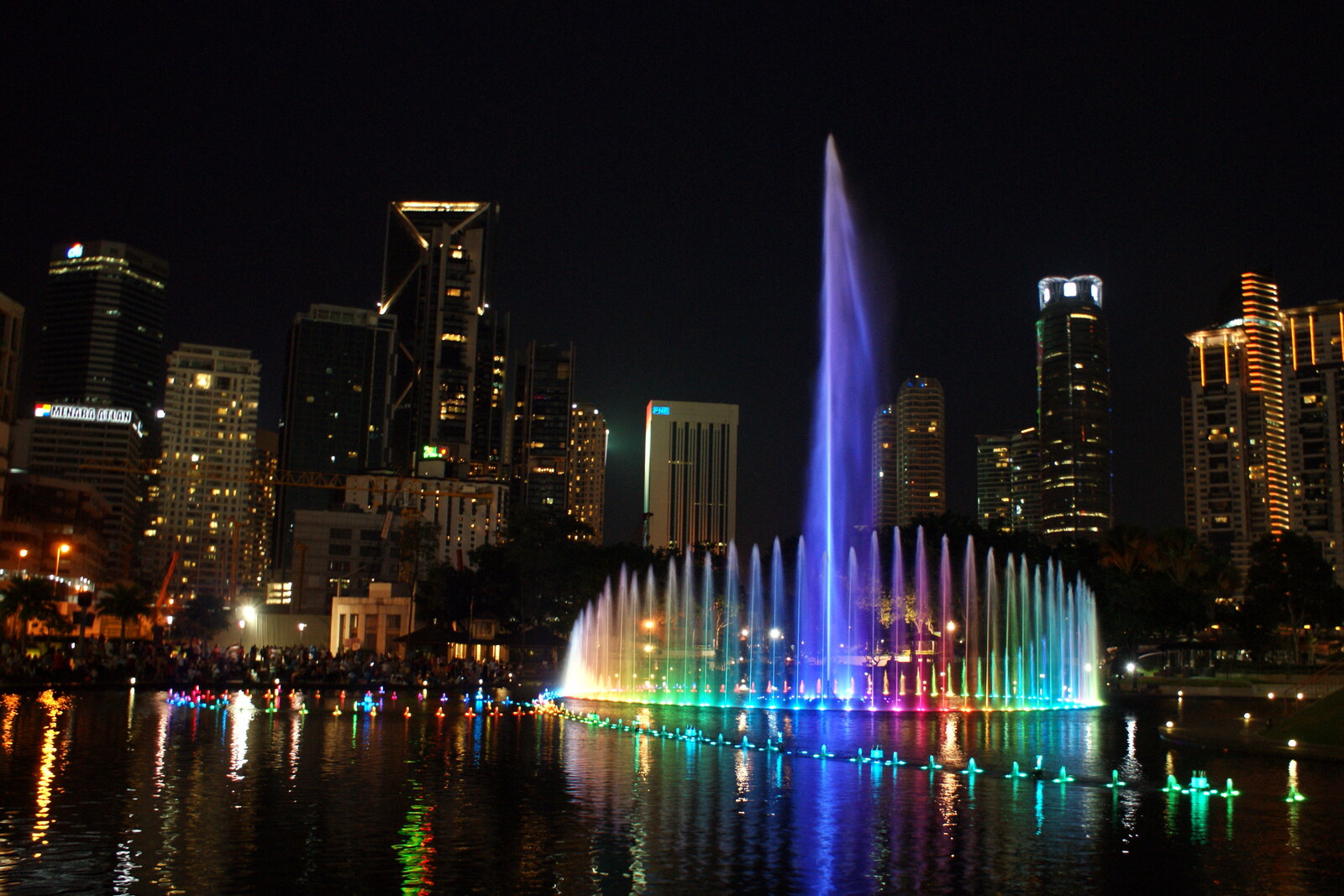
Look around first
What to notice
- The geometric line of the shore
- Fountain jets
- Underwater lights
- Pedestrian bridge
The story of the place
The shopping arcade and the quiet, densely planted part of the park are separated by an artificial lake. It was included in the park plan as a meeting place: walking paths converge here, a bridge spans the water, and fountains are arranged nearby. The shoreline is made up of straight sections of different lengths joined by rounded curves, so from a distance it looks smooth. Underwater lights are installed beneath the water, while pumps and rotating nozzles direct the jets of two musical fountains.
Eighty-four-year-old Roberto Burle Marx flew twice from Brazil to Malaysia for this park. He made his living designing gardens and public spaces, and here he wanted to create his first and only major project in Asia. His health was already failing, but in the fall of nineteen ninety-three he traveled to the foot of Mount Kinabalu and to Kuching, studied local plants, and decided which of them could grow in the new center of Kuala Lumpur.
The clients also flew halfway around the world, to Burle Marx’s studio in Rio de Janeiro. During their second visit, the architect barely came out to see them: his illness had worsened. He died on June fourth, nineteen ninety-four. Two days later, the studio sent a fax to Kuala Lumpur reporting his death. The project passed to Haruyoshi Ono, Burle Marx’s longtime partner, who had to ensure that the late architect’s drawings became a real park. The Malaysian team continued working with Haruyoshi Ono and opened the park in nineteen ninety-eight. Burle Marx himself did not live to see it completed.
The lake in front of the shopping arcade was one of the main elements of his plan. The team placed it between the buildings of the district and the quieter, densely planted part of the park: visitors, walking paths, a bridge, and water features were meant to converge here. The shore was drawn in Burle Marx’s characteristic manner. From a distance it looks smooth, but its edge is made up of straight sections of different lengths joined by rounded curves—as if a fragment of an abstract painting had been laid on the ground and filled with water.
The name “Lake Symphony” describes not the outline but the operation of two musical fountains. Pumps, rotating nozzles, underwater lights, and a program make individual jets move according to a set score. When the old equipment became outdated, the owners of twenty-three neighboring plots paid for a complete reconstruction of the fountains. Contractors replaced the pumps, lighting, and control system, but left the basin and the artificial lake itself unchanged.
So the still line of the shore belongs to Burle Marx’s final project and to the work of Haruyoshi Ono. Inside it, later technology operates: hundreds of independently controlled water effects and more than a thousand underwater lights.
Useful on site
The official page lists daily light-and-music shows at 20:00, 20:30, 21:00, 21:30, and 22:00; light shows without music are at 19:30, 20:30, and 21:30. Rain, maintenance, and events may affect the show.
Checked: June 29, 2026. Check the official source before visiting.The show may not take place because of maintenance or weather, so do not plan your entire route around a single performance. Near the wet edge, watch the surface and keep an eye on children.