 Guide On Map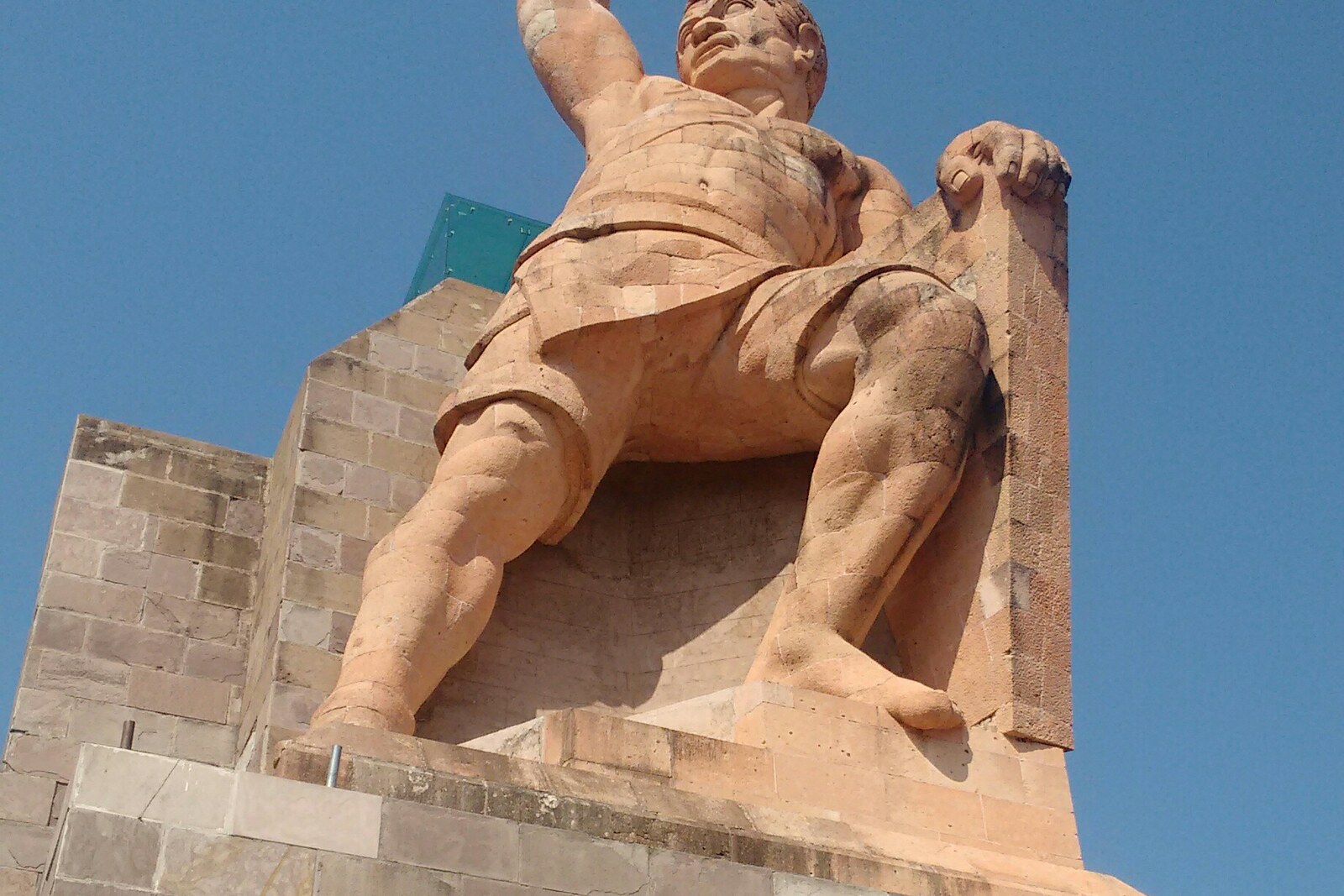
Look around first
What to notice
- The stone figure of El Pípila
- The torch in the raised hand
- The slab behind his back
- The copy of the Alhóndiga de Granaditas's northern gate
The story of the place
On Cerro de San Miguel, above the roofs of Guanajuato City, rises a giant stone figure with a slab behind his back. At its foot is a city viewing platform, from which the Alhóndiga de Granaditas can be made out among the roofs. A copy of the granary's northern gate is built into the rear wall of the pedestal, and the pink stone for the figure came from La Bufa, the same quarry that had previously supplied material for the building itself. This monument preserves the memory of the city's miners who went to Hidalgo with their tools and their knowledge of stone, fire, and underground work.
In January nineteen thirty-nine, engineers examined a small model of the future El Pípila and rejected the raised arm. The sculptor Juan Fernando Olaguíbel had bent it at such an angle that, by their calculations, the multi-ton stone structure would collapse. The state governor demanded that the pose be preserved: without a torch above the city, the entire idea was lost.
They then invited Agustín Gutiérrez Ocampo, a builder of monumental sculptures. He assured them that he could scale up the model exactly and offered the engineers a wager—his calculation against their diplomas. The engineers yielded the site to him.
Ocampo devised a system of coordinates and full-size templates. Measurements were taken from the small model, transferred to stone blocks, and then the figure was assembled like a giant puzzle. Working with Agustín were his son David Gutiérrez Becerril, who was learning the family trade, and about a hundred stonecutters, quarry workers, and assemblers. Pink stone was brought up here from the La Bufa quarry. In about a year and a half, they assembled a figure weighing more than eight hundred tons. The arm with the torch remained exactly as Olaguíbel had conceived it. For Agustín, this monument was his last major work; David went on to build monumental sculptures on his own.
The stone man is Juan José de los Reyes Martínez, nicknamed El Pípila. He earned a living as a barretero—a miner who manually broke ore rock with a heavy iron bar. According to the traditional account, during the storming of the Alhóndiga de Granaditas in eighteen ten, El Pípila shielded his back with a stone slab, made his way to the gates under fire, and set them ablaze. Documents confirm the existence of a miner with that nickname and his participation in the uprising. Historians have been unable to prove that he was the one who set the gates on fire, and that he did so alone. The figure here therefore also represents the other miners of Guanajuato City who went to Hidalgo with their tools and their knowledge of fire, stone, and underground work.
The idea of erecting a monument to them was proposed by Governor Luis Ignacio Rodríguez Taboada. On February fifth, nineteen forty, the giant with a slab behind his back and a torch in his hand was unveiled on Cerro de San Miguel. An inscription appeared on the pedestal: “There are still other alhóndigas left to burn.”
A city viewing platform has been set up at the feet of El Pípila. From it, the Alhóndiga de Granaditas is visible among the roofs. The storming itself took place there, below; here the builders recreated it in stone. In the rear wall of the pedestal is a copy of the Alhóndiga de Granaditas's northern gate, and the pink stone for the monument was quarried from the same La Bufa quarry that had previously supplied material for the granary itself.
Useful on site
Open viewing platform; the funicular, its price, and its schedule must be checked on site.
Checked: date not specified. Check the official source before visiting.First, catch your breath, then take in the panorama in sections; in poor visibility, do not try to compensate by going beyond the safe limits of the platform.