 Guide On Map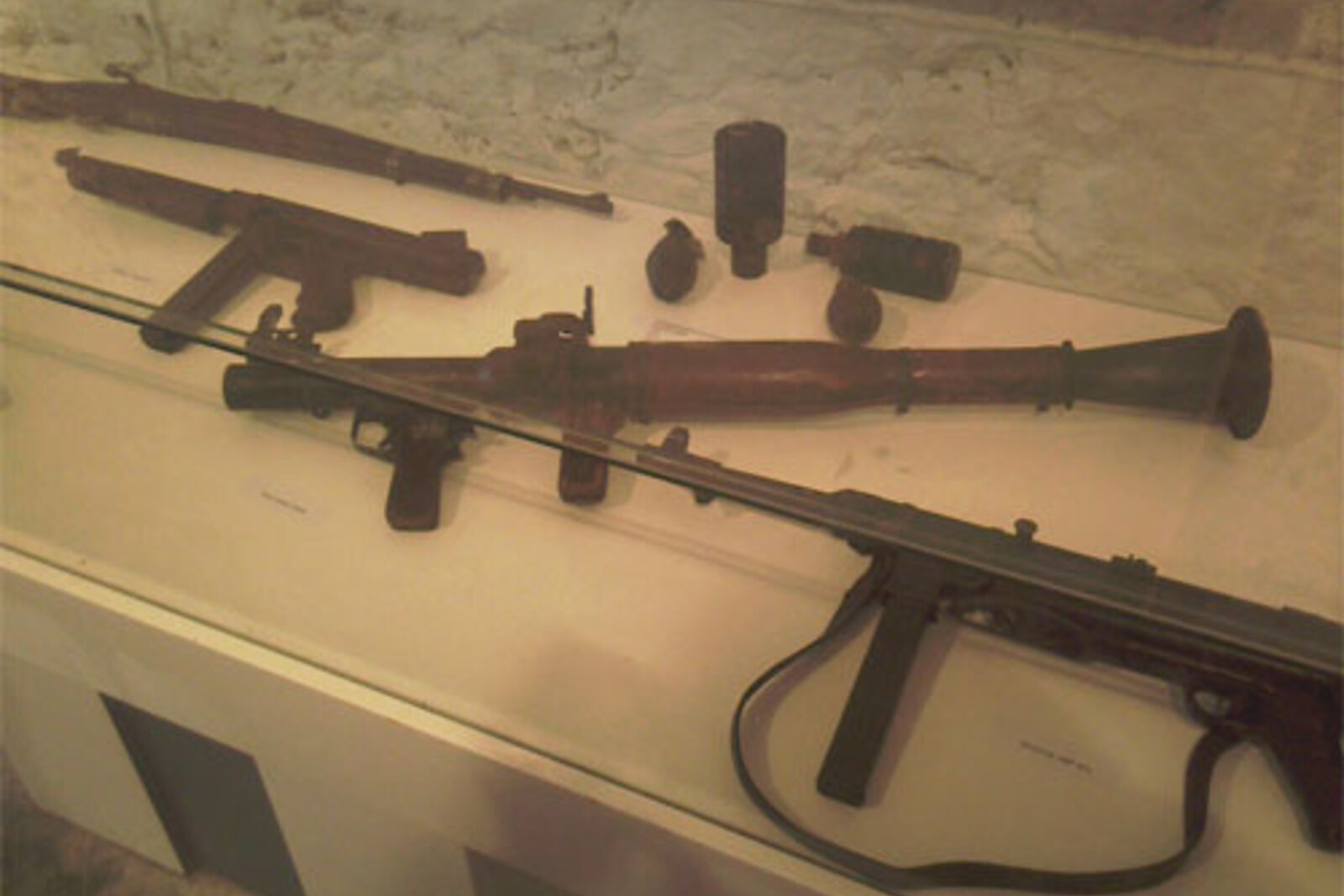
Look around first
What to notice
- Silk flag
- Photographs
- Maps
- Field diaries
The story of the place
Inside the mountain fort are photographs, maps, weapons, documents, and field diaries that war participants and Dubrovnik residents gave to museum staff. The exhibition was assembled by the curators Varina Jurica Turk and Mišo Đuraš, and later the city established a separate museum here. The halls preserve testimonies from people for whom this summit was not a distant historical place, but part of their own lives.
In a museum display case lies a small silk flag—sixty by ninety centimeters. In nineteen ninety-one, it was raised on the television retransmitter at the summit of Mount Srđ. By the end of the year, the fabric had been damaged, and it was taken down. The museum inventory names Bože Burić as the donor.
Before the war, Burić earned a living at a Dubrovnik hotel. When Croatia declared its withdrawal from Yugoslavia, he became one of the city's defenders: he wanted to prevent units of the Yugoslav People's Army and the units supporting them from taking the heights above Dubrovnik. Beginning on October twenty-fourth, police officers and volunteers kept a constant watch at Fort Imperial—in four-day shifts. Food and ammunition were brought up from the city on foot and by donkey.
The outcome of the battle on December sixth is already familiar from the story of the cable car's upper station. For the museum, one episode inside the fort matters. When the attackers reached the very building and the defenders felt that they were about to burst in, Bože Burić racked the bolt of his automatic rifle, placed a chair in the middle of the room, and sat facing the entrance. There was nowhere to retreat from the encircled summit. Burić survived the battle; the flag on the television tower also remained with the defenders, although it could no longer hang for long.
The damaged fabric was preserved. Later, Burić handed it over to museum staff. Many war participants and Dubrovnik residents did the same: they gave documents, photographs, maps, weapons, personal belongings, and field diaries so that the recent war would not remain a collection of other people's retellings.
The curators Varina Jurica Turk and Mišo Đuraš collected these testimonies and memories, then arranged an exhibition where one of its main stories had taken place. On August fifth, two thousand eight, they opened an exhibition of four hundred seventy objects in the fort. In the first nine months, twenty thousand five hundred people came up here, including city residents and schoolchildren. In two thousand sixteen, the city established a separate Museum of Croatian War of Independence.
Bože Burić's flag took the shortest journey of any museum object: from the television retransmitter on this summit to the hall inside the fort that he helped hold.
Useful on site
From April to September: daily 08:30—22:00; October: daily 09:00—20:00; from November to March: daily 09:00—17:00. Adult ticket — 5 euros, schoolchildren and students — 3 euros, children under 7 — free.
Checked: June 30, 2026. Check the official source before visiting.Read the labels beside the objects: without context, many of them look ordinary. Before taking photographs, check the museum signs and rules.