 Guide On Map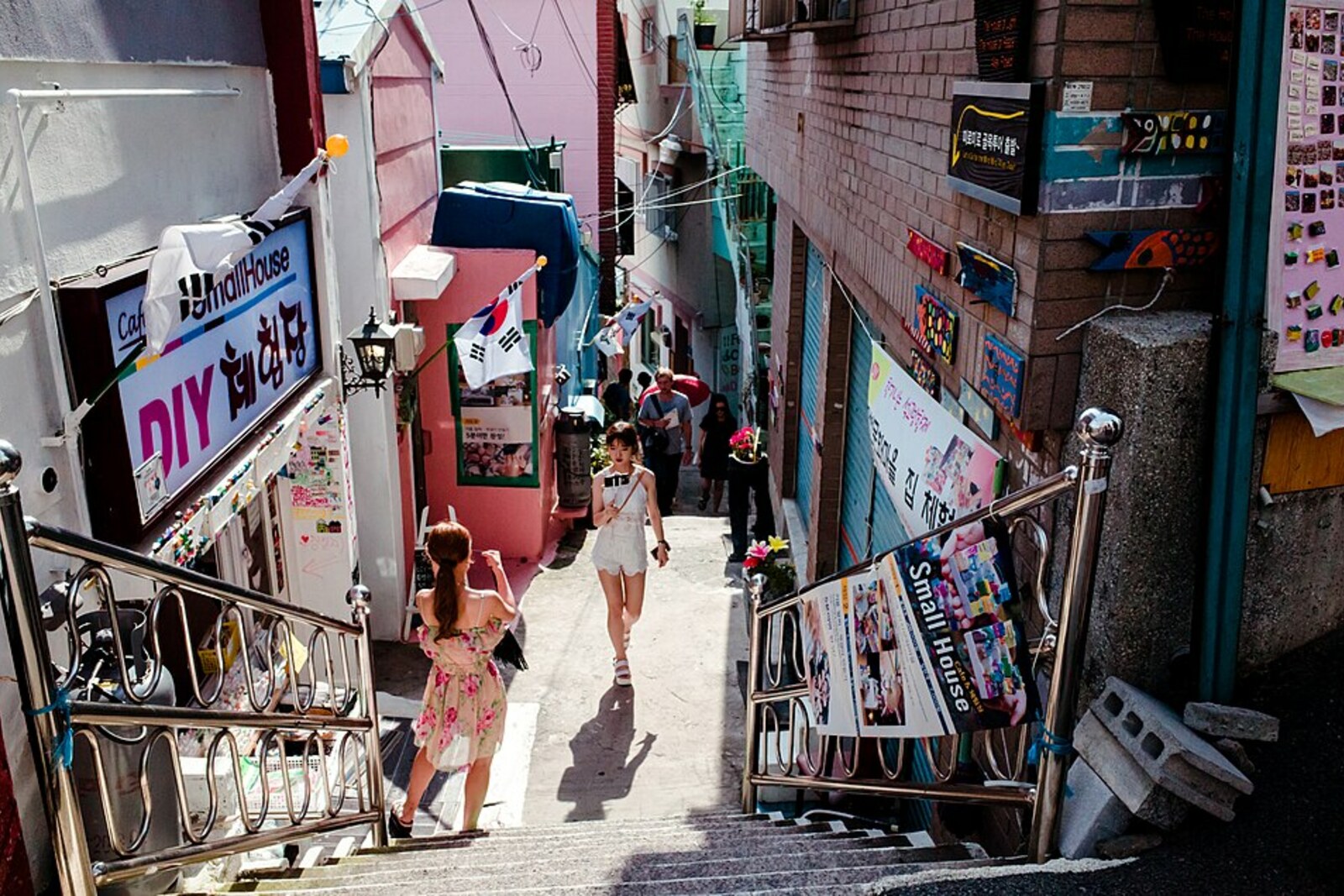
Look around first
What to notice
- A reconstruction of a wooden barrack
- Old photographs
- Household utensils
The story of the place
Around seventy exhibits at the Small Museum were brought here by Gamcheon residents. They donated old photographs and household utensils, while the organizers added a reconstruction of a wooden barrack. These objects tell of the people who occupied the hillside long before the houses were painted and artworks appeared between them.
One of the earliest settlers was Kim Mun-seong, a follower of Taegeukdo, a Korean religious movement. At the beginning of the Korean War, his parents died. Kim reached Busan from Gangwon Province with his two brothers and joined a community of fellow displaced people.
After the war, overcrowded Busan was relocating residents from the city center. In nineteen fifty-five, around four thousand followers of Taegeukdo began moving to Gamcheon. On the empty hillside, they put up about one thousand wooden houses. Electricity was installed only in nineteen sixty-five, and running water in the nineteen seventies.
The brothers needed to support themselves right away. Every day, they went down to the fish market: they cleaned passersby's shoes, sold ice cream, and later made smoking pipes for sailors. The climb back to Gamcheon ended at one of those cramped houses whose interior has now been reconstructed in the museum exhibition.
Kim Mun-seong remained in the village and, decades later, took part in its transformation into a cultural district. When the Small Museum opened here in two thousand thirteen, other residents made a similar choice: they brought out of their homes objects through which they still remembered the old Gamcheon and donated them to the shared collection.
Almost none of the earliest barracks remain. What has survived here is their reconstruction, old photographs, and around seventy objects that their owners once kept at home and then decided to leave to the entire village.
Useful on site
A separate current schedule for the Small Museum is not confirmed by a stable official page; ask about opening at the information center. Checked 2026-07-01.
Checked: July 1, 2026. Check the official source before visiting.If the museum is open, do not hurry past even the simplest objects. If entry is unavailable, do not replace it with a look at the neighboring houses.