 Guide On Map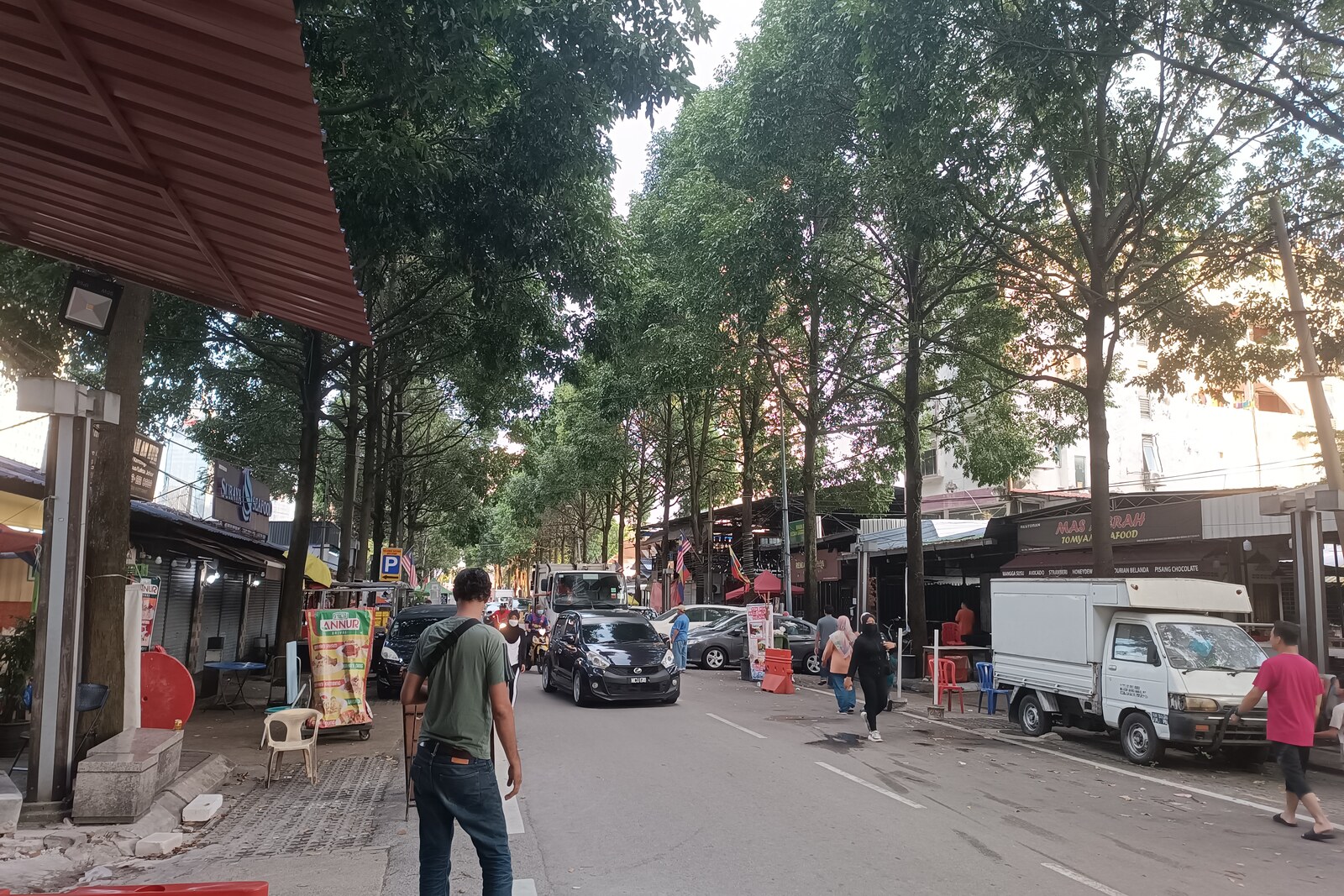
Look around first
What to notice
- Cafés
- Street stalls
- Tables with prepared food
- Street-name signs
The story of the place
Cafés and street tables with prepared food stretch from Jalan Daud toward the exit onto Jalan Raja Abdullah. Over time, vendors moved to neighboring streets, but prepared-food trade remained here. The first two words in the street name denote the title of the heir to the Selangor throne; Kuala Lumpur was the capital of this sultanate.
At the beginning of the twentieth century, members of the board of the Malay Agricultural Settlement (MAS) of Kampong Bharu allotted plots to Malay families on one condition: the land by the house had to be cultivated. The harvest had to be sold somewhere. In the nineteen thirties, several influential Malay traders set up a weekly market on this street. At first it was called the Saturday Fair, and later Pasar Minggu, the Sunday market.
Especially many sellers came from Javanese families in Kampung Baru. They brought produce grown on their plots, keropok crackers, and fermented rice tapai. Women from Minangkabau migrant families sold prepared food. For them, a stall provided an income in a settlement where life itself was tied to cultivating a small family plot. This is how one of the first centers of Malay trade in Kuala Lumpur appeared on the stretch from Jalan Daud to the exit onto what is now Jalan Raja Abdullah.
During the Japanese occupation, traders moved to Jalan Raja Abdullah, and in the nineteen fifties they were already operating on Jalan Raja Alang. However, prepared-food vendors remained on Jalan Raja Muda Musa. That is why today’s cafés and street stalls continue the trade for which Kampung Baru families began gathering here almost a century ago.
In the street name, the first two words are the title of the heir to the Selangor throne, while Musa is a person’s name. Kuala Lumpur was then the capital of this sultanate. Tengku Musa Eddin, the sultan’s eldest son, expected to inherit the throne; it is believed that the street was named in his honor in the early nineteen thirties, while he held the title Raja Muda.
In nineteen thirty-four, the British Resident Theodore Adams accused the heir of unworthy conduct and secured his removal. Musa’s father traveled to London and asked for his son’s title to be restored, but the younger brother was appointed successor. During the Japanese occupation, Musa was nevertheless placed on the throne under the name Sultan Musa Ghiatuddin Riayat Shah. After the British returned, the younger brother was restored and Musa was sent into exile. The street signs retained not his sultan’s name, but the former title of which he was stripped in nineteen thirty-four.
Useful on site
The street is always open, but food is available according to the hours of individual establishments. Wanjo states that it is open daily from early morning until midnight; other spots, markets, and seasonal stalls should be checked on the day of your visit. Cash is still useful.
Checked: June 29, 2026. Check the official source before visiting.The selection of vendors and dishes changes, and popular places may be occupied. Choose an open spot on site, ask about the food’s ingredients, and do not block the way while waiting for your order.