 Guide On Map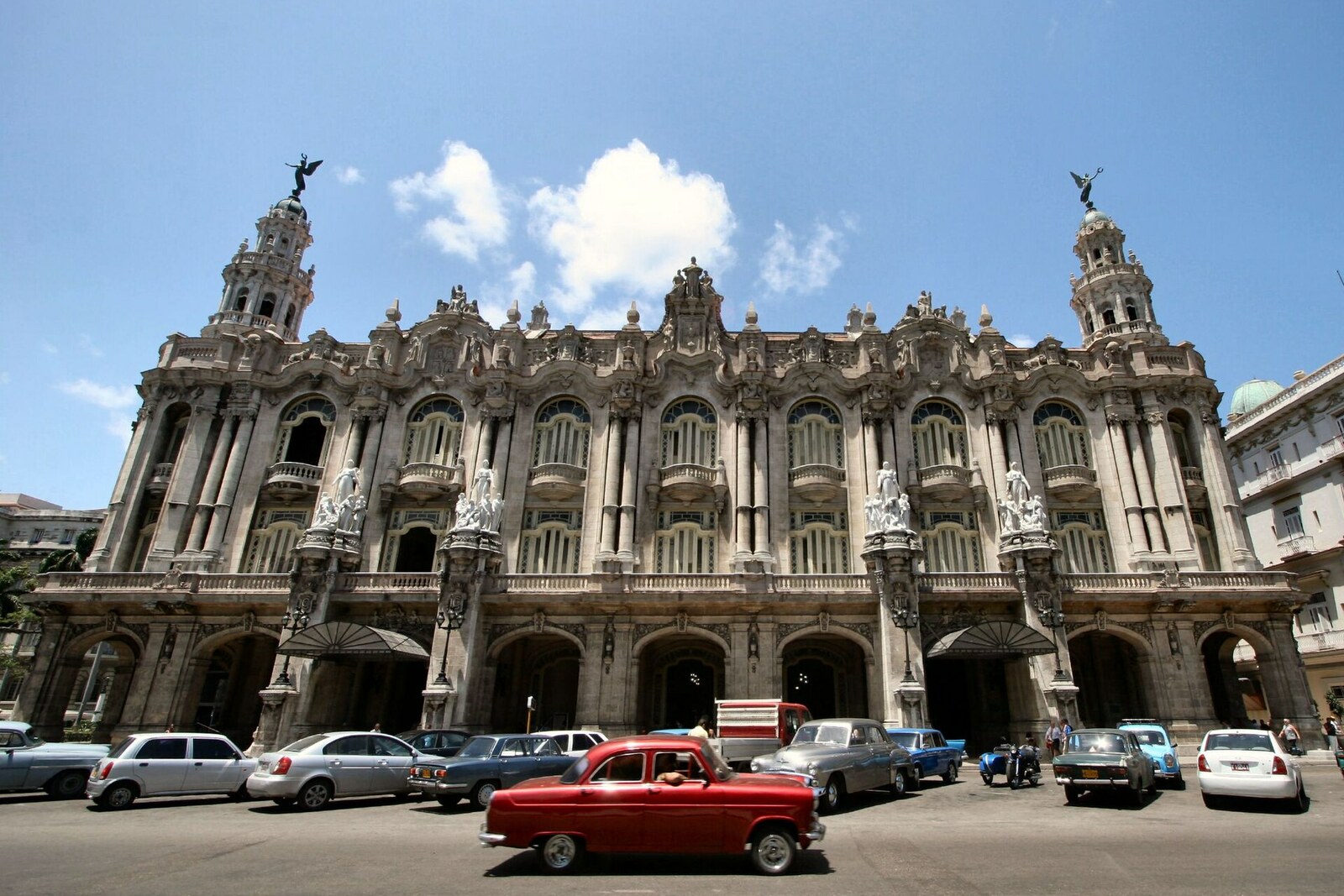
Look around first
What to notice
- Lavish facade
- Alicia Alonso's name on the building
- Bronze figure in the role of Giselle
The story of the place
In the early nineteen eighties, Alicia Alonso, founder and director of the National Ballet of Cuba, worked to turn this building into a major center for the performing arts. She wanted to bring ballet, opera, drama, concerts, and dance training together under one roof.
For such a plan, the building was an extraordinarily precise fit. The present lavish structure was built in nineteen fifteen by a mutual-aid society of immigrants from Spanish Galicia. Beside the theater auditorium were its offices, treasury, ballrooms and gambling rooms, restaurants, and cafés. By the start of Alonso's project, these rooms had long lost their former purpose, but they could be given over to smaller stages, classrooms, and exhibitions.
Alonso knew the value of a home of its own for a company. In nineteen forty-eight, she and her colleagues founded Cuba's first professional ballet company. Its original lineup included only nine Cuban performers; the rest had to be invited from abroad. The small state subsidy was not enough to support the company. Alonso continued performing with foreign companies and symphony orchestras, investing the money she earned in Cuban ballet and the school established alongside it.
Her company first appeared on this stage in nineteen fifty. From nineteen sixty-five onward, the National Ballet of Cuba has been permanently based here. So when Alonso proposed giving the remaining rooms of the former Galician Centre of Havana over to the arts, she was expanding the place on which her company's life already depended.
On April third, nineteen eighty-six, the new complex opened as the Gran Teatro de La Habana. It had three stages, a concert hall, a gallery, a library, rooms for film screenings, and five dance classrooms; it also gained its own orchestra and choir. Alonso herself directed the institution for several years. Dancers received rehearsal spaces here, while audiences came to one building for ballet, opera, plays, and concerts.
In two thousand fifteen, the Gran Teatro de La Habana Alicia Alonso was given Alicia Alonso's name—she was still alive. Three years later, a bronze figure of her in the role of Giselle, which the ballerina had performed many times on this stage, was installed in the lobby. Ninety-eight-year-old Alonso came to the unveiling and ran her hands over the sculpture: by then, she could barely see. Outside, her name identifies the entire theater; inside, her figure stands beside the auditorium around which she once gathered the other stages and classrooms.
Useful on site
Guides: Tue–Sat 09:00–17:00, Sun 09:00–12:00; performances are temporarily suspended because of roof repairs
Checked: June 19, 2026. Check the official source before visiting.To understand its history, it is enough to look at the facade. Plan a performance, tour, or visit to the auditorium separately, and do not count on free entry during your walk.