 Guide On Map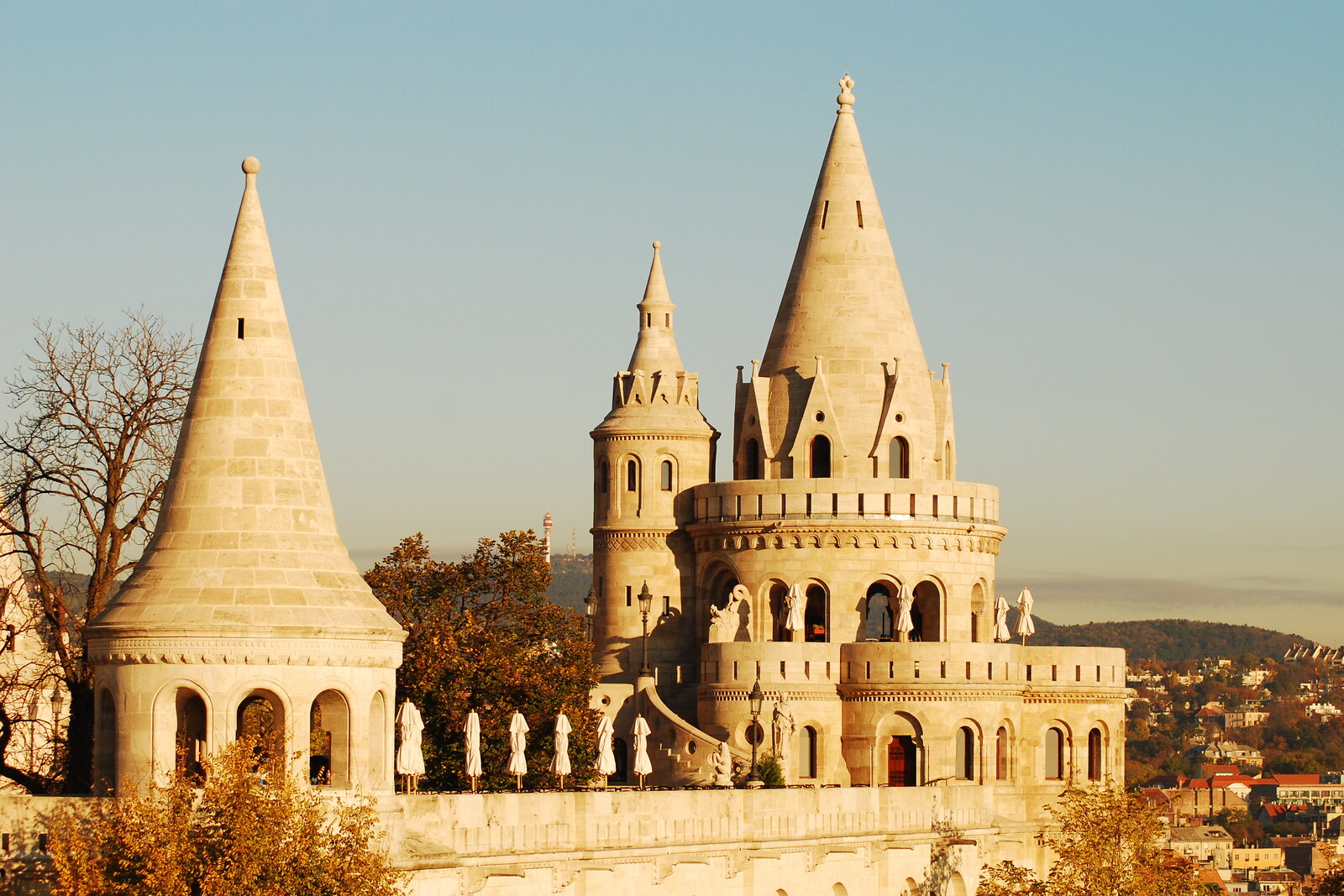
Look around first
What to notice
- White towers
- Arcades
- Viewing terraces
- Broad staircase
The story of the place
Fisherman's Bastion stands where fishermen from the Lower Town carried their catch up from the Danube to the market near what is now Matthias Church. This section of the fortress wall once guarded the approach to Buda; a narrow ascent led to it from the river side. When the fortress ceased to be military, the old wall was preserved and, at the turn of the nineteenth and twentieth centuries, a promenade gallery was built above it. The white towers, arcades, terraces, and broad staircase belong to that later conversion, while beneath the southern part survive the walls of St. Michael's Chapel.
After the death of the commander János Hunyadi, his elder son László became head of the family and tried to hold on to the offices, royal fortresses, and revenues inherited from his father. These meant garrisons, money, and armed supporters—everything on which the Hunyadis' position rested. However, King László V appointed his close associate Ulrich of Celje commander in chief; Ulrich sought the return of the fortresses to the crown.
In November fourteen fifty-six, Hunyadi's men killed Ulrich of Celje during an armed quarrel in Belgrade. The king found himself among the opposing soldiers and swore not to take revenge. László Hunyadi received the post of commander in chief and went to Buda with the king, believing that he had preserved both his life and his father's inheritance. Meanwhile, his opponents gathered their detachments around the palace.
The later chronicler György Szerémi recorded that, before his arrest, Hunyadi tried to leave the fortress. Three gates were locked. He then ran to the fourth—a small wicket gate near the cemetery and St. Michael's Chapel. Szerémi wrote several decades later and retold an oral legend, so the details of the escape cannot be treated as a record. Yet the wicket gate itself did exist right here, on the site of the former narrow ascent from the Danube side.
Fishermen from the Lower Town used this route. They carried their catch up to the fish market near the church now called Matthias Church. That is where the bastion's name comes from. According to the traditional version, the fishermen's guild was also responsible for defending this section of wall. Historians consider another origin more likely: the wall was named after Fishermen's Town below. The everyday connection is the most securely known one—the fishermen really did pass here between the river and the market.
László Hunyadi did not leave through the wicket gate. On March fourteenth, fourteen fifty-seven, he was arrested, and two days later he was beheaded in the courtyard before the royal palace. The sources record no regular judicial proceedings. The king kept his younger brother Mátyás as a hostage and took him away from Buda. The execution sparked an armed struggle between Hunyadi's supporters and the royal entourage. When László V died in the same year, the Hungarian nobles agreed to elect Mátyás king. Once king, Mátyás ordered his brother's body transferred to Alba Iulia Cathedral and buried beside their father.
The white towers and arcades appeared much later. After the fortress lost its military status, the architect Frigyes Schulek preserved the basis of the old fortifications and, between eighteen ninety-nine and nineteen oh two, turned the wall into a promenade gallery with viewing terraces. The medieval wicket gate and cemetery disappeared. Beneath the southern part of the bastion, the walls of St. Michael's Chapel survive, while Schulek's broad staircase replaced the narrow ascent along which fishermen carried goods and through which László Hunyadi tried to escape.
Useful on site
The terraces are listed as open twenty-four hours a day year-round; the upper towers and terraces have paid-access periods, usually 09:00—19:00 in the low season and 09:00—21:00 in summer. Check details on the day of your visit.
Checked: June 28, 2026. Check the official source before visiting.The freely accessible areas are enough to complete the route; individual levels may have their own visiting hours. In a crowd, do not linger in narrow passageways, and choose a viewpoint where you can stop calmly.